
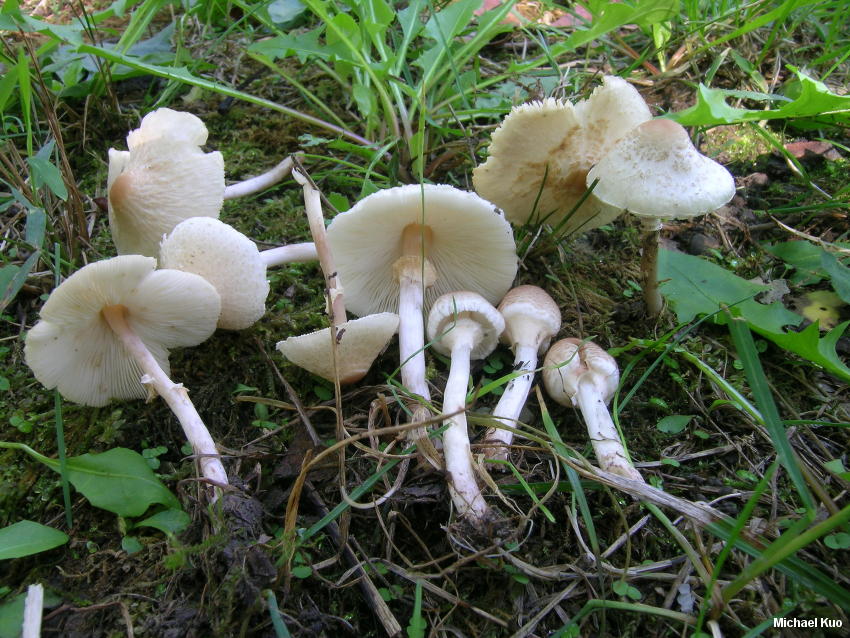
How to identify Scaly Parasol
Lepiota cristata
Got a photo? Identify mushrooms instantly with the Mushby app
Open the appTo correctly identify Scaly Parasol (Lepiota cristata), check each of these features in order. Misidentification is the most common cause of mushroom poisoning, so cross-reference multiple sources.
Step-by-step identification
- 1
Cap
Shape, color, surface texture, and diameter.
Convex to flat, with a dark brown or reddish-brown center and concentric scales radiating toward the margin on a whitish background.
- 2
Gills
Attachment to stem, color, and spacing.
Free, crowded, white to cream colored, sometimes becoming yellowish with age.
- 3
Stem
Length, shape, surface, and any ring.
Slender, hollow, whitish with a pinkish tint; features a fragile, membranous ring that often disappears.
- 4
Flesh
Color, texture, and bruising reaction.
Thin, white, and unchanging when sliced or damaged.
- 5
Fruiting body
Overall growth pattern.
Small agaricoid fungus with a pileus diameter of 2-5 cm.
- 6
Habitat
Where it grows and on what substrate.
Commonly found on lawns, in grassy areas, parks, leaf litter, and edge of woods during summer and autumn.
Key Facts
- Cap surfaces
- Scaly, reddish-brown to dark brown center
- Growth Form
- Solitary to gregarious
- Spore Print
- White
- Body color
- Whitish background with reddish-brown scales
- Odor
- Strong and unpleasant
- Flesh bruises
- No significant color change
- Height
- 3-8 cm
- Cap Diameter
- 2-5 cm
Fruit body characteristics
- Gill attachment: Free from the stem
- Stem shape: Cylindrical, slender
- Stem surface: Smooth or slightly fibrous
- Ring: Membranous, often fragile and fleeting
- Stem cross-section: Hollow
Explore Scaly Parasol
Identify mushrooms anywhere
Free on iOS, Android, and Web. Photo identification, full database, and your personal collection.