
Got a photo? Identify mushrooms instantly with the Mushby app
Open the appDescription
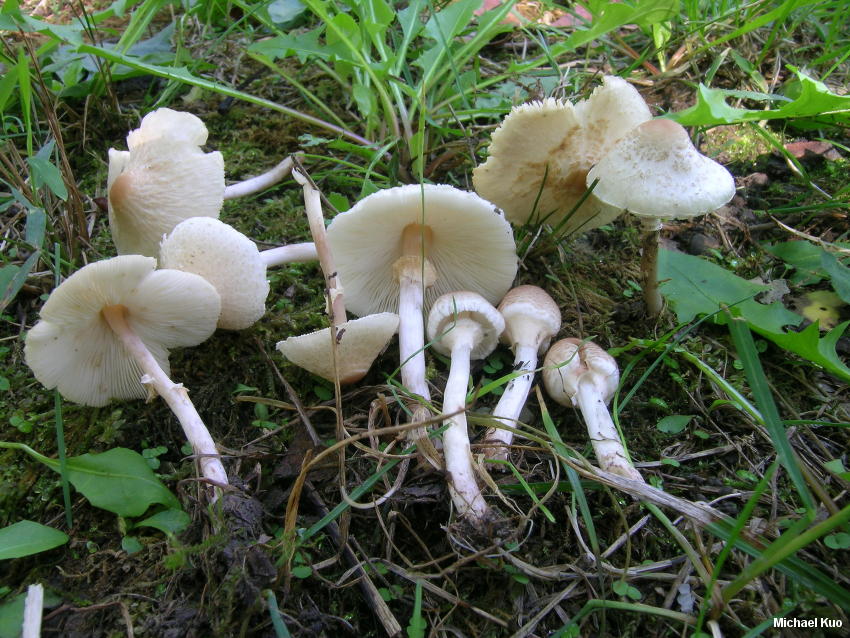
A small to medium-sized gilled mushroom characterized by its distinct scaly, reddish-brown cap and a persistent, often evanescent ring on the stem. It is a common saprobic fungus frequently found in lawns, gardens, and along woodland edges.
How to Identify
- Cap
- Convex to flat, with a dark brown or reddish-brown center and concentric scales radiating toward the margin on a whitish background.
- Gills
- Free, crowded, white to cream colored, sometimes becoming yellowish with age.
- Stem
- Slender, hollow, whitish with a pinkish tint; features a fragile, membranous ring that often disappears.
- Flesh
- Thin, white, and unchanging when sliced or damaged.
- Fruiting body
- Small agaricoid fungus with a pileus diameter of 2-5 cm.
- Habitat
- Commonly found on lawns, in grassy areas, parks, leaf litter, and edge of woods during summer and autumn.
Key Facts
- Cap surfaces: Scaly, reddish-brown to dark brown center
- Growth Form: Solitary to gregarious
- Spore Print: White
- Body color: Whitish background with reddish-brown scales
- Odor: Strong and unpleasant
- Flesh bruises: No significant color change
- Height: 3-8 cm
- Cap Diameter: 2-5 cm
- Nutrient gathering: Saprobic
Toxic
Moderate ToxicityLepiota cristata is considered toxic. It is known to cause gastrointestinal distress, including nausea, vomiting, and abdominal pain.
Quick Check
- Odor: Strong, unpleasant, often described as 'rubber-like' or mealy.
- Fruiting: Summer to late autumn.
- Substrate: Saprobic, growing on soil with decaying organic matter or leaf litter.
Where to Find
Temperate Northern Hemisphere
Widely distributed throughout Europe, North America, and parts of Asia.
Anthropogenic Habitats
Frequently thrives in human-disturbed soils, including gardens, parklands, and path sides.
Finding Tips
Look for the Scales
The concentric, reddish-brown scales on the cap are a primary diagnostic feature when combined with the small stature.
Check the Odor
The mushroom typically has a distinct, unpleasant, rubbery or mealy odor, which helps distinguish it from edible species.
Similar Species
False Parasol
Chlorophyllum molybdites
Also known as: Green-spored Lepiota
Parasol Mushroom
Macrolepiota procera
Also known as: Parasol Agaric
Shaggy Parasol
Chlorophyllum rhacodes
Also known as: Lepiota rhacodes
Scientific Classification
- Phylum
- Basidiomycota
- Class
- Agaricomycetes
- Order
- Agaricales
- Family
- Agaricaceae
- Genus
- Lepiota
Explore Scaly Parasol
Identify mushrooms anywhere
Free on iOS, Android, and Web. Photo identification, full database, and your personal collection.