
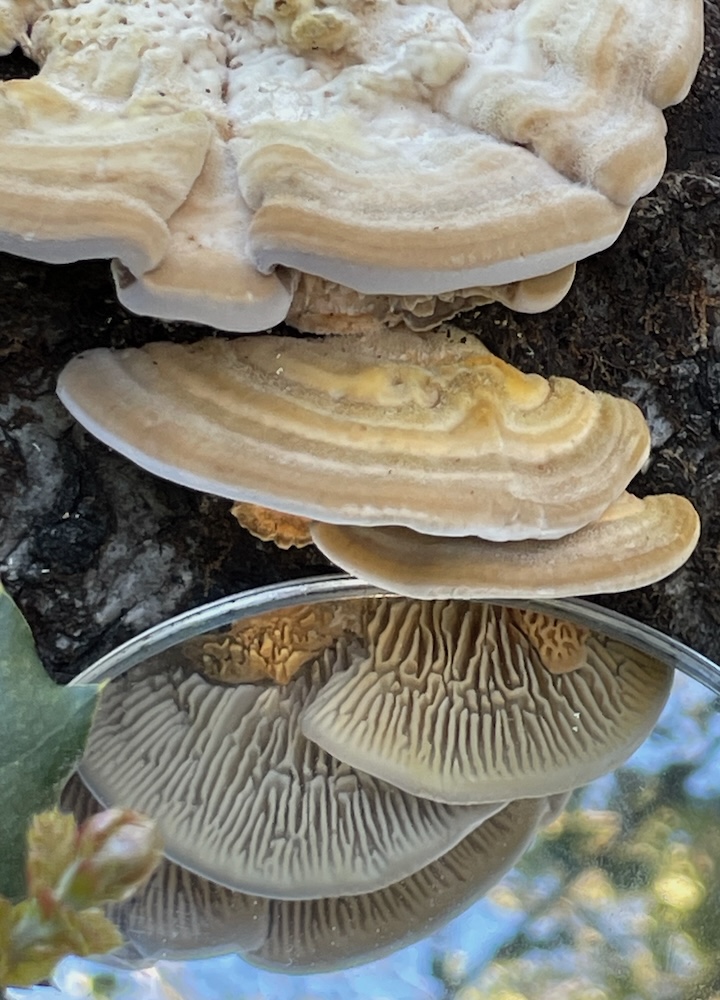
How to identify Gilled Polypore
Lenzites betulina
Got a photo? Identify mushrooms instantly with the Mushby app
Open the appTo correctly identify Gilled Polypore (Lenzites betulina), check each of these features in order. Misidentification is the most common cause of mushroom poisoning, so cross-reference multiple sources.
Step-by-step identification
- 1
Cap
Shape, color, surface texture, and diameter.
Caps are typically 2-10 cm (0.8-4 inches) across and 1-3 cm (0.4-1.2 inches) thick at the attachment point. The upper surface is concentrically zoned, often with bands of grey, brown, buff, and sometimes green (from algae). It is usually velvety or hairy, especially towards the margin, becoming smoother with age. The margin is typically thin and wavy.
- 2
Gills
Attachment to stem, color, and spacing.
The underside of the cap features a distinctive hymenophore that appears gill-like but is technically a labyrinthine pore surface. These 'gills' are thick, tough, and often anastomosing (interconnected), forming a maze-like pattern. They are typically whitish to cream, becoming yellowish or brownish with age. They are not true gills in the sense of agarics, as they are part of the polypore structure.
- 3
Stem
Length, shape, surface, and any ring.
Absent (sessile). The fruiting body is directly attached to the substrate.
- 4
Flesh
Color, texture, and bruising reaction.
The flesh is tough, leathery, and whitish to pale cream, becoming corky or woody with age. It is thin, usually 1-3 mm thick.
- 5
Fruiting body
Overall growth pattern.
The fruiting body is a sessile, fan-shaped to semicircular bracket, typically growing in overlapping clusters or rows. It is tough and leathery when fresh, becoming rigid and woody with age. The upper surface is concentrically zoned with varying shades of grey, brown, and sometimes greenish (due to algae), and is often hairy or velvety, especially when young.
- 6
Habitat
Where it grows and on what substrate.
Saprobic on dead hardwood, particularly birch (Betula spp.), but also found on oak (Quercus spp.), beech (Fagus spp.), maple (Acer spp.), and other deciduous trees. It causes a white rot.
Key Facts
- Cap surfaces
- Velvety to hairy, concentrically zoned with shades of grey, brown, buff, sometimes green.
- Growth Form
- Sessile, bracket-like, often in overlapping clusters.
- Spore Print
- White
- Body color
- Upper surface variable (grey, brown, buff, green); underside whitish to cream, becoming yellowish/brownish.
- Odor
- Mild, mushroomy or indistinct.
- Flesh bruises
- Does not bruise significantly.
- Height
- Not applicable (sessile).
- Cap Diameter
- 2-10 cm (0.8-4 inches).
Fruit body characteristics
- Gill attachment: Not true gills; labyrinthine pore surface is adnate to decurrent in appearance.
- Stem shape: Absent.
- Stem surface: Absent.
- Ring: Absent.
- Stem cross-section: Absent.
Explore Gilled Polypore
Identify mushrooms anywhere
Free on iOS, Android, and Web. Photo identification, full database, and your personal collection.