
Got a photo? Identify mushrooms instantly with the Mushby app
Open the appDescription
Lenzites betulina, commonly known as the Gilled Polypore, is a widespread and easily recognizable bracket fungus. Despite its common name and appearance, it is technically a polypore, not a true gilled mushroom. Its distinguishing feature is the labyrinthine or gill-like pore surface on the underside of its cap, which sets it apart from many other bracket fungi. It is a saprobic species, playing a crucial role in the decomposition of dead hardwood, particularly birch, throughout its range.
How to Identify
- Cap
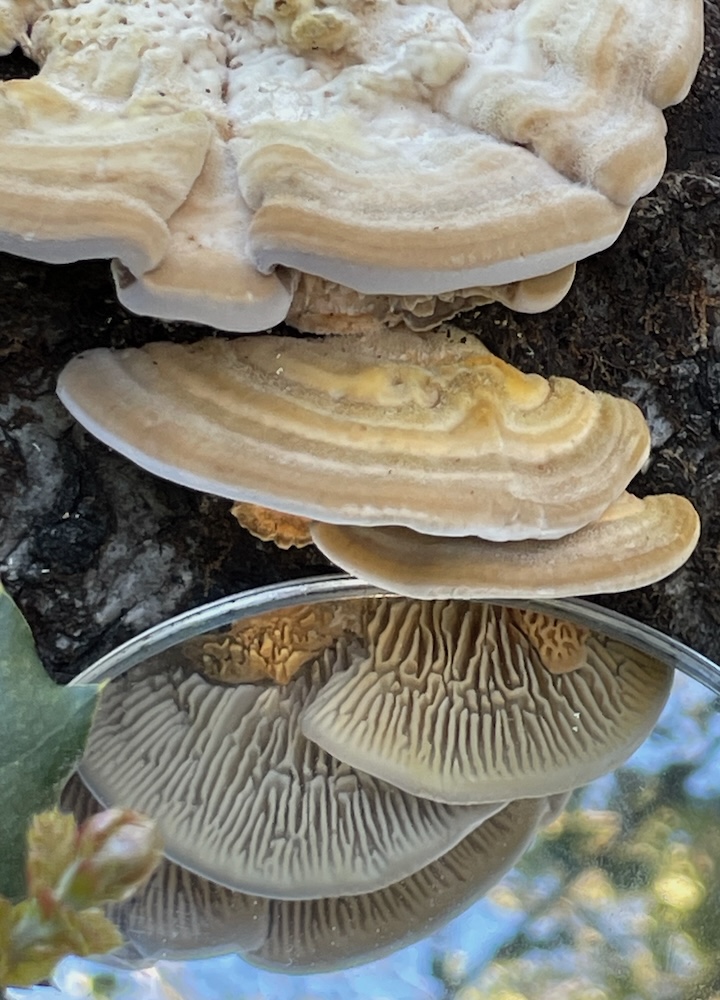
- Caps are typically 2-10 cm (0.8-4 inches) across and 1-3 cm (0.4-1.2 inches) thick at the attachment point. The upper surface is concentrically zoned, often with bands of grey, brown, buff, and sometimes green (from algae). It is usually velvety or hairy, especially towards the margin, becoming smoother with age. The margin is typically thin and wavy.
- Gills
- The underside of the cap features a distinctive hymenophore that appears gill-like but is technically a labyrinthine pore surface. These 'gills' are thick, tough, and often anastomosing (interconnected), forming a maze-like pattern. They are typically whitish to cream, becoming yellowish or brownish with age. They are not true gills in the sense of agarics, as they are part of the polypore structure.
- Stem
- Absent (sessile). The fruiting body is directly attached to the substrate.
- Flesh
- The flesh is tough, leathery, and whitish to pale cream, becoming corky or woody with age. It is thin, usually 1-3 mm thick.
- Fruiting body
- The fruiting body is a sessile, fan-shaped to semicircular bracket, typically growing in overlapping clusters or rows. It is tough and leathery when fresh, becoming rigid and woody with age. The upper surface is concentrically zoned with varying shades of grey, brown, and sometimes greenish (due to algae), and is often hairy or velvety, especially when young.
- Habitat
- Saprobic on dead hardwood, particularly birch (Betula spp.), but also found on oak (Quercus spp.), beech (Fagus spp.), maple (Acer spp.), and other deciduous trees. It causes a white rot.
Key Facts
- Cap surfaces: Velvety to hairy, concentrically zoned with shades of grey, brown, buff, sometimes green.
- Growth Form: Sessile, bracket-like, often in overlapping clusters.
- Spore Print: White
- Body color: Upper surface variable (grey, brown, buff, green); underside whitish to cream, becoming yellowish/brownish.
- Odor: Mild, mushroomy or indistinct.
- Flesh bruises: Does not bruise significantly.
- Height: Not applicable (sessile).
- Cap Diameter: 2-10 cm (0.8-4 inches).
- Nutrient gathering: Saprobic (decomposer).
Safe
SafeLenzites betulina is considered non-toxic but is inedible due to its extremely tough, leathery, and woody texture. It has no culinary value.
Quick Check
- Odor: Mild, mushroomy or indistinct
- Fruiting: Year-round, but most prominent in warmer months
- Substrate: Dead hardwood, especially birch
Where to Find
North America
Widespread across the continent, particularly in deciduous forests.
Europe
Common throughout temperate and boreal regions.
Asia
Found in temperate regions, including parts of China, Japan, and Korea.
Finding Tips
Look for dead hardwoods
Focus your search on fallen logs, stumps, and dead branches of deciduous trees, especially birch.
Check for overlapping clusters
Lenzites betulina often grows in tiered, overlapping clusters, making them easier to spot.
Examine the underside
The distinctive gill-like (labyrinthine) pore surface is the key identifying feature. Do not confuse it with true gills.
Similar Species
Turkey Tail
fungus
Also known as: Trametes versicolor
Hairy Bracket
fungus
Also known as: Trametes hirsuta
Smoky Polypore
fungus
Also known as: Bjerkandera adusta
Scientific Classification
- Phylum
- Basidiomycota
- Class
- Agaricomycetes
- Order
- Polyporales
- Family
- Polyporaceae
- Genus
- Lenzites
Storage Information
- Max Temperature: Not applicable for culinary purposes.
- Freezing duration: Not applicable for culinary purposes.
- Min Temperature: Not applicable for culinary purposes.
- Refrigeration: Not applicable for culinary purposes.
How to Clean
Not applicable for culinary purposes. If collected for scientific study or craft, gently brush off any debris. Avoid washing as it can damage the delicate structures.
Explore Gilled Polypore
Identify mushrooms anywhere
Free on iOS, Android, and Web. Photo identification, full database, and your personal collection.