
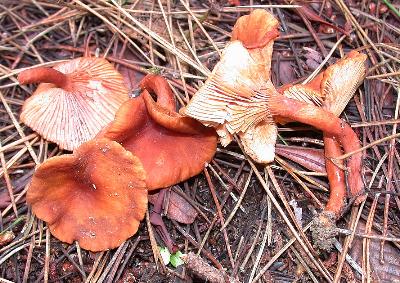
How to identify Candy Cap
Lactarius rubidus
Got a photo? Identify mushrooms instantly with the Mushby app
Open the appTo correctly identify Candy Cap (Lactarius rubidus), check each of these features in order. Misidentification is the most common cause of mushroom poisoning, so cross-reference multiple sources.
Step-by-step identification
- 1
Cap
Shape, color, surface texture, and diameter.
The cap is typically 2-6 cm (0.8-2.4 inches) in diameter, convex to plano-convex, often becoming depressed in the center with age, sometimes with a small papilla (umbo). The margin is often inrolled when young, becoming uplifted or wavy with age. The color ranges from reddish-brown to cinnamon-brown, sometimes with an orange tint, and can be somewhat hygrophanous, appearing paler when dry. The surface is smooth, dry, and often slightly velvety or pruinose when young, becoming glabrous with age.
- 2
Gills
Attachment to stem, color, and spacing.
The gills are adnate to slightly decurrent, close to subdistant, and rather narrow. They are initially pale buff to yellowish-orange, becoming darker cinnamon-buff with age. They often fork near the stem.
- 3
Stem
Length, shape, surface, and any ring.
The stem is 2-7 cm (0.8-2.8 inches) long and 0.5-1.5 cm (0.2-0.6 inches) thick, cylindrical or slightly tapering towards the base. It is often hollow or becomes hollow with age. The color is similar to the cap, reddish-brown to cinnamon-brown, sometimes paler at the apex. The surface is smooth or finely pruinose, dry, and lacks a ring or volva.
- 4
Flesh
Color, texture, and bruising reaction.
The flesh is thin, brittle, and pale reddish-brown to buff. When cut, it exudes a watery, clear to whitish latex that does not change color or stain the flesh. The odor is indistinct when fresh but develops a strong maple syrup or curry-like aroma upon drying. The taste is mild.
- 5
Fruiting body
Overall growth pattern.
The fruiting body is agaricoid, meaning it has a cap and stem with gills underneath. It is typically small to medium-sized.
- 6
Habitat
Where it grows and on what substrate.
Lactarius rubidus is mycorrhizal, forming symbiotic relationships with various tree species, primarily conifers (e.g., pines, firs, hemlocks) and sometimes hardwoods (e.g., oaks). It grows solitarily or scattered on the ground in mixed coniferous and hardwood forests.
Key Facts
- Cap surfaces
- Smooth, dry, sometimes velvety or pruinose
- Growth Form
- Solitary to scattered
- Spore Print
- Pale cream to yellowish-buff
- Body color
- Reddish-brown to cinnamon-brown
- Odor
- Indistinct (fresh), maple syrup/curry (dried)
- Flesh bruises
- Does not bruise, exudes watery latex
- Height
- 2-7 cm (0.8-2.8 inches)
- Cap Diameter
- 2-6 cm (0.8-2.4 inches)
Fruit body characteristics
- Gill attachment: Adnate to slightly decurrent
- Stem shape: Cylindrical or slightly tapering towards base
- Stem surface: Smooth or finely pruinose, dry
- Ring: Absent
- Stem cross-section: Solid, becoming hollow with age
Explore Candy Cap
Identify mushrooms anywhere
Free on iOS, Android, and Web. Photo identification, full database, and your personal collection.