
Got a photo? Identify mushrooms instantly with the Mushby app
Open the appDescription
Lactarius rubidus, commonly known as the Candy Cap, is a small to medium-sized mushroom highly prized for its distinctive maple syrup or curry-like aroma and flavor when dried. It is a member of the Russulaceae family and is characterized by its reddish-brown cap, pale gills, and the production of a watery, non-staining latex when cut or bruised. This species is a popular culinary mushroom, especially in desserts and savory dishes where its unique fragrance can be highlighted.
How to Identify
- Cap
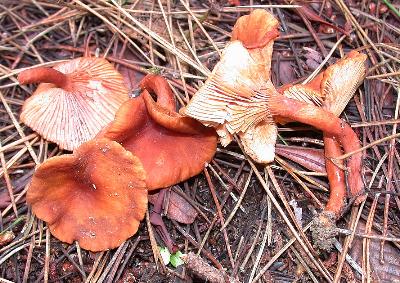
- The cap is typically 2-6 cm (0.8-2.4 inches) in diameter, convex to plano-convex, often becoming depressed in the center with age, sometimes with a small papilla (umbo). The margin is often inrolled when young, becoming uplifted or wavy with age. The color ranges from reddish-brown to cinnamon-brown, sometimes with an orange tint, and can be somewhat hygrophanous, appearing paler when dry. The surface is smooth, dry, and often slightly velvety or pruinose when young, becoming glabrous with age.
- Gills
- The gills are adnate to slightly decurrent, close to subdistant, and rather narrow. They are initially pale buff to yellowish-orange, becoming darker cinnamon-buff with age. They often fork near the stem.
- Stem
- The stem is 2-7 cm (0.8-2.8 inches) long and 0.5-1.5 cm (0.2-0.6 inches) thick, cylindrical or slightly tapering towards the base. It is often hollow or becomes hollow with age. The color is similar to the cap, reddish-brown to cinnamon-brown, sometimes paler at the apex. The surface is smooth or finely pruinose, dry, and lacks a ring or volva.
- Flesh
- The flesh is thin, brittle, and pale reddish-brown to buff. When cut, it exudes a watery, clear to whitish latex that does not change color or stain the flesh. The odor is indistinct when fresh but develops a strong maple syrup or curry-like aroma upon drying. The taste is mild.
- Fruiting body
- The fruiting body is agaricoid, meaning it has a cap and stem with gills underneath. It is typically small to medium-sized.
- Habitat
- Lactarius rubidus is mycorrhizal, forming symbiotic relationships with various tree species, primarily conifers (e.g., pines, firs, hemlocks) and sometimes hardwoods (e.g., oaks). It grows solitarily or scattered on the ground in mixed coniferous and hardwood forests.
Key Facts
- Cap surfaces: Smooth, dry, sometimes velvety or pruinose
- Growth Form: Solitary to scattered
- Spore Print: Pale cream to yellowish-buff
- Body color: Reddish-brown to cinnamon-brown
- Odor: Indistinct (fresh), maple syrup/curry (dried)
- Flesh bruises: Does not bruise, exudes watery latex
- Height: 2-7 cm (0.8-2.8 inches)
- Cap Diameter: 2-6 cm (0.8-2.4 inches)
- Nutrient gathering: Mycorrhizal
Safe
SafeLactarius rubidus is considered edible and highly prized for its unique flavor. However, it is crucial to correctly identify this mushroom, as some other Lactarius species are acrid or bitter and can cause gastrointestinal upset. There are no known toxic look-alikes that are deadly, but misidentification can lead to an unpleasant culinary experience or mild digestive issues. Always cook mushrooms thoroughly. Raw consumption of any wild mushroom is generally not recommended.
Quick Check
- Odor: Indistinct when fresh, strong maple syrup/curry when dried
- Fruiting: Late summer to fall
- Substrate: Ground in coniferous and mixed forests
Where to Find
Western North America
Common in California and the Pacific Northwest, often found under conifers like Douglas fir, redwood, and pine.
Eastern North America
Less common but can be found in mixed hardwood and conifer forests, particularly under oaks and pines.
Europe
Reported in some European regions, though often confused with other Lactarius species like L. camphoratus.
Finding Tips
Seasonality
Typically fruits from late summer through fall, sometimes into early winter in milder climates.
Associated Trees
Look for them growing on the ground near conifers (pines, firs, hemlocks) and occasionally hardwoods (oaks).
Latex Test
Always check for the watery, non-staining latex when the gills or flesh are cut. This is a key identifying feature for Lactarius species.
Aroma upon Drying
While fresh specimens have a mild odor, the characteristic maple syrup or curry aroma becomes pronounced only after drying. This is a crucial confirmation for identification.
Similar Species
Lactarius fragilis
mushroom
Also known as: Fragile Milkcap
Lactarius rufus
mushroom
Also known as: Rufous Milkcap
Lactarius camphoratus
mushroom
Also known as: Curry Milkcap
Lactarius xanthogalactus
mushroom
Also known as: Yellow-latex Milkcap
Scientific Classification
- Phylum
- Basidiomycota
- Class
- Agaricomycetes
- Order
- Russulales
- Family
- Russulaceae
- Genus
- Lactarius
Storage Information
- Max Temperature: 4°C
- Freezing duration: 6 months
- Min Temperature: 0°C
- Refrigeration: 5 days
How to Clean
Gently brush off any debris or soil with a soft brush or damp cloth. Avoid washing them under running water as they can become waterlogged and lose flavor. If necessary, a quick rinse and immediate drying are acceptable. Trim off any damaged or insect-ridden parts.
Explore Candy Cap
Identify mushrooms anywhere
Free on iOS, Android, and Web. Photo identification, full database, and your personal collection.