
Where does Milk-white Toothed Polypore grow?
Irpex lacteus
Got a photo? Identify mushrooms instantly with the Mushby app
Open the appMilk-white Toothed Polypore grows in specific habitats. Knowing where to look and when is the difference between an empty basket and a successful forage.
Where to find Milk-white Toothed Polypore
Deciduous Forests
Commonly found in deciduous forests across temperate regions, growing on fallen logs, branches, and stumps of various hardwood species.
Mixed Forests
Can also be found in mixed forests where hardwoods are present, though less frequently on conifers.
Urban and Suburban Areas
May appear on dead wood in parks, gardens, and other urban or suburban settings where suitable hardwood substrates are available.
Foraging tips
- Substrate Preference. Focus your search on dead hardwood, especially oak, maple, birch, and beech. Look for logs and branches that are well-decayed but still firm enough to support fungal growth.
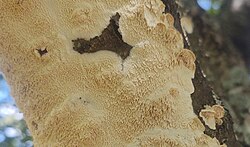
- Growth Habit. Observe the growth pattern. It often forms extensive patches on the underside or sides of logs. The effused-reflexed form will have a small, projecting cap-like edge.
- Hymenophore Transformation. Pay close attention to the hymenophore. The transition from pores to flattened teeth is a key diagnostic feature. Younger specimens might still show more poroid characteristics.
- Color and Texture. Note the white to cream color and the tough, fibrous texture. The upper surface, if present, will be finely hairy.
Quick Check
- Substrate:
- Dead hardwood.
- Fruiting:
- Resupinate to effused-reflexed, white to cream, with a hymenophore that develops into flattened teeth.
- Odor:
- Indistinct or slightly fungal.
Explore Milk-white Toothed Polypore
Identify mushrooms anywhere
Free on iOS, Android, and Web. Photo identification, full database, and your personal collection.