
Got a photo? Identify mushrooms instantly with the Mushby app
Open the appDescription
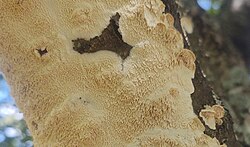
Irpex lacteus is a widespread and common saprobic fungus belonging to the family Irpicaceae. It is characterized by its resupinate to effused-reflexed growth habit and a hymenophore that transitions from poroid to irpicoid (toothed) with age. Its color is typically white to cream, hence the 'milk-white' descriptor. This species plays a significant ecological role as a white-rot fungus, decomposing dead hardwoods.
How to Identify
- Cap
- When effused-reflexed, the cap-like margin is narrow, typically 0.5-2 cm wide, and semicircular to irregular. The upper surface is finely tomentose to strigose (hairy), white to cream, sometimes becoming grayish or greenish with age due to algae. The margin is often thin and wavy.
- Gills
- Not a gilled mushroom. The hymenophore (fertile surface) is initially poroid (pore-like) but quickly develops into an irpicoid (toothed or labyrinthine) structure. The teeth are flattened, irregular, and often fused, appearing like flattened spines or ridges. They are white to cream, becoming yellowish or brownish with age or when dried. The teeth are typically 1-5 mm long.
- Stem
- Absent. This fungus grows directly on the substrate.
- Flesh
- The context (flesh) is thin, tough, fibrous, and white to cream-colored. It is not easily separable from the substrate.
- Fruiting body
- The fruiting body is typically resupinate (lying flat on the substrate) to effused-reflexed (partially resupinate with a projecting cap-like margin). It can be quite variable in shape, often forming irregular patches that can be several centimeters to tens of centimeters long and wide. The thickness is usually 1-5 mm. The upper surface, when present (effused-reflexed form), is finely hairy to velvety, zonate or azonate, and white to cream or pale yellowish, sometimes with greenish algal growth.
- Habitat
- Saprobic on dead hardwood logs, branches, and stumps. Occasionally found on conifers, but predominantly on deciduous trees. It causes a white rot.
Key Facts
- Cap surfaces: Finely tomentose to strigose (hairy) when effused-reflexed; otherwise absent.
- Growth Form: Resupinate to effused-reflexed, often forming extensive patches.
- Spore Print: White.
- Body color: White to cream, sometimes yellowish or grayish with age.
- Odor: Indistinct.
- Flesh bruises: Does not bruise significantly; may yellow slightly with age or drying.
- Height: Not applicable (resupinate/effused-reflexed).
- Cap Diameter: Not applicable (resupinate/effused-reflexed); individual reflexed margins typically 0.5-2 cm wide.
- Nutrient gathering: Saprobic (decomposes dead organic matter).
Safe
SafeIrpex lacteus is not considered toxic, but it is also not regarded as edible due to its tough, leathery texture and lack of culinary appeal. There are no known reports of toxicity from ingestion, but it is not recommended for consumption.
Quick Check
- Odor: Indistinct or slightly fungal.
- Fruiting: Resupinate to effused-reflexed, white to cream, with a hymenophore that develops into flattened teeth.
- Substrate: Dead hardwood.
Where to Find
Deciduous Forests
Commonly found in deciduous forests across temperate regions, growing on fallen logs, branches, and stumps of various hardwood species.
Mixed Forests
Can also be found in mixed forests where hardwoods are present, though less frequently on conifers.
Urban and Suburban Areas
May appear on dead wood in parks, gardens, and other urban or suburban settings where suitable hardwood substrates are available.
Finding Tips
Substrate Preference
Focus your search on dead hardwood, especially oak, maple, birch, and beech. Look for logs and branches that are well-decayed but still firm enough to support fungal growth.
Growth Habit
Observe the growth pattern. It often forms extensive patches on the underside or sides of logs. The effused-reflexed form will have a small, projecting cap-like edge.
Hymenophore Transformation
Pay close attention to the hymenophore. The transition from pores to flattened teeth is a key diagnostic feature. Younger specimens might still show more poroid characteristics.
Color and Texture
Note the white to cream color and the tough, fibrous texture. The upper surface, if present, will be finely hairy.
Similar Species
Trametes versicolor
fungus
Also known as: Turkey Tail
Schizopora paradoxa
fungus
Also known as: Split Porecrust
Ceriporia reticulata
fungus
Also known as: Net-like Porecrust
Scientific Classification
- Phylum
- Basidiomycota
- Class
- Agaricomycetes
- Order
- Polyporales
- Family
- Irpicaceae
- Genus
- Irpex
Storage Information
- Max Temperature: Not applicable for consumption.
- Freezing duration: Not applicable for consumption.
- Min Temperature: Not applicable for consumption.
- Refrigeration: Not applicable for consumption.
How to Clean
Not applicable as Irpex lacteus is not considered edible. If collected for scientific study, specimens should be carefully removed from the substrate with a knife or chisel, avoiding contamination with soil or other debris. Brushing off loose particles is usually sufficient.
Explore Milk-white Toothed Polypore
Identify mushrooms anywhere
Free on iOS, Android, and Web. Photo identification, full database, and your personal collection.