
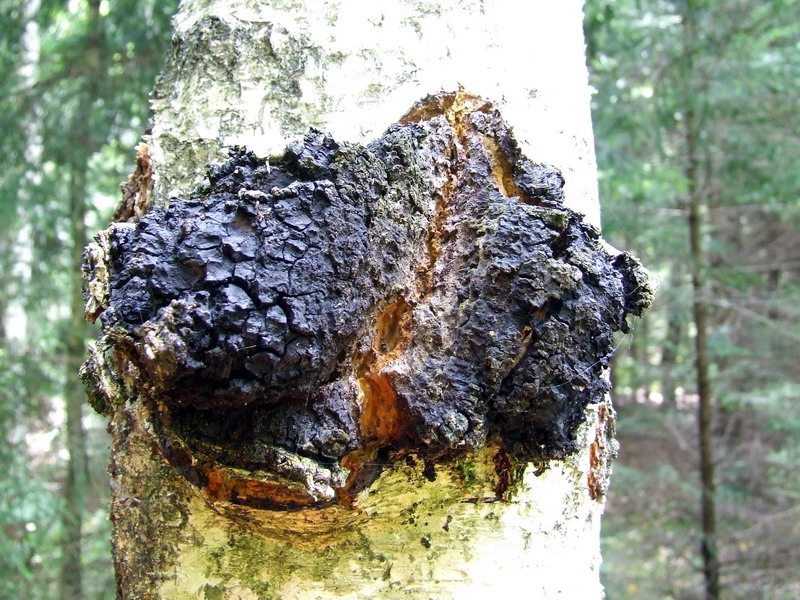
How to identify Chaga mushroom
Inonotus obliquus
Got a photo? Identify mushrooms instantly with the Mushby app
Open the appTo correctly identify Chaga mushroom (Inonotus obliquus), check each of these features in order. Misidentification is the most common cause of mushroom poisoning, so cross-reference multiple sources.
Step-by-step identification
- 1
Cap
Shape, color, surface texture, and diameter.
Not applicable, as the visible Chaga is a sterile conk (sclerotium), not a typical mushroom cap. The rare, fertile fruiting body, which develops post-mortem on the host tree, is a resupinate (crust-like) pore surface, initially whitish and becoming brownish, forming under the bark.
- 2
Gills
Attachment to stem, color, and spacing.
Not applicable. Chaga is a polypore, and the sterile conk does not produce gills. The fertile fruiting body, forming after the host tree's death, has a poroid hymenium, not gills.
- 3
Stem
Length, shape, surface, and any ring.
Not applicable. The sterile conk is sessile and directly attached to the host tree. The fertile fruiting body is resupinate and does not have a stem.
- 4
Flesh
Color, texture, and bruising reaction.
The interior flesh of the Chaga conk is firm, corky to woody, and exhibits a yellowish-brown to rust-brown color, often with lighter, whitish veins or streaks.
- 5
Fruiting body
Overall growth pattern.
The sterile conk of Inonotus obliquus appears as a hardened, irregular, charcoal-like mass, often deeply fissured and black on the exterior. The interior is rust-brown to yellowish-brown, corky, and sometimes marbled with whitish veins. It can range from fist-sized to over a foot in diameter.
- 6
Habitat
Where it grows and on what substrate.
Chaga grows predominantly on live birch trees (Betula spp.) in cold northern latitudes, including boreal forests of Russia, Eastern Europe, Northern Europe, Korea, Canada, and the northern United States. It can occasionally be found on other hardwood trees like alder, beech, maple, or elm, but birch is its primary host.
Key Facts
- Cap surfaces
- Not applicable for the sterile conk. The surface of the conk is rough, deeply furrowed, and black.
- Growth Form
- Sclerotium (sterile mycelial mass) forming an irregular, tumor-like conk on living trees.
- Spore Print
- White to yellowish-white (for the rarely seen fertile fruiting body).
- Body color
- Exterior: Black, charcoal-like; Interior: Rust-brown to yellowish-brown, often with whitish veins.
- Odor
- Mild, earthy, woody.
- Flesh bruises
- Does not bruise in the typical mushroom sense; the interior color remains consistent.
- Height
- Variable; conks can be from 5 cm (2 inches) to over 30 cm (12 inches) in height/diameter, and protrude several centimeters from the tree.
- Cap Diameter
- Not applicable; referring to the diameter of the conk, which can range from 10 cm to over 30 cm (4-12+ inches).
Fruit body characteristics
- Gill attachment: Not applicable; a polypore.
- Stem shape: Not applicable; sessile conk.
- Stem surface: Not applicable; sessile conk.
- Ring: Not applicable.
- Stem cross-section: Not applicable.
Explore Chaga mushroom
Identify mushrooms anywhere
Free on iOS, Android, and Web. Photo identification, full database, and your personal collection.