
Got a photo? Identify mushrooms instantly with the Mushby app
Open the appDescription
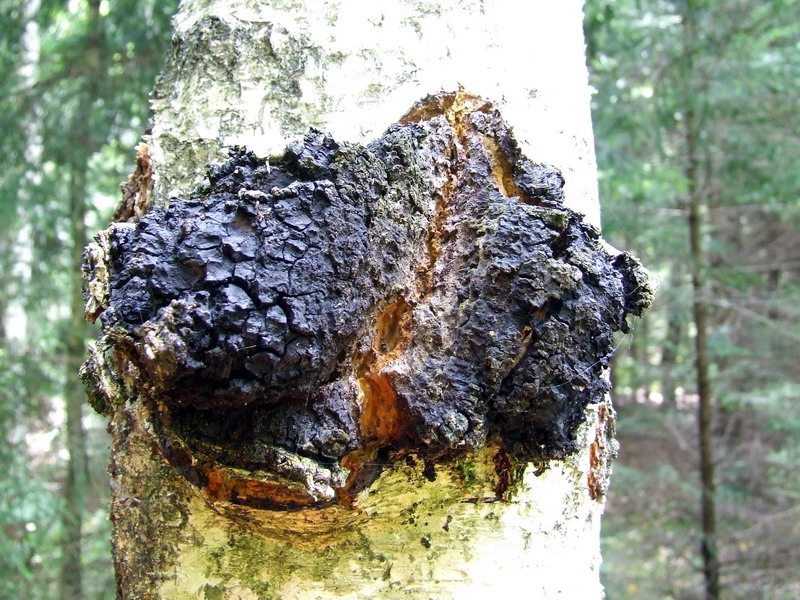
Inonotus obliquus, commonly known as Chaga mushroom, is a sterile conk or sclerotium that primarily grows on birch trees in cold climates. It is not a true mushroom in the traditional sense, as the visible growth is a highly pigmented, charcoal-like mass of mycelium infused with wood, rather than a typical fruiting body with gills and a cap. The actual fertile fruiting body is rarely seen and forms only after the host tree dies, appearing as a crust-like structure under the bark.
How to Identify
- Cap
- Not applicable, as the visible Chaga is a sterile conk (sclerotium), not a typical mushroom cap. The rare, fertile fruiting body, which develops post-mortem on the host tree, is a resupinate (crust-like) pore surface, initially whitish and becoming brownish, forming under the bark.
- Gills
- Not applicable. Chaga is a polypore, and the sterile conk does not produce gills. The fertile fruiting body, forming after the host tree's death, has a poroid hymenium, not gills.
- Stem
- Not applicable. The sterile conk is sessile and directly attached to the host tree. The fertile fruiting body is resupinate and does not have a stem.
- Flesh
- The interior flesh of the Chaga conk is firm, corky to woody, and exhibits a yellowish-brown to rust-brown color, often with lighter, whitish veins or streaks.
- Fruiting body
- The sterile conk of Inonotus obliquus appears as a hardened, irregular, charcoal-like mass, often deeply fissured and black on the exterior. The interior is rust-brown to yellowish-brown, corky, and sometimes marbled with whitish veins. It can range from fist-sized to over a foot in diameter.
- Habitat
- Chaga grows predominantly on live birch trees (Betula spp.) in cold northern latitudes, including boreal forests of Russia, Eastern Europe, Northern Europe, Korea, Canada, and the northern United States. It can occasionally be found on other hardwood trees like alder, beech, maple, or elm, but birch is its primary host.
Key Facts
- Cap surfaces: Not applicable for the sterile conk. The surface of the conk is rough, deeply furrowed, and black.
- Growth Form: Sclerotium (sterile mycelial mass) forming an irregular, tumor-like conk on living trees.
- Spore Print: White to yellowish-white (for the rarely seen fertile fruiting body).
- Body color: Exterior: Black, charcoal-like; Interior: Rust-brown to yellowish-brown, often with whitish veins.
- Odor: Mild, earthy, woody.
- Flesh bruises: Does not bruise in the typical mushroom sense; the interior color remains consistent.
- Height: Variable; conks can be from 5 cm (2 inches) to over 30 cm (12 inches) in height/diameter, and protrude several centimeters from the tree.
- Cap Diameter: Not applicable; referring to the diameter of the conk, which can range from 10 cm to over 30 cm (4-12+ inches).
- Nutrient gathering: Parasitic, drawing nutrients from the host tree, eventually leading to its demise.
Safe
SafeInonotus obliquus (Chaga) is not considered toxic in its traditional use as a tea or extract. However, like many concentrated herbal substances, it can have adverse effects if consumed excessively or by individuals with certain medical conditions. It contains oxalates, which can be problematic for individuals with kidney issues or those prone to kidney stones. There have been rare reports of kidney damage with long-term, extremely high-dose consumption. Chaga can also interact with blood-thinning medications and blood sugar-lowering medications. It is crucial to consult a healthcare professional before regular consumption, especially if pregnant, breastfeeding, on medication, or managing existing health conditions. It is not intended for consumption raw.
Quick Check
- Odor: Earthy, fungal, mild (especially when fresh or drying), somewhat woody or slightly smoky when dried.
- Fruiting: Sterile conk, irregularly shaped, hard, charcoal-like exterior.
- Substrate: Parasitic on living birch trees, occasionally other hardwoods.
Where to Find
Boreal Forests
Commonly found in the boreal forests of Russia, Eastern Europe, Northern Europe, Canada, and the northern United States.
Birch Woodlands
Specifically look for it on mature birch trees within these regions. It prefers colder climates.
Finding Tips
Host Tree Identification
Always confirm the host tree is a birch (Betula species), as Chaga primarily grows on birch. While rare, similar-looking growths on other trees might not be Chaga or could be other fungi.
Look for the Conk
Scan tree trunks, especially older, larger birch trees, for the characteristic charcoal-like, irregular growth. It often appears as if part of the tree has been burned.
Interior Color Confirmation
If in doubt and if ethical harvesting is permitted, a small sample can be taken to confirm the rust-brown to yellowish-brown, corky interior. Do not damage healthy trees unnecessarily.
Seasonality
Chaga can be found year-round, but it is often harvested in winter when it is believed to be most potent, and when the absence of leaves makes spotting it easier.
Sustainable Harvesting
Harvest Chaga responsibly. Do not take all of the conk from a single tree, leave a portion to allow for regrowth and the tree's health. Avoid damaging the tree's bark.
Similar Species
Birch Polypore
Fungus
Also known as: Piptoporus betulinus
Lumpy Bracket
Fungus
Also known as: Trametes gibbosa
Cinder Conk
Fungus
Also known as: Inonotus cuticularis
King Trumpet Mushroom
Fungus
Also known as: Pleurotus eryngii
Scientific Classification
- Phylum
- Basidiomycota
- Class
- Agaricomycetes
- Order
- Hymenochaetales
- Family
- Hymenochaetaceae
- Genus
- Inonotus
Storage Information
- Max Temperature: Dried pieces of Chaga or Chaga powder should be stored in an airtight container at room temperature (below 25°C or 77°F) for up to 1-2 years.
- Freezing duration: When dried and properly stored, Chaga can last for "1-2 years"
- Min Temperature: Chaga, especially if fresh or partially dried, can be stored frozen to preserve potency. Place chunks in freezer-safe bags. Freezing is suitable for "several years".
- Refrigeration: Fresh Chaga is not typically stored in a refrigerator for extended periods, as it tends to dry out or become moldy. If briefly stored, use within "a few days".
How to Clean
The Chaga conk usually requires minimal cleaning. Any loose bark, moss, or dirt can be brushed off with a stiff brush. It is generally not washed as it will be dried and processed.
Explore Chaga mushroom
Identify mushrooms anywhere
Free on iOS, Android, and Web. Photo identification, full database, and your personal collection.