
How to identify Azure Bolete
Gyroporus cyanescens
Got a photo? Identify mushrooms instantly with the Mushby app
Open the appTo correctly identify Azure Bolete (Gyroporus cyanescens), check each of these features in order. Misidentification is the most common cause of mushroom poisoning, so cross-reference multiple sources.
Step-by-step identification
- 1
Cap
Shape, color, surface texture, and diameter.
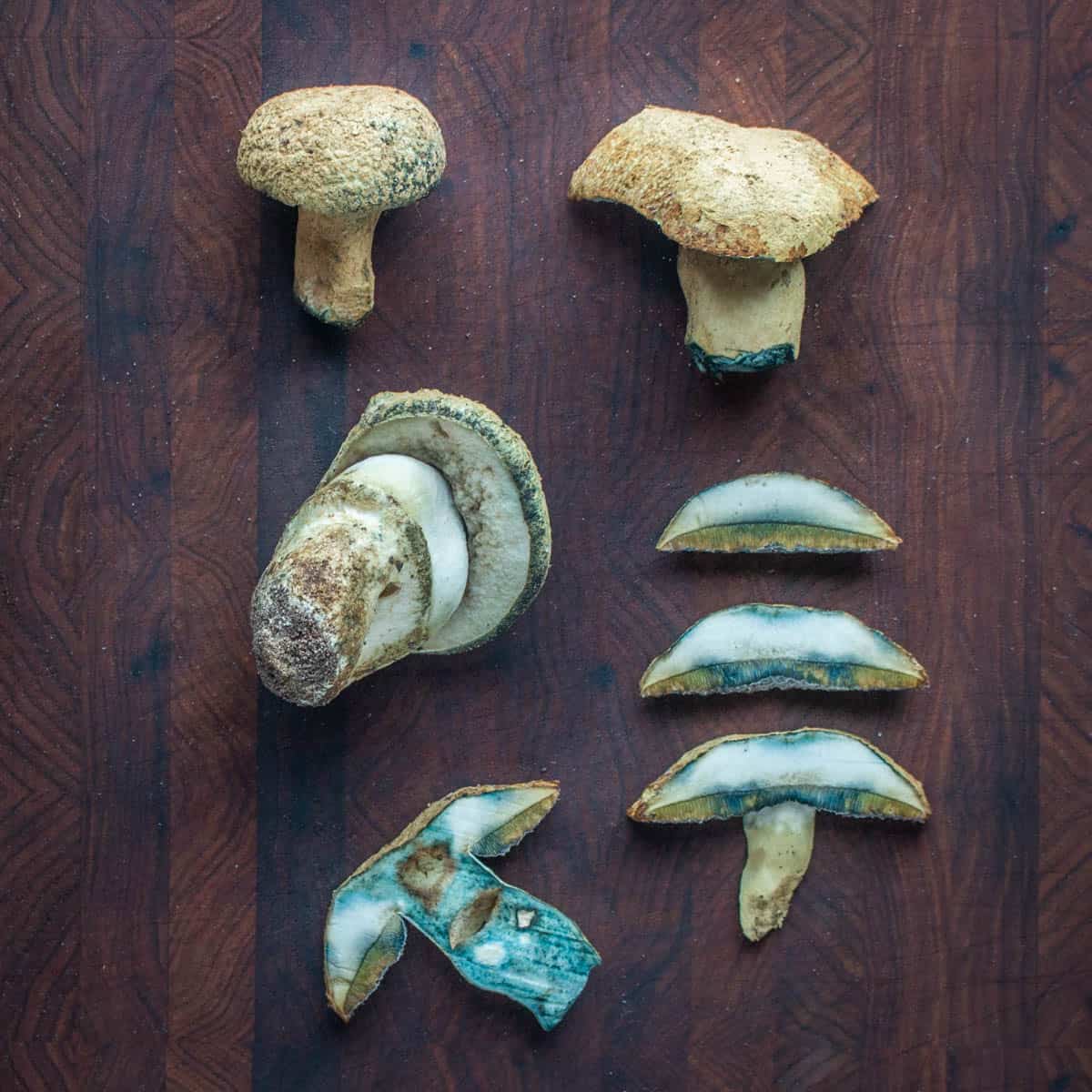
The cap is typically 5-15 cm (2-6 inches) in diameter, convex to broadly convex or flat in maturity. The color ranges from pale straw yellow, ochraceous, or buff to light brown. The surface is often dry, finely tomentose or velvety, sometimes cracking slightly in age or dry conditions. When bruised, it instantly turns a vibrant indigo blue.
- 2
Gills
Attachment to stem, color, and spacing.
Gyroporus cyanescens has pores, not gills. The pore surface is initially whitish to cream or pale yellow, becoming more yellowish with age. The pores are small and angular. They immediately stain a vivid blue when bruised.
- 3
Stem
Length, shape, surface, and any ring.
The stem is 5-15 cm (2-6 inches) long and 1-3 cm (0.4-1.2 inches) thick, typically swollen or club-shaped, often tapering towards the base. It is characteristically hollow or chambered (lacunose) internally, especially when mature. The surface is similar in color to the cap (whitish to yellowish), often covered with coarse, stiff fibrils, and stains blue when handled. No ring or volva is present.
- 4
Flesh
Color, texture, and bruising reaction.
The flesh is white to yellowish, firm, and thick. Upon cutting, it rapidly changes to a deep azure blue, which may eventually fade to a grayish-blue or greenish-blue after a few minutes or hours. The bluing reaction is a key identifying feature.
- 5
Fruiting body
Overall growth pattern.
The fruiting body is a classic bolete shape, with a cap, pores (instead of gills), and a central stipe (stem). Its most striking feature is the dramatic and immediate blue staining of all parts when bruised or cut.
- 6
Habitat
Where it grows and on what substrate.
This mushroom grows solitary or scattered on the ground in deciduous or coniferous forests, forming mycorrhizal associations. It prefers sandy or gravely soils.
Key Facts
- Cap surfaces
- Dry, finely tomentose or velvety, sometimes cracked
- Growth Form
- Solitary to scattered
- Spore Print
- Pale yellow
- Body color
- Pale straw yellow to ochraceous or light brown (cap), whitish to yellowish (pores, stem, flesh)
- Odor
- Mild, pleasant or indistinct
- Flesh bruises
- Rapidly and intensely azure blue
- Height
- 5-15 cm (2-6 inches)
- Cap Diameter
- 5-15 cm (2-6 inches)
Fruit body characteristics
- Gill attachment: Not applicable (pores instead of gills)
- Stem shape: Cylindrical, clavate (club-shaped) or ventricose (swollen in the middle)
- Stem surface: Dry, often covered with coarse, stiff fibrils, whitish to yellowish
- Ring: Absent
- Stem cross-section: Hollow or chambered (lacunose)
Explore Azure Bolete
Identify mushrooms anywhere
Free on iOS, Android, and Web. Photo identification, full database, and your personal collection.