
Got a photo? Identify mushrooms instantly with the Mushby app
Open the appDescription
Gyroporus cyanescens, commonly known as the Azure Bolete or Cornflower Bolete, is a distinctive edible bolete recognized by its rapid and intense blue bruising reaction upon handling or injury. It is a mycorrhizal fungus, typically found in association with deciduous or coniferous trees, and is appreciated by foragers for its mild taste and unique appearance.
How to Identify
- Cap
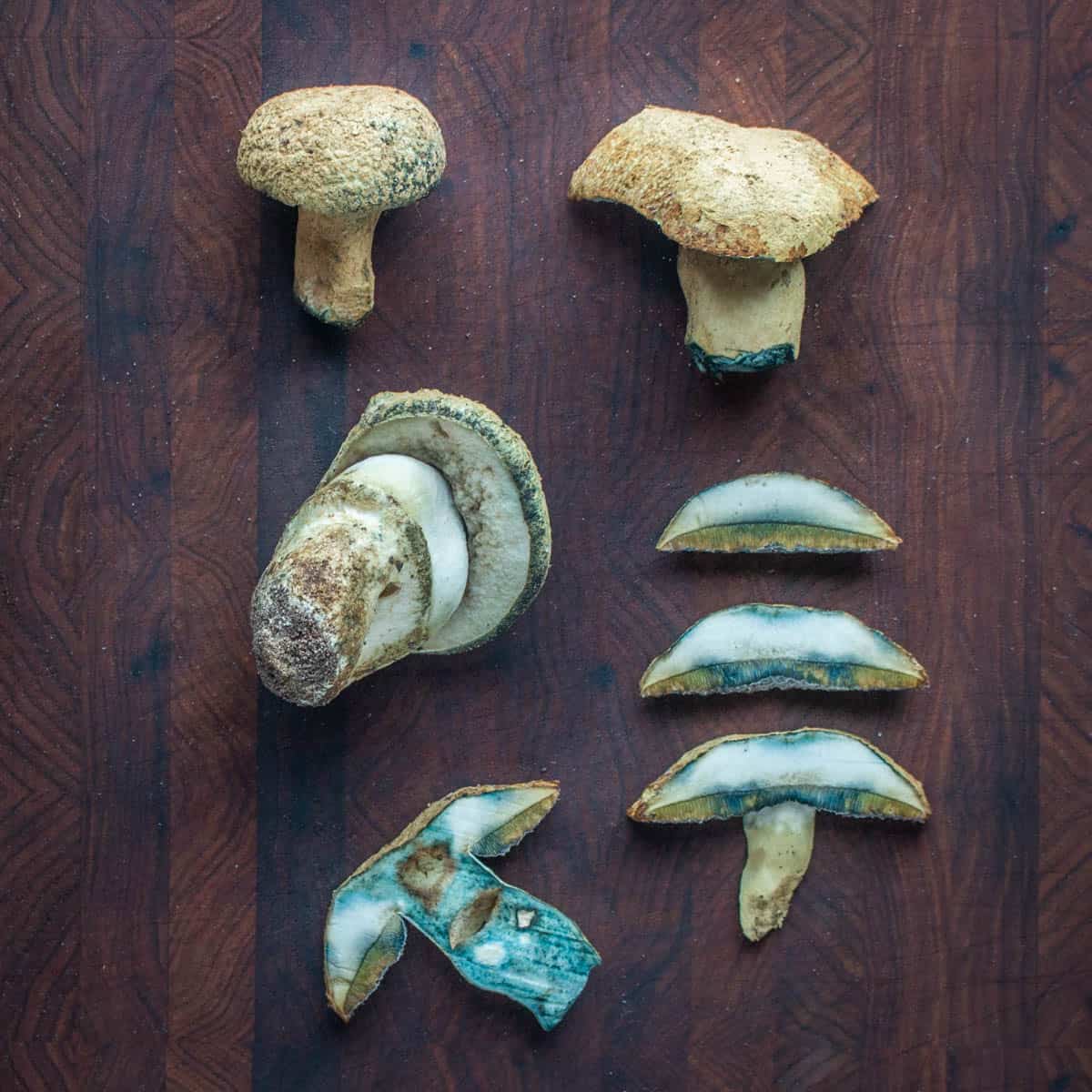
- The cap is typically 5-15 cm (2-6 inches) in diameter, convex to broadly convex or flat in maturity. The color ranges from pale straw yellow, ochraceous, or buff to light brown. The surface is often dry, finely tomentose or velvety, sometimes cracking slightly in age or dry conditions. When bruised, it instantly turns a vibrant indigo blue.
- Gills
- Gyroporus cyanescens has pores, not gills. The pore surface is initially whitish to cream or pale yellow, becoming more yellowish with age. The pores are small and angular. They immediately stain a vivid blue when bruised.
- Stem
- The stem is 5-15 cm (2-6 inches) long and 1-3 cm (0.4-1.2 inches) thick, typically swollen or club-shaped, often tapering towards the base. It is characteristically hollow or chambered (lacunose) internally, especially when mature. The surface is similar in color to the cap (whitish to yellowish), often covered with coarse, stiff fibrils, and stains blue when handled. No ring or volva is present.
- Flesh
- The flesh is white to yellowish, firm, and thick. Upon cutting, it rapidly changes to a deep azure blue, which may eventually fade to a grayish-blue or greenish-blue after a few minutes or hours. The bluing reaction is a key identifying feature.
- Fruiting body
- The fruiting body is a classic bolete shape, with a cap, pores (instead of gills), and a central stipe (stem). Its most striking feature is the dramatic and immediate blue staining of all parts when bruised or cut.
- Habitat
- This mushroom grows solitary or scattered on the ground in deciduous or coniferous forests, forming mycorrhizal associations. It prefers sandy or gravely soils.
Key Facts
- Cap surfaces: Dry, finely tomentose or velvety, sometimes cracked
- Growth Form: Solitary to scattered
- Spore Print: Pale yellow
- Body color: Pale straw yellow to ochraceous or light brown (cap), whitish to yellowish (pores, stem, flesh)
- Odor: Mild, pleasant or indistinct
- Flesh bruises: Rapidly and intensely azure blue
- Height: 5-15 cm (2-6 inches)
- Cap Diameter: 5-15 cm (2-6 inches)
- Nutrient gathering: Mycorrhizal
Safe
SafeGyroporus cyanescens is considered an excellent edible mushroom. However, it is crucial to properly identify it to avoid confusion with potentially toxic look-alikes, though true toxic look-alikes are rare if the blue staining reaction is correctly observed. Always cook mushrooms thoroughly, as raw consumption can lead to gastrointestinal upset in some individuals.
Quick Check
- Odor: Mild, pleasant, or indistinct
- Fruiting: Summer to early autumn (July-October)
- Substrate: Terrestrial, growing on soil, mycorrhizal with deciduous and coniferous trees
Where to Find
North America
Widely distributed throughout eastern North America, less common in the west.
Europe
Common in many parts of Europe, particularly central and northern regions.
Asia
Reported from parts of Asia, though less frequently documented than in North America and Europe.
Finding Tips
Season
Typically fruits from summer to early autumn, generally July through October, depending on location and weather conditions.
Associated Trees
Look for it near oak, birch, beech, pine, and other coniferous or deciduous trees with which it forms mycorrhizal relationships.
Soil Preference
Often found in sandy or gravelly soils, sometimes along trails or disturbed areas within suitable forests.
Key Identification Trait
Always check for the rapid and intense blue bruising reaction on the cap, pores, stem, and flesh upon handling or cutting. This is the most reliable identifying characteristic.
Similar Species
Gyroporus castaneus
Bolete
Also known as: Chestnut Bolete
Gyroporus purpurinus
Bolete
Also known as: Purple-staining Bolete
Scientific Classification
- Phylum
- Basidiomycota
- Class
- Agaricomycetes
- Order
- Boletales
- Family
- Gyroporaceae
- Genus
- Gyroporus
Storage Information
- Max Temperature: 35°F (2°C)
- Freezing duration: 6 months
- Min Temperature: 32°F (0°C)
- Refrigeration: 5 days
How to Clean
Gently brush off any visible dirt or debris with a soft brush or damp cloth. Avoid washing under running water unless absolutely necessary, as boletes can absorb a lot of moisture. If washing is unavoidable, do so quickly and pat dry immediately. The intense blue color caused by bruising will dissipate somewhat during cooking.
Explore Azure Bolete
Identify mushrooms anywhere
Free on iOS, Android, and Web. Photo identification, full database, and your personal collection.