
Got a photo? Identify mushrooms instantly with the Mushby app
Open the appDescription
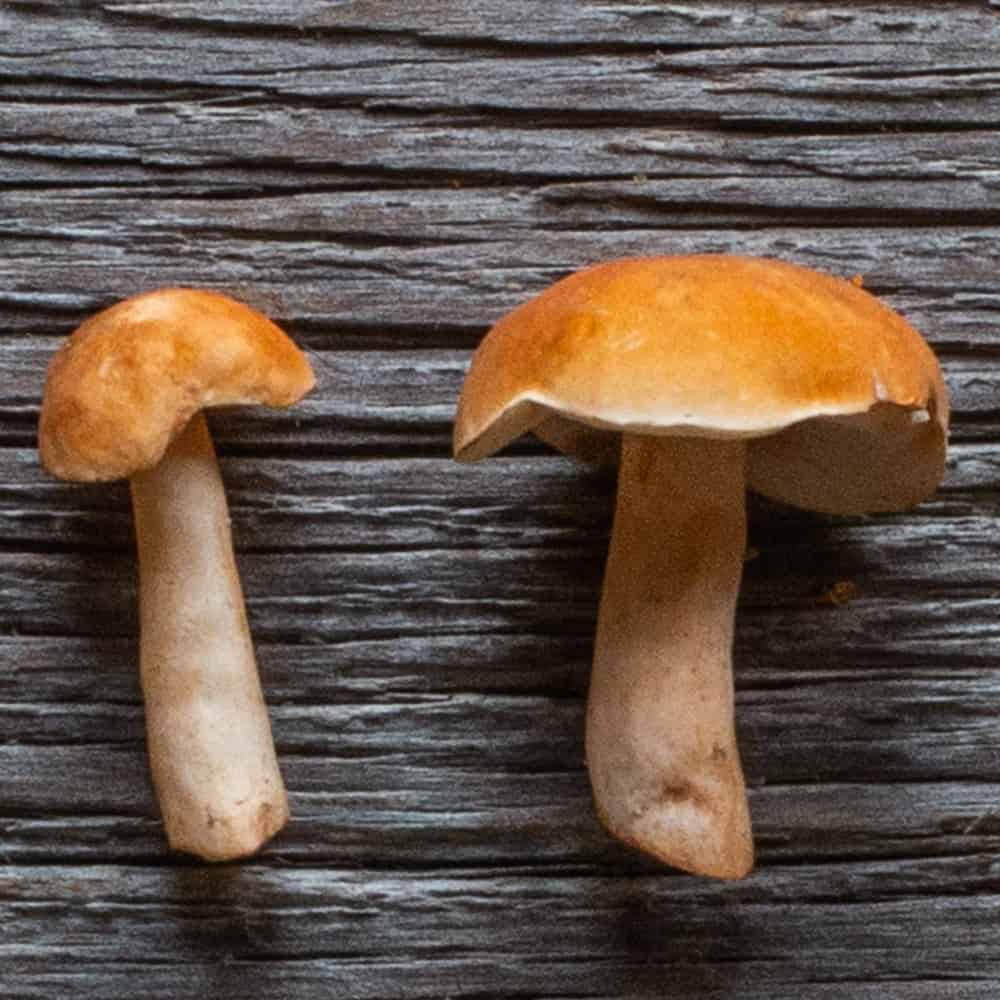
Gyroporus castaneus, commonly known as the chestnut bolete, is a relatively small, edible mushroom distinguished by its dry, chestnut-brown cap and hollow stem. It is found in deciduous woodlands, particularly under oak and chestnut trees.
How to Identify
- Cap
- The cap is chestnut-brown, dry, and smooth, often becoming cracked in age. It is initially convex, later flattening out. The cap surface is not sticky or slimy.
- Gills
- Instead of gills, it has a pore surface. The pores are small, round, and white to pale yellow, bruising slightly brownish when handled. The pore surface is free from the stem.
- Stem
- The stem is typically the same color as the cap or slightly paler, dry, and smooth. A key characteristic is that the stem is hollow when mature, which distinguishes it from similar boletes.
- Flesh
- The flesh is white and does not change color when cut or bruised. It has a mild, nutty taste and a faint, pleasant odor.
- Fruiting body
- The fruiting body of Gyroporus castaneus is typically small to medium-sized, with a cap diameter ranging from 4 to 10 cm. The overall appearance is neat and compact.
- Habitat
- Gyroporus castaneus is found in deciduous woodlands, particularly under oak and chestnut trees. It is a mycorrhizal fungus, forming a symbiotic relationship with the roots of these trees. It typically fruits in summer and autumn.
Key Facts
- Cap surfaces: Dry, smooth, sometimes cracked
- Growth Form: Mycorrhizal
- Spore Print: Pale yellow
- Body color: Chestnut-brown
- Odor: Mild, nutty
- Flesh bruises: No bruising
- Height: 4-10 cm
- Cap Diameter: 4-10 cm
- Nutrient gathering: Mycorrhizal
Safe
SafeGyroporus castaneus is considered an edible mushroom and is not known to be toxic. However, it is important to properly identify it to avoid confusion with other potentially toxic species.
Quick Check
- Odor: Mild, nutty
- Fruiting: Summer to Autumn
- Substrate: Deciduous woodlands, under oak and chestnut trees
Where to Find
Deciduous Woodlands
Prefers areas under oak and chestnut trees.
Europe
Commonly found throughout Europe.
Finding Tips
Check Under Trees
Look around the base of oak and chestnut trees in late summer and autumn.
Examine the Stem
Ensure the stem is hollow, a key identifier for this species.
Similar Species
Bay Bolete
a species of bolete fungus
Also known as: Imleria badia
Bitter Bolete
a species of fungus
Also known as: Tylopilus felleus
Scientific Classification
- Phylum
- Basidiomycota
- Class
- Agaricomycetes
- Order
- Boletales
- Family
- Gyroporaceae
- Genus
- Gyroporus
Storage Information
- Max Temperature: 2
- Freezing duration: 3 months
- Min Temperature: -18
- Refrigeration: 3 days
How to Clean
Clean the Chestnut Bolete by gently brushing off any dirt or debris. Avoid washing it unless necessary, as it can become waterlogged. A soft brush or a dry cloth works best.
Explore Chestnut Bolete
Identify mushrooms anywhere
Free on iOS, Android, and Web. Photo identification, full database, and your personal collection.