
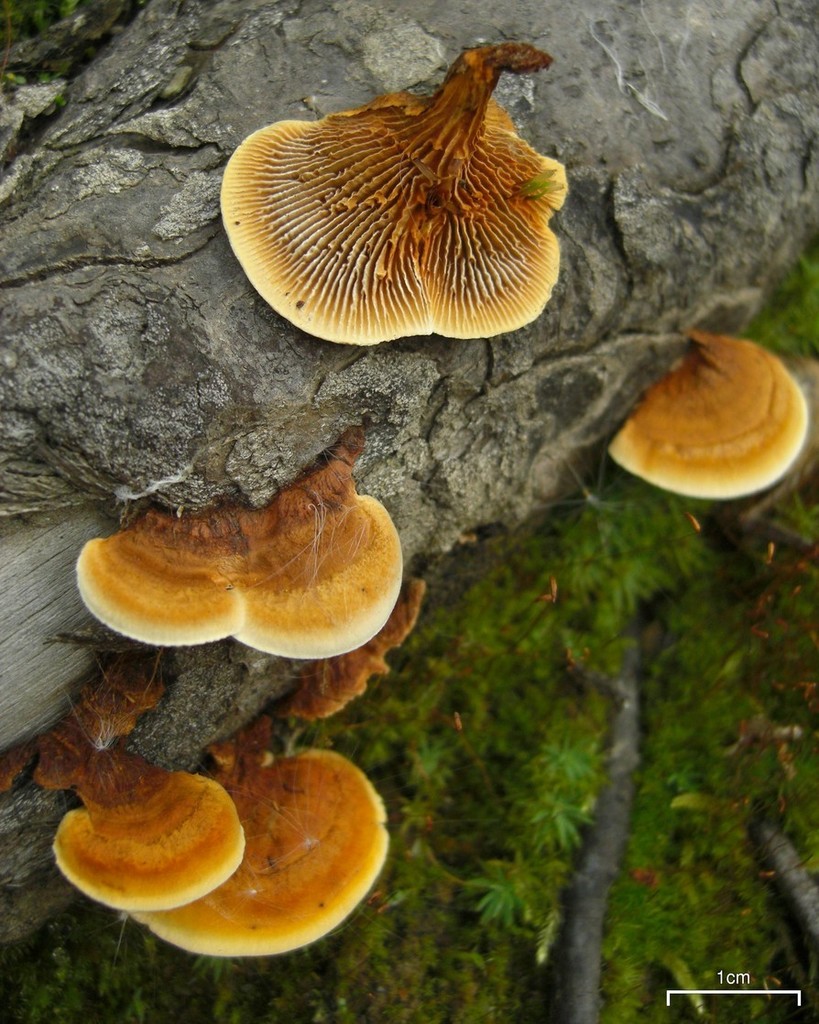
How to identify Conifer Mazegill
Gloeophyllum sepiarium
Got a photo? Identify mushrooms instantly with the Mushby app
Open the appTo correctly identify Conifer Mazegill (Gloeophyllum sepiarium), check each of these features in order. Misidentification is the most common cause of mushroom poisoning, so cross-reference multiple sources.
Step-by-step identification
- 1
Cap
Shape, color, surface texture, and diameter.
The upper surface is concentrically zoned, velvety or hairy when young, becoming smoother with age. Color is variable, ranging from yellowish-brown to rusty brown, dark brown, or nearly black, often with a brighter yellowish-orange margin, especially when young and actively growing. The margin can be wavy or lobed.
- 2
Gills
Attachment to stem, color, and spacing.
Unlike true gills, these are highly labyrinthine (maze-like) or sometimes more poroid, especially towards the margin. They are typically rusty brown to dark brown, often with a brighter, sterile, yellowish-orange margin. The spore-bearing surface is decurrent on resupinate portions.
- 3
Stem
Length, shape, surface, and any ring.
Sessile (stemless), attached directly to the wood, or sometimes effuso-reflexed (partially resupinate with an upturned cap-like margin).
- 4
Flesh
Color, texture, and bruising reaction.
Tough, leathery, and corky, rusty brown to dark brown in color. Does not change color when cut or bruised.
- 5
Fruiting body
Overall growth pattern.
Typically fan-shaped, bracket-like, or elongated, growing in overlapping tiers or singly. Tough and leathery to woody when mature. Dimensions range from 3-15 cm wide and 1-4 cm thick, projecting up to 8 cm from the substrate.
- 6
Habitat
Where it grows and on what substrate.
Saprobic on dead wood of coniferous trees, rarely on hardwoods. Commonly found on logs, stumps, fallen branches, and structural timbers, causing a brown rot. It can be found on both standing and fallen wood.
Key Facts
- Cap surfaces
- Velvety to hairy when young, becoming smoother; concentrically zoned.
- Growth Form
- Sessile, bracket-like, effuso-reflexed, sometimes overlapping.
- Spore Print
- White to pale yellow.
- Body color
- Caps: yellowish-brown to rusty brown, dark brown, often with a brighter yellowish-orange margin. Pore surface: rusty brown to dark brown.
- Odor
- Indistinct or faintly woody.
- Flesh bruises
- Does not bruise.
- Height
- Not applicable (sessile).
- Cap Diameter
- 3-15 cm wide, 1-4 cm thick.
Fruit body characteristics
- Gill attachment: Decurrent in effuso-reflexed forms, otherwise attached directly to the substrate in bracket forms; often labyrinthine (maze-like) to poroid.
- Stem shape: Absent (sessile).
- Stem surface: Absent.
- Ring: Absent.
- Stem cross-section: Absent.
Explore Conifer Mazegill
Identify mushrooms anywhere
Free on iOS, Android, and Web. Photo identification, full database, and your personal collection.