
Got a photo? Identify mushrooms instantly with the Mushby app
Open the appDescription
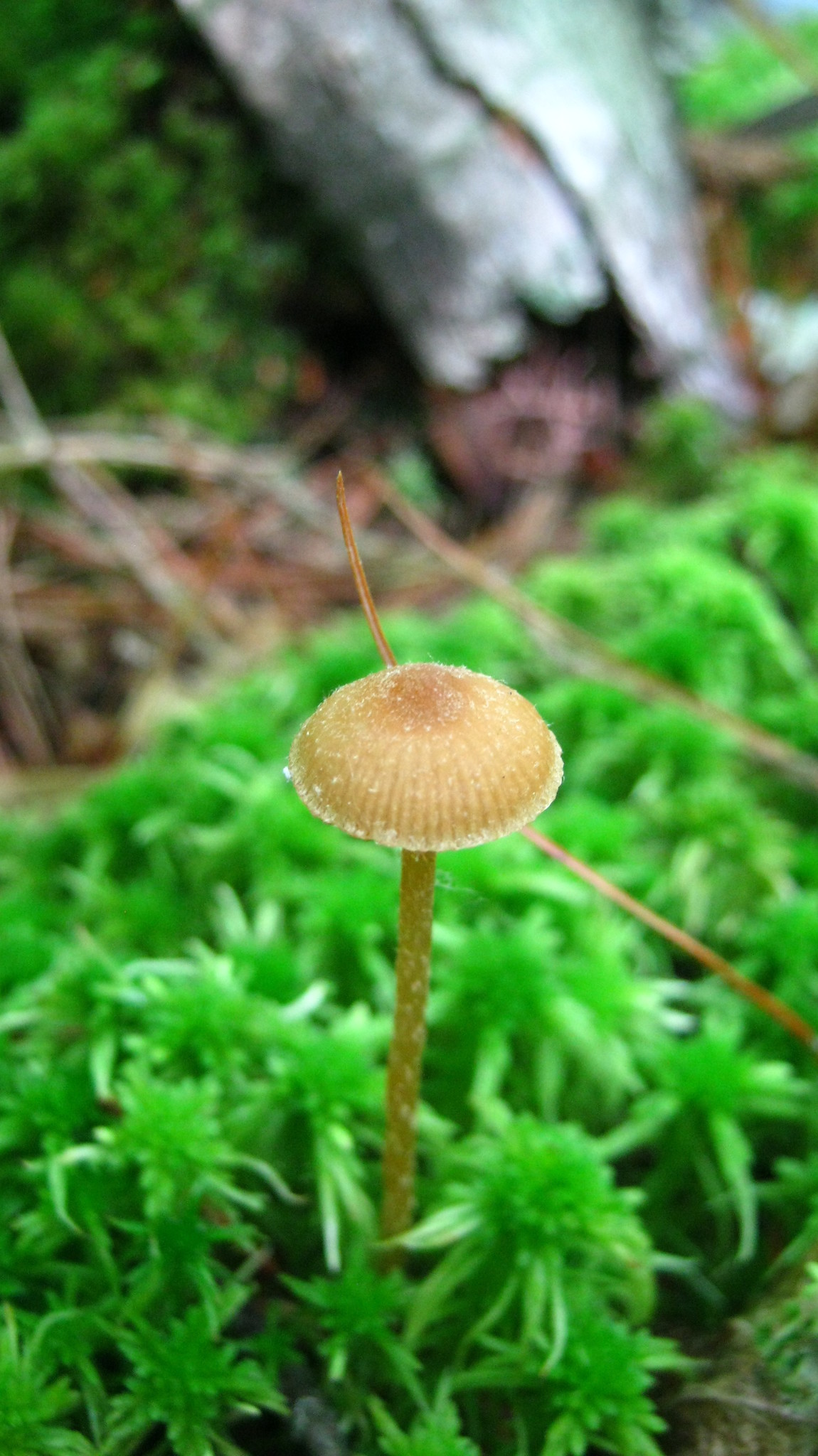
Galerina paludosa, commonly known as the Bog Bell or Marsh Galerina, is a small, delicate, and highly toxic mushroom belonging to the family Hymenogastraceae. It is characterized by its hygrophanous cap, typically found in sphagnum bogs and other wet, mossy habitats. This species is saprobic, deriving nutrients from decaying organic matter in its specialized wetland environment. Its unassuming appearance belies its deadly toxicity, as it contains amatoxins, the same potent poisons found in the Death Cap (Amanita phalloides).
How to Identify
- Cap
- 1-3 cm in diameter, initially conical or bell-shaped, expanding to convex or broadly umbonate with age. The surface is smooth, hygrophanous, meaning it changes color depending on moisture content. When moist, it is typically reddish-brown to yellowish-brown, often with striations visible through to the center. When dry, it fades to a pale buff or yellowish-tan. The margin is often translucent-striate when moist.
- Gills
- Adnate to adnexed, sometimes with a slight decurrent tooth. They are moderately crowded, narrow, and initially pale yellowish-brown, becoming rusty brown to cinnamon brown with age due to the maturing spores. There are often lamellulae (short gills) present.
- Stem
- 3-10 cm long and 1-3 mm thick, slender, cylindrical, and often slightly enlarged at the base. It is concolorous with the cap or slightly paler, often darker towards the base. The surface is smooth or finely pruinose (powdery) at the apex, becoming fibrillose (with fine fibers) towards the base. A distinctive feature is the presence of a persistent, membranous, white to pale yellowish ring (annulus) located in the upper part of the stem. Below the ring, the stem is often covered with fine, white fibrils or a white sheath, especially when young, which can be remnants of a partial veil. The base is often surrounded by white mycelial threads.
- Flesh
- Thin, fragile, and concolorous with the cap surface, or slightly paler. It does not change color when bruised or cut.
- Fruiting body
- Small, fragile, and typically solitary to scattered. The overall appearance is slender and delicate.
- Habitat
- Typically found growing gregariously or scattered among Sphagnum moss in bogs, fens, marshes, and other wet, acidic environments. It is a saprobic species, decomposing organic matter in these specialized habitats.
Key Facts
- Cap surfaces: Smooth, hygrophanous, often striate when moist.
- Growth Form: Solitary to gregarious.
- Spore Print: Rusty brown to cinnamon brown.
- Body color: Reddish-brown to yellowish-brown (moist), fading to pale buff (dry).
- Odor: Indistinct or mildly fungoid.
- Flesh bruises: Does not bruise.
- Height: 3-10 cm
- Cap Diameter: 1-3 cm
- Nutrient gathering: Saprobic
Toxic
DeadlyGalerina paludosa is highly toxic and potentially deadly if ingested. It contains amatoxins, which are cyclic peptides that inhibit RNA polymerase II, leading to severe liver and kidney damage. Symptoms typically appear 6-24 hours after ingestion and include severe gastrointestinal distress (nausea, vomiting, diarrhea, abdominal pain), followed by a false recovery period, and then progressive liver and kidney failure, which can be fatal if not treated promptly and aggressively.
Quick Check
- Odor: Mildly fungoid or indistinct, not distinctive.
- Fruiting: Late spring to late autumn, peaking in summer and early autumn.
- Substrate: Sphagnum moss, decaying organic matter in bogs and wet habitats.
Where to Find
Sphagnum Bogs
The primary habitat for Galerina paludosa, where it grows directly from or among Sphagnum moss.
Fens and Marshes
Other wet, acidic wetland environments with abundant mosses and decaying organic matter.
Wet Coniferous Forests
Occasionally found in very wet areas within coniferous forests, particularly where Sphagnum moss is present.
Finding Tips
Look for Sphagnum Moss
Always search in areas dominated by Sphagnum moss, as this is its preferred substrate.
Check Wet Areas
Focus on the wettest parts of bogs and marshes, often near standing water or saturated ground.
Observe Small Details
Due to its small size, careful observation of the stem ring and gill color is crucial for identification.
Similar Species
Funeral Bell
Galerina
Also known as: Deadly Galerina
Autumn Skullcap
Galerina
Also known as: Galerina marginata
Conocybe
Conocybe
Also known as: Conecap
Mycena
Mycena
Also known as: Bonnet mushroom
Scientific Classification
- Phylum
- Basidiomycota
- Class
- Agaricomycetes
- Order
- Agaricales
- Family
- Hymenogastraceae
- Genus
- Galerina
Explore Bog Bell
Identify mushrooms anywhere
Free on iOS, Android, and Web. Photo identification, full database, and your personal collection.