
How to identify Dog Vomit Slime Mold
Fuligo septica
Got a photo? Identify mushrooms instantly with the Mushby app
Open the appTo correctly identify Dog Vomit Slime Mold (Fuligo septica), check each of these features in order. Misidentification is the most common cause of mushroom poisoning, so cross-reference multiple sources.
Step-by-step identification
- 1
Cap
Shape, color, surface texture, and diameter.
Not applicable; this organism does not form a cap like traditional mushrooms. The entire structure is the spore-producing body (aethalium).
- 2
Gills
Attachment to stem, color, and spacing.
Not applicable; this organism does not produce gills.
- 3
Stem
Length, shape, surface, and any ring.
Not applicable; this organism does not produce a stem.
- 4
Flesh
Color, texture, and bruising reaction.
The internal consistency is initially soft and moist, often described as custardy or foamy. As it dries, it becomes friable and powdery due to the mature spores and capillitial threads.
- 5
Fruiting body
Overall growth pattern.
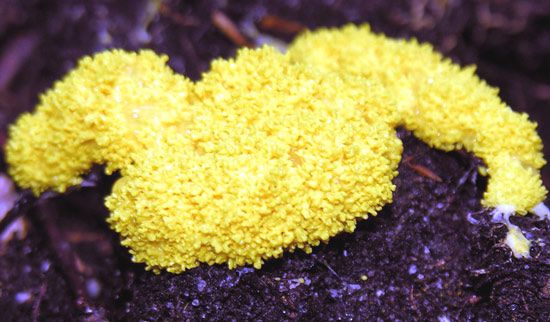
Initially, it appears as a bright yellow, creamy, or sometimes white, amorphous, cushion-like to pulvinate (cushion-shaped) mass, resembling foamy or vomited material. It can be smooth or wrinkled. As it matures, it often calcifies, becoming brittle and drying to a more crusty, off-white, yellowish, or even brownish-purple effusiveness, eventually releasing dark spores. The entire fruiting body, technically called an aethalium, can range from a few centimeters to over 20-30 cm in greatest dimension and be 1-3 cm thick.
- 6
Habitat
Where it grows and on what substrate.
Typically found on decaying wood, bark mulch, wood chips, leaf litter, and occasionally on living plants or grass. It thrives in moist, shaded environments, often after periods of rain.
Key Facts
- Cap surfaces
- Not applicable
- Growth Form
- Amorphous, cushion-like, pulvinate, effused
- Spore Print
- Purplish-black to black (due to the mass of dark spores)
- Body color
- Bright sulfur yellow, creamy white, sometimes orange or pinkish, drying to off-white, light yellow, or brownish-purple.
- Odor
- Indeterminate to slightly musty or ammoniacal.
- Flesh bruises
- Not applicable; it does not bruise in the manner of a mushroom. The color may change upon drying or disturbance as it matures and calcifies.
- Height
- 1-3 cm (thickness)
- Cap Diameter
- Typically 2-30 cm (greatest dimension)
Fruit body characteristics
- Gill attachment: Not applicable
- Stem shape: Not applicable
- Stem surface: Not applicable
- Ring: Not applicable
- Stem cross-section: Not applicable
Explore Dog Vomit Slime Mold
Identify mushrooms anywhere
Free on iOS, Android, and Web. Photo identification, full database, and your personal collection.