
Got a photo? Identify mushrooms instantly with the Mushby app
Open the appDescription
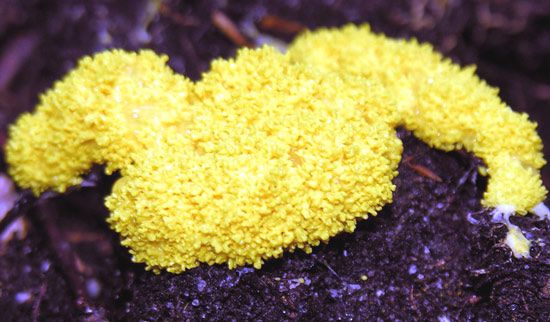
Fuligo septica is a widely distributed species of myxomycetes, a group of organisms commonly known as 'slime molds'. Despite its common name and appearance, it is not a fungus, but rather a protist belonging to the class Myxogastria. It typically appears as a bright yellow or creamy white, amorphous mass on decaying wood and other organic matter. This organism undergoes a complex life cycle involving a 'plasmodium' stage, a single-celled, multinucleate mass that can move and engulf food particles, and a 'fruiting body' stage where it develops into the more prominent, spore-producing structure.
How to Identify
- Cap
- Not applicable; this organism does not form a cap like traditional mushrooms. The entire structure is the spore-producing body (aethalium).
- Gills
- Not applicable; this organism does not produce gills.
- Stem
- Not applicable; this organism does not produce a stem.
- Flesh
- The internal consistency is initially soft and moist, often described as custardy or foamy. As it dries, it becomes friable and powdery due to the mature spores and capillitial threads.
- Fruiting body
- Initially, it appears as a bright yellow, creamy, or sometimes white, amorphous, cushion-like to pulvinate (cushion-shaped) mass, resembling foamy or vomited material. It can be smooth or wrinkled. As it matures, it often calcifies, becoming brittle and drying to a more crusty, off-white, yellowish, or even brownish-purple effusiveness, eventually releasing dark spores. The entire fruiting body, technically called an aethalium, can range from a few centimeters to over 20-30 cm in greatest dimension and be 1-3 cm thick.
- Habitat
- Typically found on decaying wood, bark mulch, wood chips, leaf litter, and occasionally on living plants or grass. It thrives in moist, shaded environments, often after periods of rain.
Key Facts
- Cap surfaces: Not applicable
- Growth Form: Amorphous, cushion-like, pulvinate, effused
- Spore Print: Purplish-black to black (due to the mass of dark spores)
- Body color: Bright sulfur yellow, creamy white, sometimes orange or pinkish, drying to off-white, light yellow, or brownish-purple.
- Odor: Indeterminate to slightly musty or ammoniacal.
- Flesh bruises: Not applicable; it does not bruise in the manner of a mushroom. The color may change upon drying or disturbance as it matures and calcifies.
- Height: 1-3 cm (thickness)
- Cap Diameter: Typically 2-30 cm (greatest dimension)
- Nutrient gathering: Phagotrophic (engulfs bacteria, spores, and other microscopic particles)
Safe
SafeFuligo septica is generally considered non-toxic to humans and animals. However, it is not edible due to its unpleasant texture and taste. Some indigenous cultures in Mexico (specifically the Mixtec people) consume the plasmodial stage, fried 'like scrambled eggs', giving rise to one of its common names, 'caca de luna' or 'moon excrement'. Foraging for consumption is not recommended for individuals unfamiliar with its precise identification and traditional preparation methods, due to the general risks associated with consuming wild organisms and potential misidentification.
Quick Check
- Odor: Indeterminate; often described as earthy or musty, sometimes slightly chemical or ammoniacal, but not distinctive or pleasant.
- Fruiting: Aethalium (a cushion-like, spore-bearing structure)
- Substrate: Decaying wood, bark, leaf litter, wood chips, plant debris
Where to Find
Decaying wood in forests
Commonly found on logs, stumps, and fallen branches in both deciduous and coniferous forests.
Mulched garden beds
Frequently appears in gardens that use wood chip mulch, especially after rain.
Leaf litter
Can be observed growing on thick accumulations of decaying leaves on the forest floor.
Finding Tips
Look after rain
The plasmodial stage and subsequent fruiting body formation are highly dependent on moisture. Therefore, it is most likely to be observed after rain or in consistently damp conditions.
Check shaded, undisturbed areas
It prefers shaded, humid environments away from direct sunlight, such as under dense foliage or in sheltered spots.
Examine decaying organic matter
Focus your search on rotting logs, fallen branches, wood chip paths, and leaf piles.
Similar Species
Physarum polycephalum
Slime Mold
Also known as: Many-headed Slime
Enteridium lycopodii
Slime Mold
Also known as: False Puffball Slime
Scientific Classification
- Phylum
- Mycetozoa (or Amoebozoa, depending on current taxonomic view)
- Class
- Myxogastria
- Order
- Physarales
- Family
- Physaraceae
- Genus
- Fuligo
Storage Information
- Max Temperature: N/A
- Freezing duration: N/A
- Min Temperature: N/A
- Refrigeration: N/A
How to Clean
Not applicable, as this is not a culinary species. If encountered in a garden where removal is desired, simply rake it away or allow it to dry out naturally, after which it will turn into a harmless, powdery mass.
Explore Dog Vomit Slime Mold
Identify mushrooms anywhere
Free on iOS, Android, and Web. Photo identification, full database, and your personal collection.