
Got a photo? Identify mushrooms instantly with the Mushby app
Open the appDescription
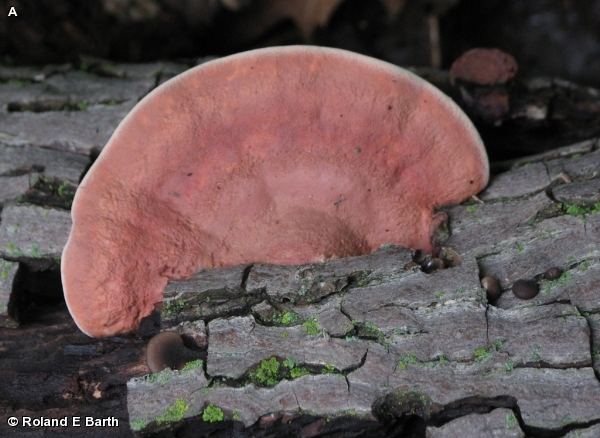
Fomitopsis rosea, commonly known as the Rosy Polypore, is a perennial, sessile polypore fungus characterized by its distinctive pinkish to reddish-brown pore surface and often rosy-tinged upper surface. It is a white-rot fungus, playing a crucial ecological role in the decomposition of coniferous wood, particularly spruce and fir. This species is known for its hard, woody texture and typically grows in a shelf-like or hoof-shaped manner on dead or dying conifers.
How to Identify
- Cap
- The upper surface (pileus) is hard, woody, and often covered with a thin, resinous crust in older specimens. Coloration varies from pinkish-brown to reddish-brown, sometimes with grayish or blackish zones, especially towards the base. The margin is usually thick, rounded, and often lighter in color, sometimes with a distinct rosy hue.
- Gills
- Not gilled. The hymenophore consists of a pore surface. The pore surface is a distinctive rosy pink to reddish-brown, becoming duller with age. Pores are small, 3-5 per millimeter, circular to angular, and the tubes are stratified in older specimens, matching the color of the pore surface.
- Stem
- Absent (sessile). The fruiting body is directly attached to the substrate.
- Flesh
- The context (flesh) is tough, corky to woody, and pale pinkish-brown to reddish-brown, often with a faint, pleasant odor when fresh. It does not change color when bruised or cut.
- Fruiting body
- Perennial, sessile, hoof-shaped to shelf-like, often imbricate (overlapping). Typically 2-15 cm wide, 2-10 cm deep, and 1-6 cm thick. The upper surface is concentrically zoned, often with a dull, finely tomentose to glabrous texture, ranging in color from pinkish-brown, reddish-brown, to grayish-brown, often with a paler margin. The margin is typically rounded and can be pinkish or whitish when actively growing.
- Habitat
- Saprobic on dead or dying coniferous wood, particularly spruce (Picea spp.), fir (Abies spp.), and hemlock (Tsuga spp.). Less commonly found on hardwoods. Causes a brown rot.
Key Facts
- Cap surfaces: Dull, finely tomentose to glabrous, concentrically zoned, often with a thin resinous crust in older specimens.
- Growth Form: Sessile, solitary or imbricate, hoof-shaped to shelf-like.
- Spore Print: White
- Body color: Upper surface: pinkish-brown, reddish-brown, grayish-brown. Pore surface: rosy pink to reddish-brown.
- Odor: Faintly pleasant.
- Flesh bruises: Does not bruise.
- Height: Not applicable (sessile).
- Cap Diameter: 2-15 cm wide, 2-10 cm deep, 1-6 cm thick.
- Nutrient gathering: Saprobic (decomposer of dead wood).
Safe
SafeFomitopsis rosea is considered inedible due to its extremely tough, woody texture. It is not known to be toxic, but it is not consumed.
Quick Check
- Odor: Faintly pleasant, sometimes described as slightly acidic or mushroomy.
- Fruiting: Perennial, sessile, hoof-shaped to shelf-like.
- Substrate: Dead or dying coniferous wood (spruce, fir, hemlock).
Where to Find
Coniferous Forests
Common in boreal and temperate coniferous forests across North America, Europe, and Asia.
Dead or Dying Conifers
Look for it on fallen logs, stumps, and standing dead trees of spruce, fir, and hemlock.
Finding Tips
Substrate Specificity
Focus your search on coniferous wood, as Fomitopsis rosea rarely grows on hardwoods.
Perennial Nature
Being perennial, specimens can be found year-round, but fresh growth and vibrant colors are most apparent during warmer, wetter months.
Distinctive Color
The rosy pink to reddish-brown pore surface is a key identifying feature, especially in fresh specimens.
Similar Species
Red-belted Conk
Fomitopsis
Also known as: Red-banded Polypore, Fomitopsis pinicola
Cinnabar Polypore
Pycnoporus
Also known as: Pycnoporus cinnabarinus
Artist's Conk
Ganoderma
Also known as: Ganoderma applanatum
Scientific Classification
- Phylum
- Basidiomycota
- Class
- Agaricomycetes
- Order
- Polyporales
- Family
- Fomitopsidaceae
- Genus
- Fomitopsis
Storage Information
- Max Temperature: Not applicable
- Freezing duration: Not applicable
- Min Temperature: Not applicable
- Refrigeration: Not applicable
How to Clean
Not applicable, as this mushroom is not edible. If collected for study or display, simply brush off any loose debris with a soft brush.
Explore Rosy Polypore
Identify mushrooms anywhere
Free on iOS, Android, and Web. Photo identification, full database, and your personal collection.