
Got a photo? Identify mushrooms instantly with the Mushby app
Open the appDescription
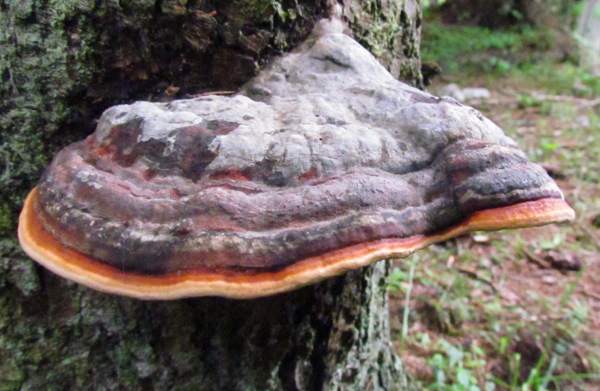
Fomitopsis pinicola, commonly known as the Red-belt Conk, is a wood-decaying bracket fungus found on conifer and occasionally hardwood trees. It plays a significant role in forest ecosystems by decomposing deadwood, but can also be a pathogen on living trees. The fungus earns its common name from the characteristic reddish-brown band that often borders its margin.
How to Identify
- Cap
- The upper surface is smooth to bumpy, with concentric furrows and ridges. The color varies from pale yellow or orange when young to reddish-brown, dark brown, or almost black with age. A characteristic reddish-brown band is often present along the outer margin, especially in actively growing specimens. The margin is typically rounded and lighter in color.
- Gills
- Absent. Fomitopsis pinicola is a polypore, meaning it has pores instead of gills. The pore surface is whitish to yellowish, bruising brown when handled. Pores are small and round, numbering 4-6 per millimeter.
- Stem
- Absent. The fruit body is sessile, attaching directly to the wood.
- Flesh
- The flesh (context) is yellowish to light brown, corky to woody, and lacks a distinctive odor or taste.
- Fruiting body
- The fruit body is a perennial, shelf-like bracket, typically 5-40 cm wide, 3-20 cm deep, and 2-10 cm thick. It is hard and woody.
- Habitat
- Primarily found on dead or dying coniferous wood, especially pine, spruce, and fir. It can also occur on hardwoods. Fomitopsis pinicola causes a brown rot, weakening the wood. It's found in forests throughout the northern hemisphere.
Key Facts
- Cap surfaces: Smooth to bumpy, with concentric furrows and ridges.
- Growth Form: Bracket/Shelf
- Spore Print: White to yellowish.
- Body color: Variable: Pale yellow/orange when young to reddish-brown, dark brown, or almost black with age.
- Odor: Indistinct or slightly fungal.
- Flesh bruises: Pore surface bruises brown when handled.
- Height: 2-10 cm thick
- Cap Diameter: 5-40 cm wide, 3-20 cm deep
- Nutrient gathering: Saprobic (decomposer) and weakly parasitic.
Safe
SafeFomitopsis pinicola is generally considered non-toxic, but it is not typically consumed due to its extremely tough and woody texture. There are no known reports of poisoning from this fungus. However, due to its toughness, it is not digestible and may cause gastrointestinal upset in some individuals if ingested in significant quantities.
Quick Check
- Odor: Indistinct or slightly fungal.
- Fruiting: Perennial, shelf-like conk.
- Substrate: Dead or dying coniferous wood, occasionally hardwoods.
Where to Find
Coniferous Forests
Red-belt Conks are most commonly found in coniferous forests, where they grow on dead or dying conifer trees like pine, spruce, and fir. Look for them on fallen logs, standing dead trees (snags), and stumps.
Mixed Forests
While less common, Red-belt Conks can also be found in mixed forests that contain both coniferous and deciduous trees. In these environments, they may grow on either type of wood, though conifers are still the preferred substrate.
Disturbed Areas
They can also be found in disturbed areas within forests such as forest clearings, logging sites, or areas affected by windthrow or insect infestations, as these areas often have abundant deadwood.
Finding Tips
Look for Brown Rot
Red-belt Conks cause a brown rot, which means the wood they decay becomes reddish-brown, dry, and crumbly. This is a good indication that the fungus may be present in the area.
Check Undersides of Logs
Examine the undersides of fallen logs, as conks often start growing in these sheltered locations.
Observe Seasonally
While Red-belt Conks are perennial and can be found year-round, they are often more conspicuous during periods of higher moisture, such as spring and fall.
Similar Species
Ganoderma applanatum
Bracket fungus
Also known as: Artist's Conk
Ganoderma tsugae
Bracket fungus
Also known as: Hemlock Varnish Shelf
Fomes fomentarius
Bracket fungus
Also known as: Hoof Fungus
Scientific Classification
- Phylum
- Basidiomycota
- Class
- Agaricomycetes
- Order
- Polyporales
- Family
- Fomitopsidaceae
- Genus
- Fomitopsis
Storage Information
- Max Temperature: N/A (Typically not stored for consumption)
- Freezing duration: N/A
- Min Temperature: N/A
- Refrigeration: N/A
How to Clean
The Red-belt Conk is generally not consumed due to its extremely tough and woody texture. However, if considering it for any potential use (e.g., research, dyeing), cleaning would involve removing any debris such as bark, dirt, or insects with a stiff brush. Rinsing with water should be minimized.
Explore Red-belt Conk
Identify mushrooms anywhere
Free on iOS, Android, and Web. Photo identification, full database, and your personal collection.