
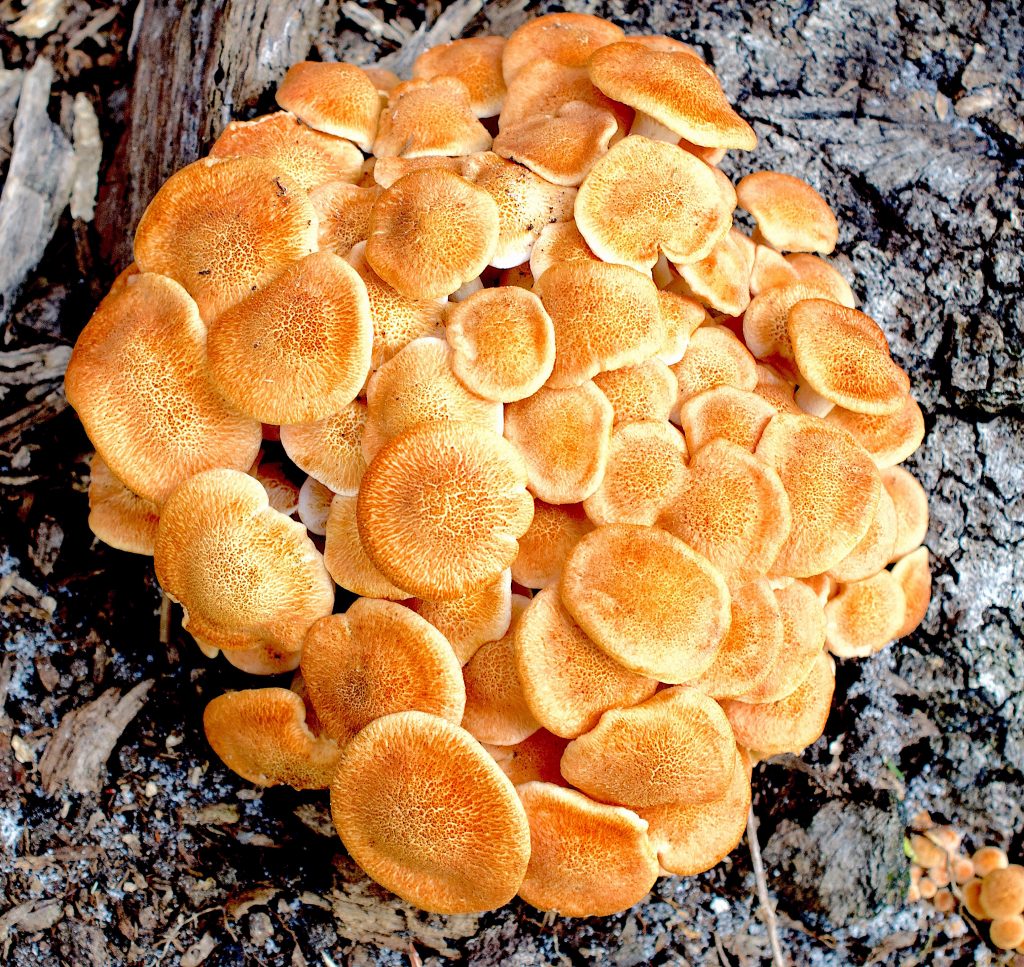
Where does Ringless Honey Mushroom grow?
Desarmillaria tabescens
Got a photo? Identify mushrooms instantly with the Mushby app
Open the appRingless Honey Mushroom grows in specific habitats. Knowing where to look and when is the difference between an empty basket and a successful forage.
Where to find Ringless Honey Mushroom
Eastern North America
Widely distributed throughout the eastern United States and Canada, particularly common in hardwood forests.
Southeastern United States
Especially prevalent in the warmer climates of the southeastern U.S., where it can fruit prolifically.
Europe
Also found in parts of Europe, though less common than in North America, often under different scientific names in older literature.
Foraging tips
- Look for Clusters. Desarmillaria tabescens almost always grows in dense clusters at the base of trees or on stumps. Solitary specimens are rare.
- Check for Absence of Ring. The most critical identification feature is the complete absence of a ring (annulus) on the stem. This immediately rules out most Armillaria species.
- Examine Substrate. Always check if the mushrooms are growing on wood (living or dead), as this is their preferred substrate. They are not typically found growing directly from the ground unless there is buried wood.
- Observe Cap Scales. Young specimens often have small, dark, appressed scales on the cap, which can be a helpful indicator, though they may fade with age.
Quick Check
- Substrate:
- Deciduous wood (living or dead), stumps, buried roots.
- Fruiting:
- Late summer to late autumn, sometimes into early winter in warmer climates.
- Odor:
- Mild, mushroomy, sometimes slightly sweet or fruity.
Explore Ringless Honey Mushroom
Identify mushrooms anywhere
Free on iOS, Android, and Web. Photo identification, full database, and your personal collection.