
Got a photo? Identify mushrooms instantly with the Mushby app
Open the appDescription
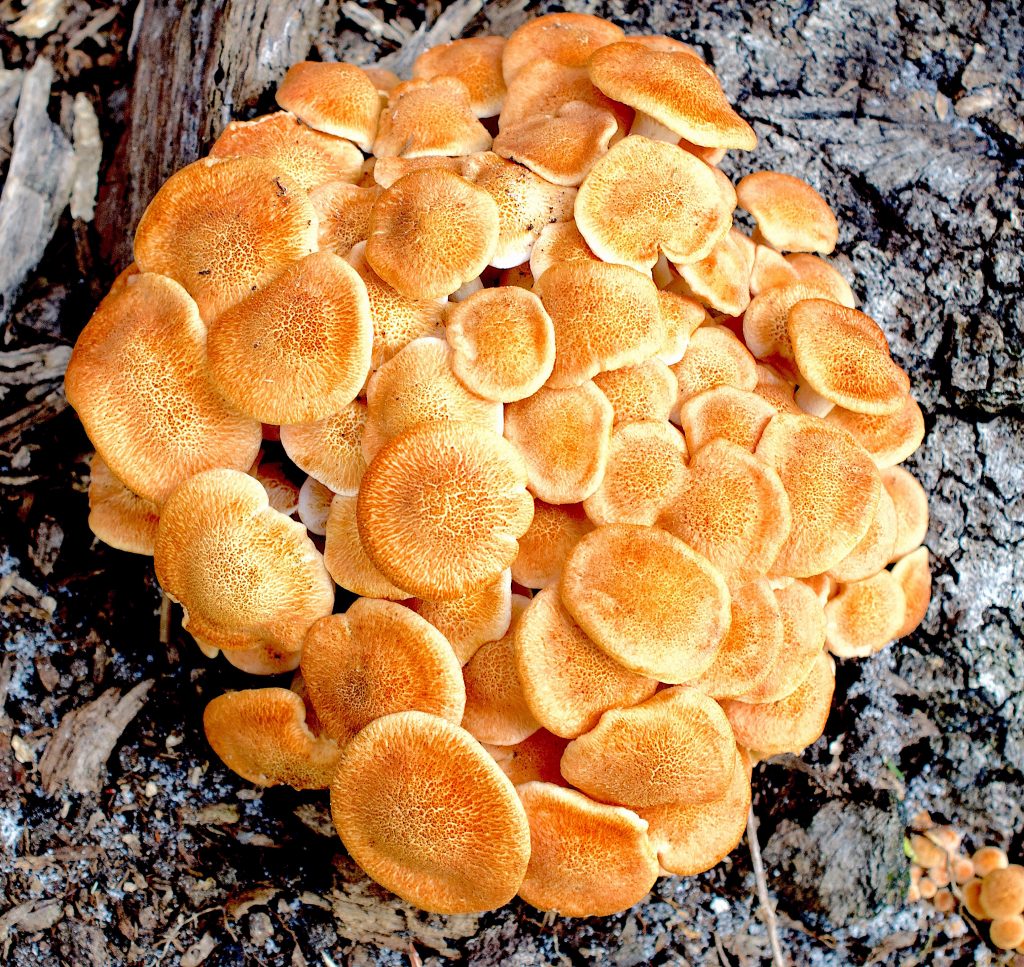
Desarmillaria tabescens, commonly known as the Ringless Honey Mushroom, is a widespread and ecologically significant fungus. Unlike its close relatives in the genus Armillaria, it lacks an annulus (ring) on its stipe, a key distinguishing feature. It is a parasitic and saprobic species, often found growing in dense clusters at the base of trees or on decaying wood, causing white rot. While considered edible by many, proper identification and cooking are crucial due to potential mild gastrointestinal upset in some individuals and the presence of toxic look-alikes.
How to Identify
- Cap
- Caps are 2-10 cm (0.8-4 inches) in diameter, convex to broadly convex, flattening with age, often with a central umbo. The surface is dry, typically covered with small, dark, appressed scales, especially when young, which may disappear with age or rain. Color varies from honey-yellow to reddish-brown, often darker towards the center.
- Gills
- Adnate to subdecurrent, crowded, and whitish to cream-colored when young, becoming yellowish to pinkish-buff with age, sometimes developing rusty spots. They are not bioluminescent.
- Stem
- Stems are 5-15 cm (2-6 inches) long and 0.5-1.5 cm (0.2-0.6 inches) thick, tapering slightly towards the base or sometimes swollen. They are fibrous, tough, and concolorous with the cap or paler, often darkening towards the base. Crucially, there is no annulus (ring) present, which distinguishes it from Armillaria species. The base of the stem may be slightly fuzzy or hairy.
- Flesh
- White to pale yellowish, firm, and relatively thin. It does not change color when cut or bruised.
- Fruiting body
- Typically grows in dense clusters (cespitose) at the base of deciduous trees, on stumps, or from buried wood. The overall color ranges from yellowish-brown to reddish-brown.
- Habitat
- Saprobic and parasitic on the roots and bases of various deciduous trees, occasionally conifers. It causes a white rot. Found in woodlands, parks, and gardens.
Key Facts
- Cap surfaces: Dry, scaly (especially when young), smooth with age.
- Growth Form: Cespitose (clustered).
- Spore Print: White to cream.
- Body color: Yellowish-brown to reddish-brown.
- Odor: Mild, pleasant, mushroomy.
- Flesh bruises: No color change.
- Height: 5-15 cm (2-6 inches).
- Cap Diameter: 2-10 cm (0.8-4 inches).
- Nutrient gathering: Parasitic and Saprobic.
Safe
Mild ToxicityDesarmillaria tabescens is generally considered edible when thoroughly cooked. However, it can cause mild gastrointestinal upset (nausea, vomiting, diarrhea) in some sensitive individuals, especially if consumed raw, undercooked, or in large quantities. It is crucial to cook them well. There are also several toxic look-alikes, such as the Jack O'Lantern mushroom (Omphalotus illudens), which can cause severe gastrointestinal distress. Always be 100% certain of your identification.
Quick Check
- Odor: Mild, mushroomy, sometimes slightly sweet or fruity.
- Fruiting: Late summer to late autumn, sometimes into early winter in warmer climates.
- Substrate: Deciduous wood (living or dead), stumps, buried roots.
Where to Find
Eastern North America
Widely distributed throughout the eastern United States and Canada, particularly common in hardwood forests.
Southeastern United States
Especially prevalent in the warmer climates of the southeastern U.S., where it can fruit prolifically.
Europe
Also found in parts of Europe, though less common than in North America, often under different scientific names in older literature.
Finding Tips
Look for Clusters
Desarmillaria tabescens almost always grows in dense clusters at the base of trees or on stumps. Solitary specimens are rare.
Check for Absence of Ring
The most critical identification feature is the complete absence of a ring (annulus) on the stem. This immediately rules out most Armillaria species.
Examine Substrate
Always check if the mushrooms are growing on wood (living or dead), as this is their preferred substrate. They are not typically found growing directly from the ground unless there is buried wood.
Observe Cap Scales
Young specimens often have small, dark, appressed scales on the cap, which can be a helpful indicator, though they may fade with age.
Similar Species
Honey Mushroom
Armillaria mellea
Also known as: True Honey Mushroom
Jack O'Lantern Mushroom
Omphalotus illudens
Also known as: Eastern Jack O'Lantern
Sulphur Tuft
Hypholoma fasciculare
Also known as: Clustered Woodlover
Scientific Classification
- Phylum
- Basidiomycota
- Class
- Agaricomycetes
- Order
- Agaricales
- Family
- Physalacriaceae
- Genus
- Desarmillaria
Storage Information
- Max Temperature: 4°C
- Freezing duration: 6 months
- Min Temperature: 0°C
- Refrigeration: 5-7 days
How to Clean
Brush off any debris with a soft brush or damp cloth. Avoid washing them under running water as they can become waterlogged. Trim off any tough or damaged parts of the stem.
Explore Ringless Honey Mushroom
Identify mushrooms anywhere
Free on iOS, Android, and Web. Photo identification, full database, and your personal collection.