Got a photo? Identify mushrooms instantly with the Mushby app
Open the appDescription
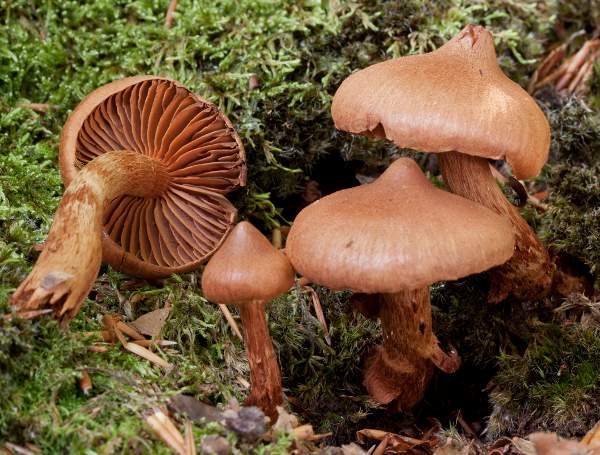
Cortinarius mushrooms, also known as Webcaps, are a large genus of mushrooms that are found in a wide variety of habitats around the world. They are known for their distinctive web-like veil, which covers the gills in young specimens. Cortinarius mushrooms vary in size and color, but most have a cap that is convex or bell-shaped. The gills are usually close together and can range in color from white to brown to reddish. The stem is often slender and may be covered in a thin, web-like veil. Many Cortinarius mushrooms are edible, but some are poisonous.
How to Identify
- Cap
- The cap is usually convex or bell-shaped and can range in color from white to brown to reddish. It is often covered in a thin, web-like veil, which is called a cortina.
- Gills
- The gills are usually close together and can range in color from white to brown to reddish. They are often attached to the stem.
- Stem
- The stem is often slender and may be covered in a thin, web-like veil. The stem can be cylindrical or slightly tapered and can range in color from white to brown to reddish.
- Flesh
- The flesh of Cortinarius mushrooms is often white or pale yellow. It can be firm or brittle.
- Fruiting body
- The fruiting body is usually a medium-sized mushroom with a cap that is convex or bell-shaped. The gills are usually close together and can range in color from white to brown to reddish. The stem is often slender and may be covered in a thin, web-like veil.
- Habitat
- Cortinarius mushrooms grow in a variety of habitats, including forests, meadows, and fields. They are often found in association with trees, such as pines, oaks, and birches.
Key Facts
- Cap surfaces: Dry, Smooth, Sticky, Slimy, Viscid
- Growth Form: Solitary, Clumps, Fairy rings
- Spore Print: Rust, Brown, Purple
- Body color: Brown, Red, White, Yellow, Purple, Orange
- Odor: Musty, Earthy, Spicy
- Flesh bruises: Can bruise, Can turn blue or green
- Height: 2-10 cm
- Cap Diameter: 2-10 cm
- Nutrient gathering: Saprobic
Toxic
Severe ToxicityMany Cortinarius mushrooms are toxic and can cause severe gastrointestinal distress, including vomiting, diarrhea, and abdominal cramps.
Quick Check
- Odor: Earthy, Spicy, Musty
- Fruiting: On the ground
- Substrate: Wood, Soil, Leaves
Where to Find
Woods & Forests
Cortinarius mushrooms grow in a variety of habitats, including forests, meadows, and fields. They are often found in association with trees, such as pines, oaks, and birches.
Finding Tips
Identification Tips
Cortinarius mushrooms can be difficult to identify, as there are many species that look similar. It is important to consult a field guide or an expert before eating any Cortinarius mushroom.
Similar Species
Galerina
Galerina
Also known as: Galerina, Galerina
Pholiota
Pholiota
Also known as: Pholiota, Pholiota
Gymnopilus
Gymnopilus
Also known as: Gymnopilus, Gymnopilus
Scientific Classification
- Phylum
- Basidiomycota
- Class
- Agaricomycetes
- Order
- Agaricales
- Family
- Cortinariaceae
- Genus
- Cortinarius
Explore Cortinarius
Identify mushrooms anywhere
Free on iOS, Android, and Web. Photo identification, full database, and your personal collection.