
How to identify Chanterelle
Cantharellus
Got a photo? Identify mushrooms instantly with the Mushby app
Open the appTo correctly identify Chanterelle (Cantharellus), check each of these features in order. Misidentification is the most common cause of mushroom poisoning, so cross-reference multiple sources.
Step-by-step identification
- 1
Cap
Shape, color, surface texture, and diameter.
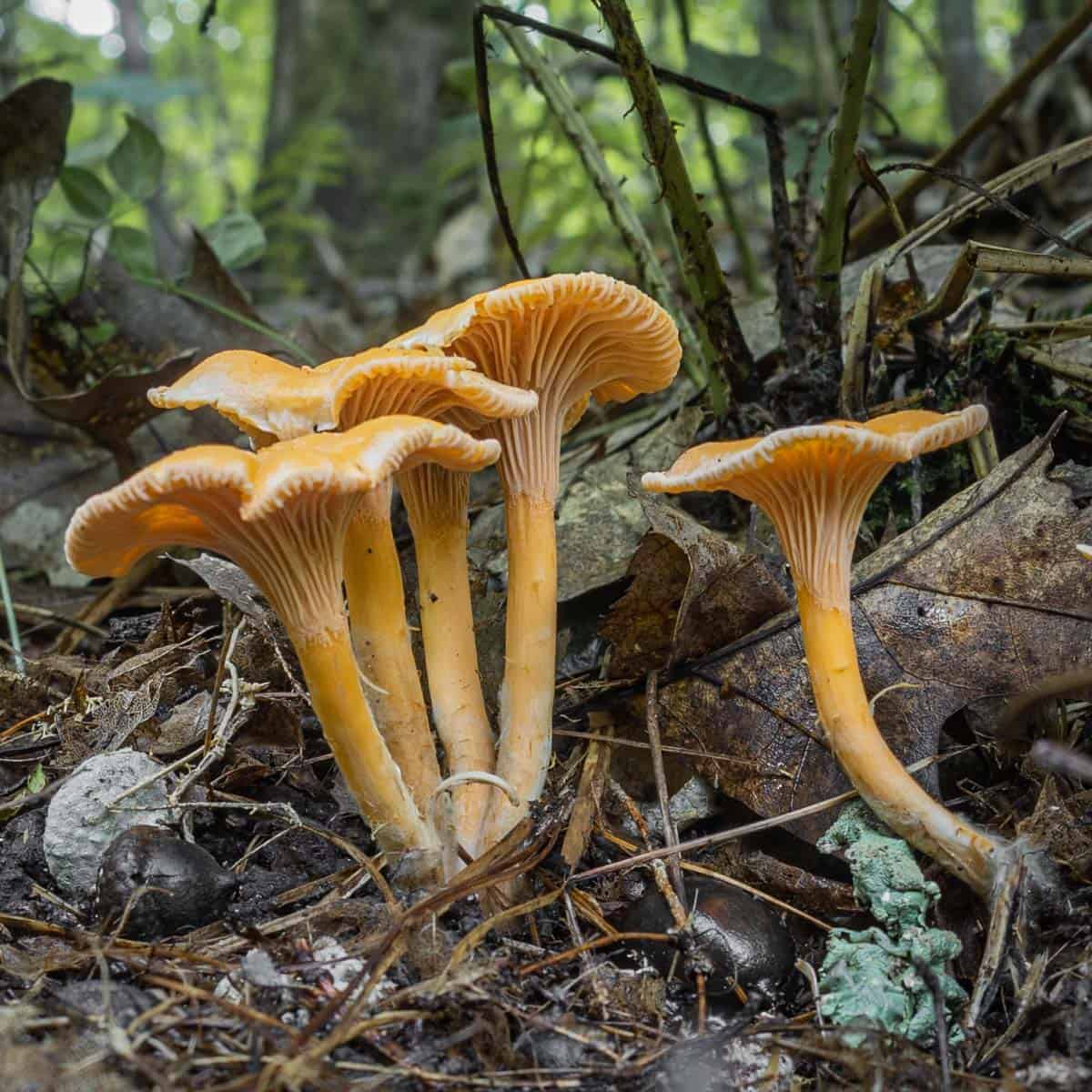
Caps range from 2-10 cm (0.8-4 inches) in diameter, initially convex with an inrolled margin, becoming flat, then depressed to deeply infundibuliform (funnel-shaped) with age. The margin is often wavy, lobed, or irregular. The color is typically golden-yellow to orange, sometimes paler yellow or whitish, and can be smooth or slightly scaly.
- 2
Gills
Attachment to stem, color, and spacing.
Chanterelles do not have true gills. Instead, they possess blunt, vein-like, often forked ridges or folds that run down the stem (decurrent). These false gills are the same color as or slightly paler than the cap and are not easily separated from the cap flesh.
- 3
Stem
Length, shape, surface, and any ring.
The stem is solid, tapering downwards, and often confluent with the cap, meaning there is no clear distinction between the cap and stem. It is typically 2-8 cm (0.8-3 inches) long and 0.5-2 cm (0.2-0.8 inches) thick, colored similarly to the cap, and smooth.
- 4
Flesh
Color, texture, and bruising reaction.
The flesh is firm, thick, and whitish to pale yellow, often bruising slightly reddish-orange in some species. It has a distinctive fruity aroma, often compared to apricots, and a mild to peppery taste.
- 5
Fruiting body
Overall growth pattern.
The fruiting body is typically funnel-shaped or vase-shaped, often irregular, with a wavy or lobed margin. It is fleshy and firm.
- 6
Habitat
Where it grows and on what substrate.
Chanterelles are mycorrhizal, forming symbiotic relationships with the roots of various trees, including oaks, beeches, birches, pines, and spruces. They typically grow on the ground in mossy areas, often in mixed deciduous and coniferous forests.
Key Facts
- Cap surfaces
- Smooth to slightly scaly
- Growth Form
- Solitary to scattered or in groups
- Spore Print
- White to pale yellow or cream
- Body color
- Golden-yellow to orange, sometimes paler
- Odor
- Distinctive fruity, apricot-like
- Flesh bruises
- Does not bruise significantly, sometimes slightly reddish-orange in some species
- Height
- 2-8 cm (0.8-3 inches)
- Cap Diameter
- 2-10 cm (0.8-4 inches)
Fruit body characteristics
- Gill attachment: Decurrent (false gills run down the stem)
- Stem shape: Tapering downwards, often irregular
- Stem surface: Smooth
- Ring: Absent
- Stem cross-section: Solid
Explore Chanterelle
Identify mushrooms anywhere
Free on iOS, Android, and Web. Photo identification, full database, and your personal collection.