
Got a photo? Identify mushrooms instantly with the Mushby app
Open the appDescription
Chanterelles are a group of highly prized edible fungi, renowned for their distinctive fruity aroma, often described as apricot-like, and their peppery taste. They are characterized by their funnel-shaped caps, false gills (folds), and vibrant colors, typically ranging from golden-yellow to orange. They are mycorrhizal, forming symbiotic relationships with trees, and are widely sought after by foragers globally.
How to Identify
- Cap
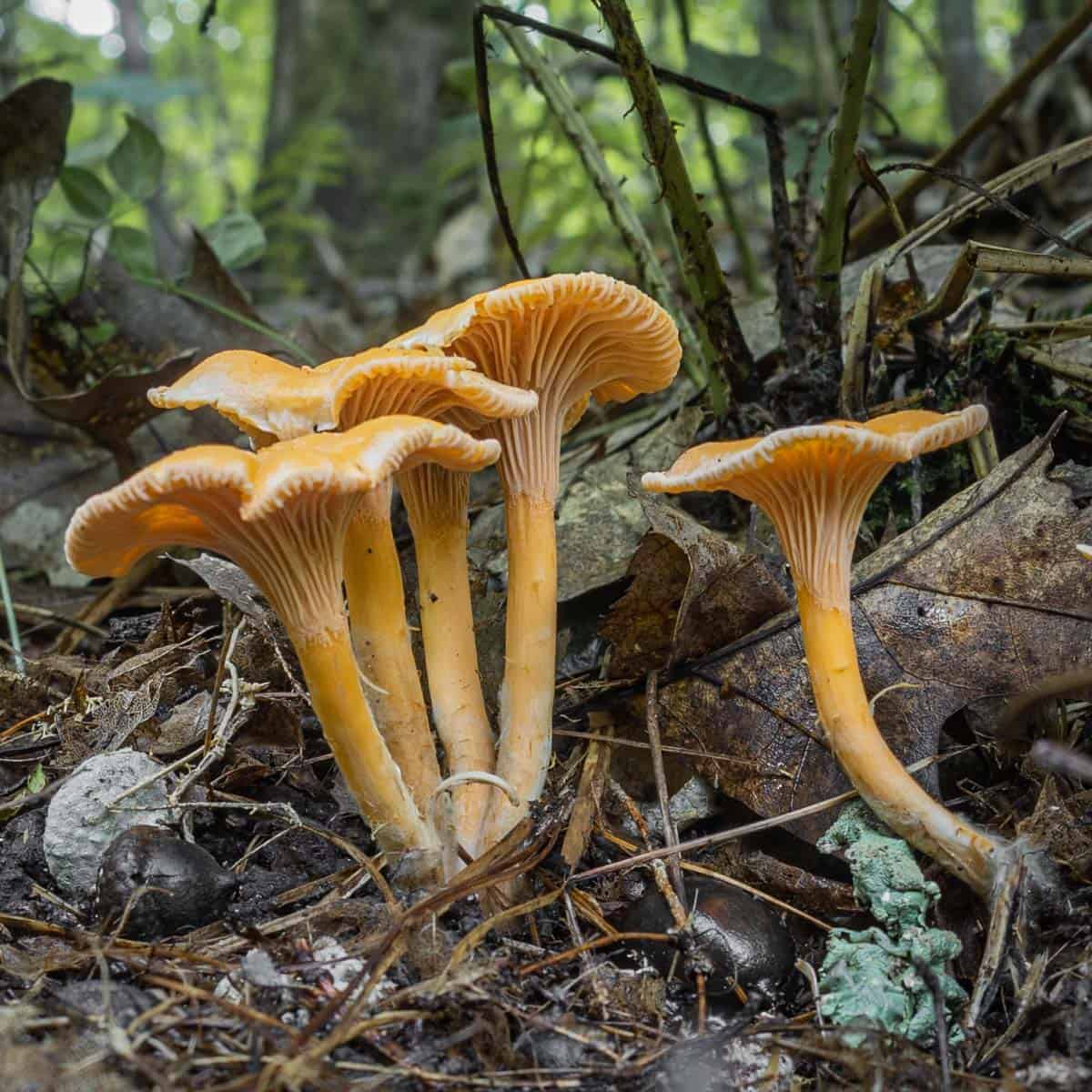
- Caps range from 2-10 cm (0.8-4 inches) in diameter, initially convex with an inrolled margin, becoming flat, then depressed to deeply infundibuliform (funnel-shaped) with age. The margin is often wavy, lobed, or irregular. The color is typically golden-yellow to orange, sometimes paler yellow or whitish, and can be smooth or slightly scaly.
- Gills
- Chanterelles do not have true gills. Instead, they possess blunt, vein-like, often forked ridges or folds that run down the stem (decurrent). These false gills are the same color as or slightly paler than the cap and are not easily separated from the cap flesh.
- Stem
- The stem is solid, tapering downwards, and often confluent with the cap, meaning there is no clear distinction between the cap and stem. It is typically 2-8 cm (0.8-3 inches) long and 0.5-2 cm (0.2-0.8 inches) thick, colored similarly to the cap, and smooth.
- Flesh
- The flesh is firm, thick, and whitish to pale yellow, often bruising slightly reddish-orange in some species. It has a distinctive fruity aroma, often compared to apricots, and a mild to peppery taste.
- Fruiting body
- The fruiting body is typically funnel-shaped or vase-shaped, often irregular, with a wavy or lobed margin. It is fleshy and firm.
- Habitat
- Chanterelles are mycorrhizal, forming symbiotic relationships with the roots of various trees, including oaks, beeches, birches, pines, and spruces. They typically grow on the ground in mossy areas, often in mixed deciduous and coniferous forests.
Key Facts
- Cap surfaces: Smooth to slightly scaly
- Growth Form: Solitary to scattered or in groups
- Spore Print: White to pale yellow or cream
- Body color: Golden-yellow to orange, sometimes paler
- Odor: Distinctive fruity, apricot-like
- Flesh bruises: Does not bruise significantly, sometimes slightly reddish-orange in some species
- Height: 2-8 cm (0.8-3 inches)
- Cap Diameter: 2-10 cm (0.8-4 inches)
- Nutrient gathering: Mycorrhizal
Safe
SafeChanterelles (Cantharellus cibarius sensu lato) are widely regarded as excellent edible mushrooms. However, misidentification with toxic look-alikes can lead to severe gastrointestinal distress or worse. It is crucial to be absolutely certain of identification before consumption. Always cook chanterelles thoroughly; raw consumption is not recommended and can cause mild digestive upset in some individuals.
Quick Check
- Odor: Fruity, often described as apricot-like
- Fruiting: Summer to Fall
- Substrate: Ground, mycorrhizal with various trees
Where to Find
North America
Widely distributed across temperate forests, particularly in the Pacific Northwest, Eastern United States, and parts of Canada. Found under conifers and hardwoods.
Europe
Common throughout Europe, especially in Scandinavia, Central Europe, and the British Isles. Associated with oak, beech, and spruce forests.
Asia
Found in parts of Asia, including Japan and Korea, often in association with specific tree species.
Australia and New Zealand
Some species of Cantharellus are found in these regions, often associated with native tree species.
Finding Tips
Timing is Key
Chanterelles typically fruit from summer through fall, often after periods of rain. The exact season varies by region.
Look for Specific Trees
Focus your search in forests with known mycorrhizal partners like oak, beech, birch, pine, and spruce.
Mossy Areas and Slopes
They often prefer mossy ground, especially on slopes or near old logging roads where drainage is good.
Check for Clusters
Chanterelles frequently grow in scattered groups or clusters, so if you find one, look closely for more nearby.
Distinctive Aroma
Learn to recognize their characteristic fruity, apricot-like scent, which can help confirm identification.
Similar Species
False Chanterelle
Hygrophoropsis aurantiaca
Also known as: Orange Chanterelle
Jack O'Lantern Mushroom
Omphalotus illudens (North America), Omphalotus olearius (Europe)
Also known as: Ghost Fungus (some species)
Gilled Chanterelle
Craterellus tubaeformis
Also known as: Trumpet Chanterelle, Yellowfoot
Scientific Classification
- Phylum
- Basidiomycota
- Class
- Agaricomycetes
- Order
- Cantharellales
- Family
- Cantharellaceae
- Genus
- Cantharellus
Storage Information
- Max Temperature: 4°C
- Freezing duration: 12 months
- Min Temperature: 0°C
- Refrigeration: 7 days
How to Clean
Chanterelles are best cleaned by gently brushing off dirt and debris with a soft brush or cloth. Avoid washing them under running water if possible, as they can absorb water and become soggy. If heavily soiled, a quick rinse and immediate drying are acceptable. Trim off any damaged or insect-eaten parts.
Explore Chanterelle
Identify mushrooms anywhere
Free on iOS, Android, and Web. Photo identification, full database, and your personal collection.