
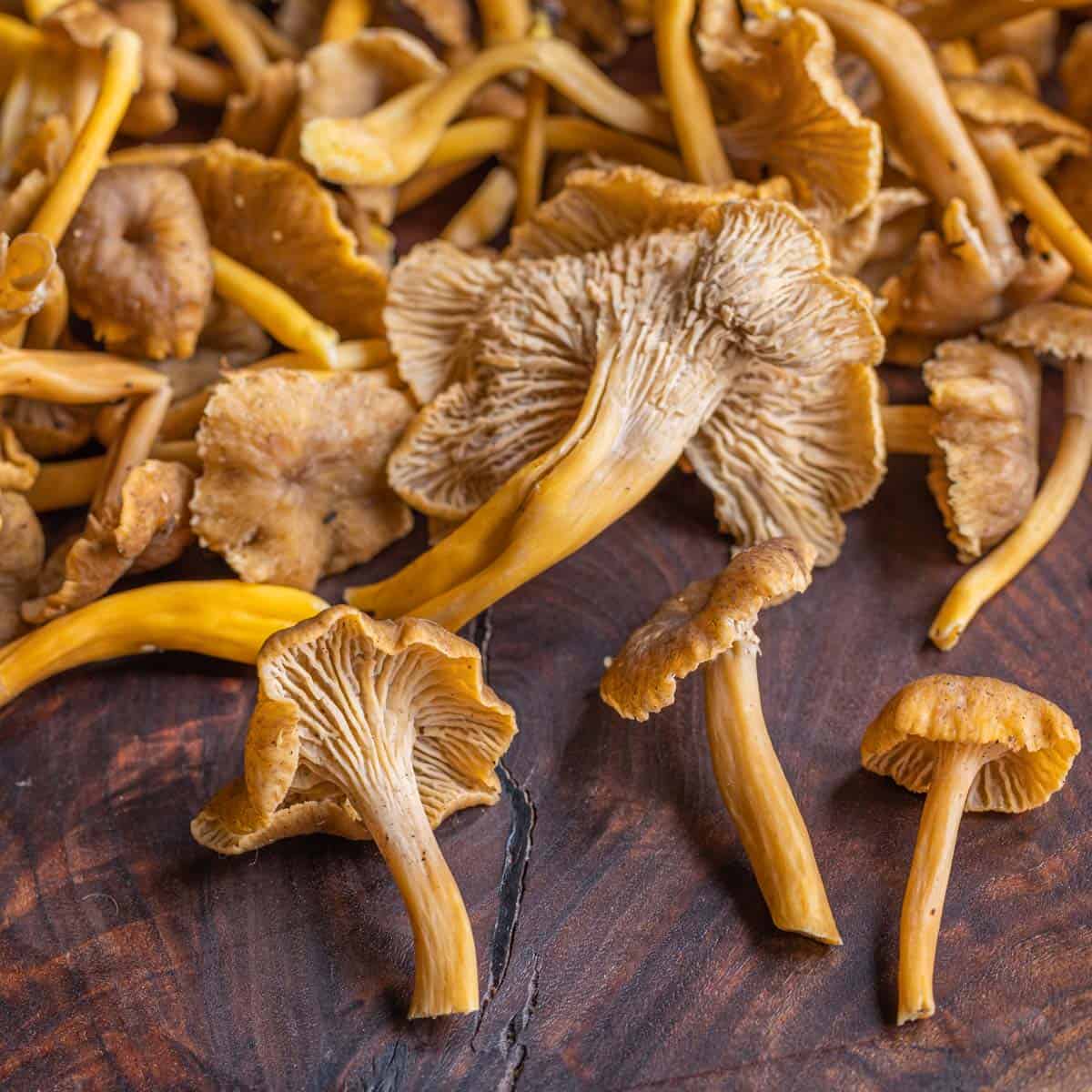
How to identify Small Chanterelle
Cantharellus minor
Got a photo? Identify mushrooms instantly with the Mushby app
Open the appTo correctly identify Small Chanterelle (Cantharellus minor), check each of these features in order. Misidentification is the most common cause of mushroom poisoning, so cross-reference multiple sources.
Step-by-step identification
- 1
Cap
Shape, color, surface texture, and diameter.
Caps are 0.5-3 cm (0.2-1.2 inches) in diameter, convex at first, becoming plano-convex to depressed, and eventually funnel-shaped or vase-shaped, often with an irregular or wavy margin. The color ranges from bright yellow to orangish-yellow, fading with age. The surface is smooth and dry.
- 2
Gills
Attachment to stem, color, and spacing.
Instead of true gills, Cantharellus minor has blunt, gill-like ridges or folds that are decurrent (run down the stem). These ridges are typically paler than the cap, sometimes almost white, but can be yellowish and are often forked and cross-veined.
- 3
Stem
Length, shape, surface, and any ring.
The stem is 1-3 cm (0.4-1.2 inches) long and 0.2-0.6 cm (0.08-0.24 inches) thick. It is typically even or tapering downwards, solid, and smooth. Its color is similar to the cap or slightly paler, typically yellow to orangish-yellow, and can be somewhat pruinose (finely powdered) when young.
- 4
Flesh
Color, texture, and bruising reaction.
The flesh is thin, soft, and brittle, and shares the same color as the cap or a slightly paler yellow. It does not change color when bruised. The odor is distinctly fruity, often described as apricot-like, and the taste is mild.
- 5
Fruiting body
Overall growth pattern.
The fruiting body is typically small, often clustered or scattered, and exhibits the classic chanterelle shape.
- 6
Habitat
Where it grows and on what substrate.
Typically found growing terrestrially in hardwood forests, often associated with oaks (Quercus spp.) and other deciduous trees. They can grow solitarily, scattered, or in small groups.
Key Facts
- Cap surfaces
- Smooth, dry
- Growth Form
- Solitary, scattered, or in small groups
- Spore Print
- White to pale yellowish
- Body color
- Bright yellow to orangish-yellow
- Odor
- Fruity (apricot-like)
- Flesh bruises
- No color change
- Height
- 1-3 cm (0.4-1.2 inches)
- Cap Diameter
- 0.5-3 cm (0.2-1.2 inches)
Fruit body characteristics
- Gill attachment: Decurrent, blunt, fold-like ridges
- Stem shape: Even or tapering downwards
- Stem surface: Smooth, sometimes pruinose when young
- Ring: Absent
- Stem cross-section: Solid
Explore Small Chanterelle
Identify mushrooms anywhere
Free on iOS, Android, and Web. Photo identification, full database, and your personal collection.