
Got a photo? Identify mushrooms instantly with the Mushby app
Open the appDescription
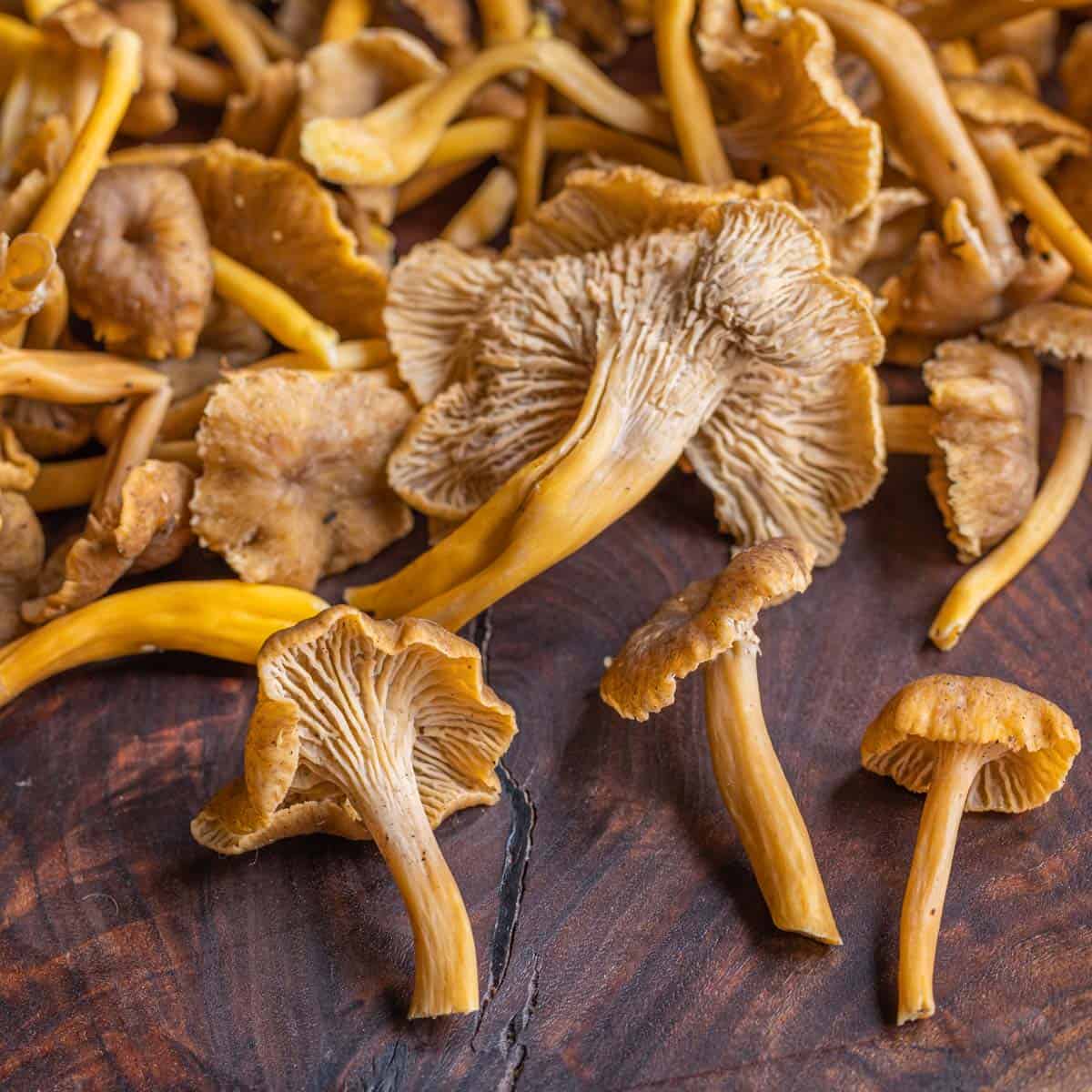
Cantharellus minor is a diminutive species of chanterelle, significantly smaller than its more common relatives like Cantharellus cibarius. It is characterized by its bright yellow to orange coloration, funnel-shaped cap, and blunt, gill-like ridges (not true gills) that run down the stem. Despite its small size, it shares the delicate, fruity aroma and flavor characteristic of chanterelles, making it a prized find for those who appreciate smaller, more subtle culinary mushrooms.
How to Identify
- Cap
- Caps are 0.5-3 cm (0.2-1.2 inches) in diameter, convex at first, becoming plano-convex to depressed, and eventually funnel-shaped or vase-shaped, often with an irregular or wavy margin. The color ranges from bright yellow to orangish-yellow, fading with age. The surface is smooth and dry.
- Gills
- Instead of true gills, Cantharellus minor has blunt, gill-like ridges or folds that are decurrent (run down the stem). These ridges are typically paler than the cap, sometimes almost white, but can be yellowish and are often forked and cross-veined.
- Stem
- The stem is 1-3 cm (0.4-1.2 inches) long and 0.2-0.6 cm (0.08-0.24 inches) thick. It is typically even or tapering downwards, solid, and smooth. Its color is similar to the cap or slightly paler, typically yellow to orangish-yellow, and can be somewhat pruinose (finely powdered) when young.
- Flesh
- The flesh is thin, soft, and brittle, and shares the same color as the cap or a slightly paler yellow. It does not change color when bruised. The odor is distinctly fruity, often described as apricot-like, and the taste is mild.
- Fruiting body
- The fruiting body is typically small, often clustered or scattered, and exhibits the classic chanterelle shape.
- Habitat
- Typically found growing terrestrially in hardwood forests, often associated with oaks (Quercus spp.) and other deciduous trees. They can grow solitarily, scattered, or in small groups.
Key Facts
- Cap surfaces: Smooth, dry
- Growth Form: Solitary, scattered, or in small groups
- Spore Print: White to pale yellowish
- Body color: Bright yellow to orangish-yellow
- Odor: Fruity (apricot-like)
- Flesh bruises: No color change
- Height: 1-3 cm (0.4-1.2 inches)
- Cap Diameter: 0.5-3 cm (0.2-1.2 inches)
- Nutrient gathering: Mycorrhizal (symbiotic with tree roots)
Safe
SafeCantharellus minor is considered a choice edible mushroom. However, misidentification with toxic look-alikes is a significant risk. The most dangerous look-alike is the Jack O'Lantern mushroom (Omphalotus illudens), which causes severe gastrointestinal upset. Always be 100% certain of your identification before consumption. Never consume wild mushrooms raw; always cook them thoroughly.
Quick Check
- Odor: Fruity (apricot-like)
- Fruiting: Summer to early fall, peaking in warm, wet periods.
- Substrate: Terrestrial, typically in hardwood forests, especially with oaks.
Where to Find
Eastern North America
Widely distributed throughout the eastern United States and parts of Canada, particularly in areas with hardwood forests.
Southeastern United States
Common in the Appalachian region and other southeastern states, where oak forests are prevalent.
Finding Tips
Look in Hardwood Forests
Focus your search on forests dominated by oak trees, as Cantharellus minor forms mycorrhizal associations with them.
Check Mossy Areas
They often prefer moist, mossy areas within the forest, especially after periods of rain.
Search After Rain
Fruiting is typically triggered by rainfall, so the best time to look is a few days after a good rain shower.
Look Closely
Due to their small size, they can be easily overlooked. Scan the forest floor carefully, especially amongst leaf litter.
Similar Species
Smooth Chanterelle
Chanterelle
Also known as: Cantharellus lateritius
Golden Chanterelle
Chanterelle
Also known as: Cantharellus cibarius, Girolle
Jack O'Lantern Mushroom
Mycology
Also known as: Omphalotus illudens, Omphalotus olearius
False Chanterelle
Hygrophoropsis
Also known as: Hygrophoropsis aurantiaca
Scientific Classification
- Phylum
- Basidiomycota
- Class
- Agaricomycetes
- Order
- Cantharellales
- Family
- Cantharellaceae
- Genus
- Cantharellus
Storage Information
- Max Temperature: 4°C
- Freezing duration: 6 months
- Min Temperature: 0°C
- Refrigeration: 7 days
How to Clean
Gently brush off any dirt or debris with a soft brush or a damp cloth. Avoid washing them under running water as they can absorb water and become soggy.
Explore Small Chanterelle
Identify mushrooms anywhere
Free on iOS, Android, and Web. Photo identification, full database, and your personal collection.