
How to identify Pacific Golden Chanterelle
Cantharellus formosus
Got a photo? Identify mushrooms instantly with the Mushby app
Open the appTo correctly identify Pacific Golden Chanterelle (Cantharellus formosus), check each of these features in order. Misidentification is the most common cause of mushroom poisoning, so cross-reference multiple sources.
Step-by-step identification
- 1
Cap
Shape, color, surface texture, and diameter.
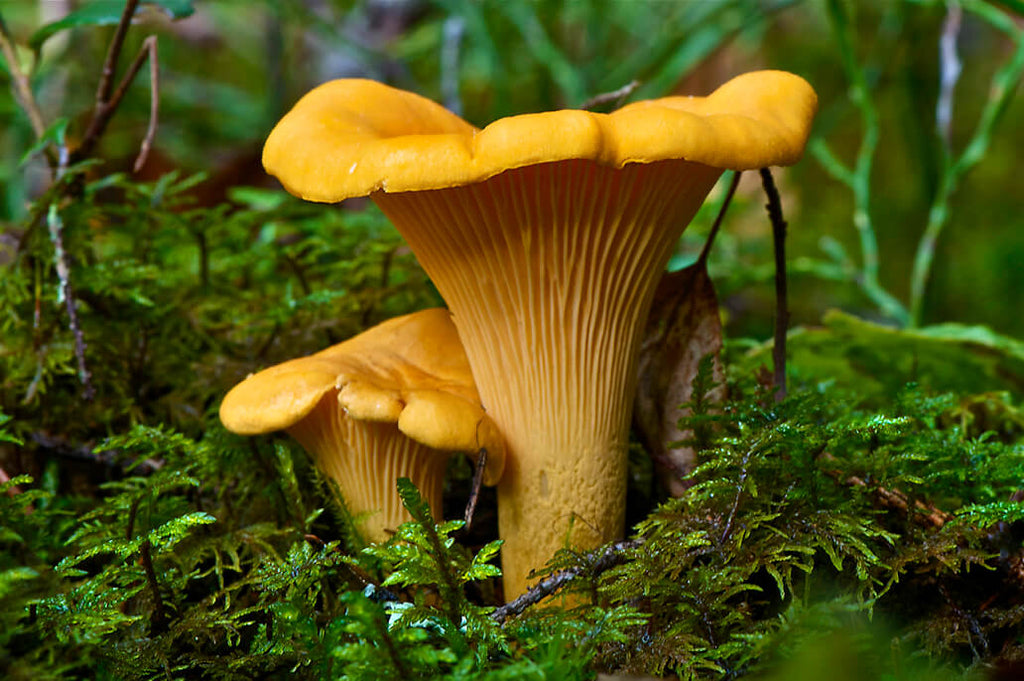
The cap is 2-12 cm (0.8-4.7 inches) in diameter, convex when young, becoming flat, depressed, or deeply funnel-shaped with age. The margin is often wavy and irregular. The surface is smooth to finely scaly, dry, and typically golden-yellow to orange-yellow, sometimes fading in direct sunlight.
- 2
Gills
Attachment to stem, color, and spacing.
Instead of true gills, Cantharellus formosus has blunt, vein-like, often forked ridges (false gills) that are decurrent (running down the stem). These ridges are the same color as or slightly paler than the cap, and they are not easily separated from the cap flesh.
- 3
Stem
Length, shape, surface, and any ring.
The stem is 3-10 cm (1.2-3.9 inches) long and 0.5-2.5 cm (0.2-1 inch) thick, tapering downwards or sometimes equal in width. It is solid, smooth, and typically the same color as the cap, though sometimes paler near the base. It is continuous with the cap.
- 4
Flesh
Color, texture, and bruising reaction.
The flesh is firm, thick, and whitish to pale yellow, often bruising slightly reddish-orange when cut or damaged. It has a distinctive fruity aroma, often compared to apricots, and a mild, slightly peppery taste when raw.
- 5
Fruiting body
Overall growth pattern.
The fruiting body is typically golden-yellow to orange-yellow, funnel-shaped, and fleshy. It lacks true gills, instead having blunt, fold-like ridges.
- 6
Habitat
Where it grows and on what substrate.
Mycorrhizal with conifers, primarily Douglas-fir (Pseudotsuga menziesii), but also found with Western Hemlock (Tsuga heterophylla) and other conifers. It grows terrestrially, often scattered or in groups, in mossy or needle-covered forest floors.
Key Facts
- Cap surfaces
- Smooth to finely scaly, dry
- Growth Form
- Scattered or in groups
- Spore Print
- White to pale yellow
- Body color
- Golden-yellow to orange-yellow
- Odor
- Fruity, apricot-like
- Flesh bruises
- Slightly reddish-orange when damaged
- Height
- 3-10 cm (1.2-3.9 inches)
- Cap Diameter
- 2-12 cm (0.8-4.7 inches)
Fruit body characteristics
- Gill attachment: Decurrent (false gills)
- Stem shape: Tapering downwards or equal
- Stem surface: Smooth
- Ring: Absent
- Stem cross-section: Solid
Explore Pacific Golden Chanterelle
Identify mushrooms anywhere
Free on iOS, Android, and Web. Photo identification, full database, and your personal collection.