
Got a photo? Identify mushrooms instantly with the Mushby app
Open the appDescription
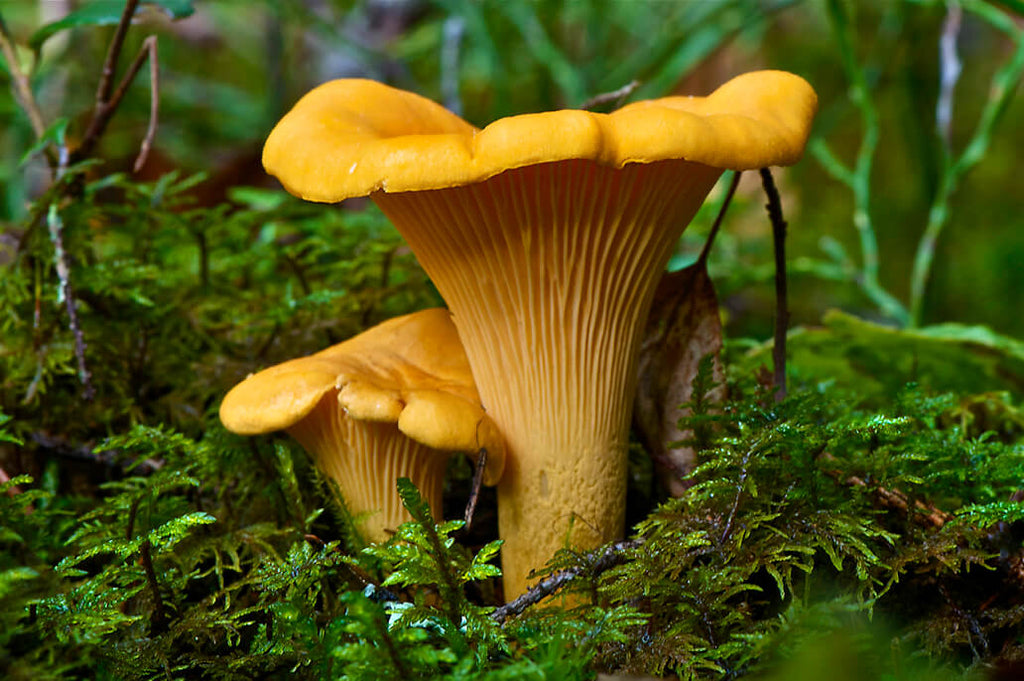
Cantharellus formosus, commonly known as the Pacific Golden Chanterelle, is a highly prized edible mushroom native to the Pacific Northwest of North America. It is characterized by its vibrant golden-yellow color, distinctive funnel shape, and blunt, gill-like ridges (false gills) that run down the stem. This species is renowned for its fruity aroma, often described as apricot-like, and its delicious, slightly peppery flavor when cooked. It is a mycorrhizal fungus, forming symbiotic relationships with specific tree species, primarily conifers.
How to Identify
- Cap
- The cap is 2-12 cm (0.8-4.7 inches) in diameter, convex when young, becoming flat, depressed, or deeply funnel-shaped with age. The margin is often wavy and irregular. The surface is smooth to finely scaly, dry, and typically golden-yellow to orange-yellow, sometimes fading in direct sunlight.
- Gills
- Instead of true gills, Cantharellus formosus has blunt, vein-like, often forked ridges (false gills) that are decurrent (running down the stem). These ridges are the same color as or slightly paler than the cap, and they are not easily separated from the cap flesh.
- Stem
- The stem is 3-10 cm (1.2-3.9 inches) long and 0.5-2.5 cm (0.2-1 inch) thick, tapering downwards or sometimes equal in width. It is solid, smooth, and typically the same color as the cap, though sometimes paler near the base. It is continuous with the cap.
- Flesh
- The flesh is firm, thick, and whitish to pale yellow, often bruising slightly reddish-orange when cut or damaged. It has a distinctive fruity aroma, often compared to apricots, and a mild, slightly peppery taste when raw.
- Fruiting body
- The fruiting body is typically golden-yellow to orange-yellow, funnel-shaped, and fleshy. It lacks true gills, instead having blunt, fold-like ridges.
- Habitat
- Mycorrhizal with conifers, primarily Douglas-fir (Pseudotsuga menziesii), but also found with Western Hemlock (Tsuga heterophylla) and other conifers. It grows terrestrially, often scattered or in groups, in mossy or needle-covered forest floors.
Key Facts
- Cap surfaces: Smooth to finely scaly, dry
- Growth Form: Scattered or in groups
- Spore Print: White to pale yellow
- Body color: Golden-yellow to orange-yellow
- Odor: Fruity, apricot-like
- Flesh bruises: Slightly reddish-orange when damaged
- Height: 3-10 cm (1.2-3.9 inches)
- Cap Diameter: 2-12 cm (0.8-4.7 inches)
- Nutrient gathering: Mycorrhizal
Safe
SafeCantharellus formosus is a highly prized edible mushroom. However, misidentification with toxic look-alikes can lead to serious illness. Always be 100% certain of your identification before consumption. Cooking is recommended for all wild mushrooms.
Quick Check
- Odor: Fruity, apricot-like
- Fruiting: Late summer to late fall
- Substrate: Terrestrial, mycorrhizal with conifers
Where to Find
Pacific Northwest of North America
This is the primary geographic distribution, encompassing coastal and inland coniferous forests from British Columbia, Canada, south through Washington, Oregon, and northern California, USA.
Coniferous Forests
Specifically, forests dominated by Douglas-fir, Western Hemlock, and other conifers are preferred habitats.
Finding Tips
Timing
Peak season is typically late summer through fall (August to November), often after significant rainfall. In some mild coastal areas, they can be found into early winter.
Habitat Specifics
Look in older growth coniferous forests, particularly under Douglas-fir. They often grow in mossy areas or among needle litter. They can be found on slopes or flat ground.
Visual Search
Their bright color can make them stand out against the forest floor, but they can also be partially hidden by leaves or needles. Scan the ground carefully, especially in areas with good moisture retention.
Associated Plants
While not directly associated, areas with huckleberry bushes or salal can sometimes indicate suitable chanterelle habitat.
Similar Species
Golden Chanterelle
Chanterelle
Also known as: Cantharellus cibarius
Smooth Chanterelle
Chanterelle
Also known as: Cantharellus lateritius
Jack O'Lantern Mushroom
Omphalotus
Also known as: Omphalotus illudens, Omphalotus olivascens
False Chanterelle
Hygrophoropsis
Also known as: Hygrophoropsis aurantiaca
Scientific Classification
- Phylum
- Basidiomycota
- Class
- Agaricomycetes
- Order
- Cantharellales
- Family
- Cantharellaceae
- Genus
- Cantharellus
Storage Information
- Max Temperature: 4°C
- Freezing duration: 6-12 months
- Min Temperature: 0°C
- Refrigeration: 5-10 days
How to Clean
Gently brush off any dirt, needles, or debris with a soft brush or damp cloth. Avoid washing them under running water if possible, as they can absorb water and become soggy. If heavily soiled, a quick rinse and immediate drying are acceptable. Trim off any damaged or insect-eaten parts.
Explore Pacific Golden Chanterelle
Identify mushrooms anywhere
Free on iOS, Android, and Web. Photo identification, full database, and your personal collection.