
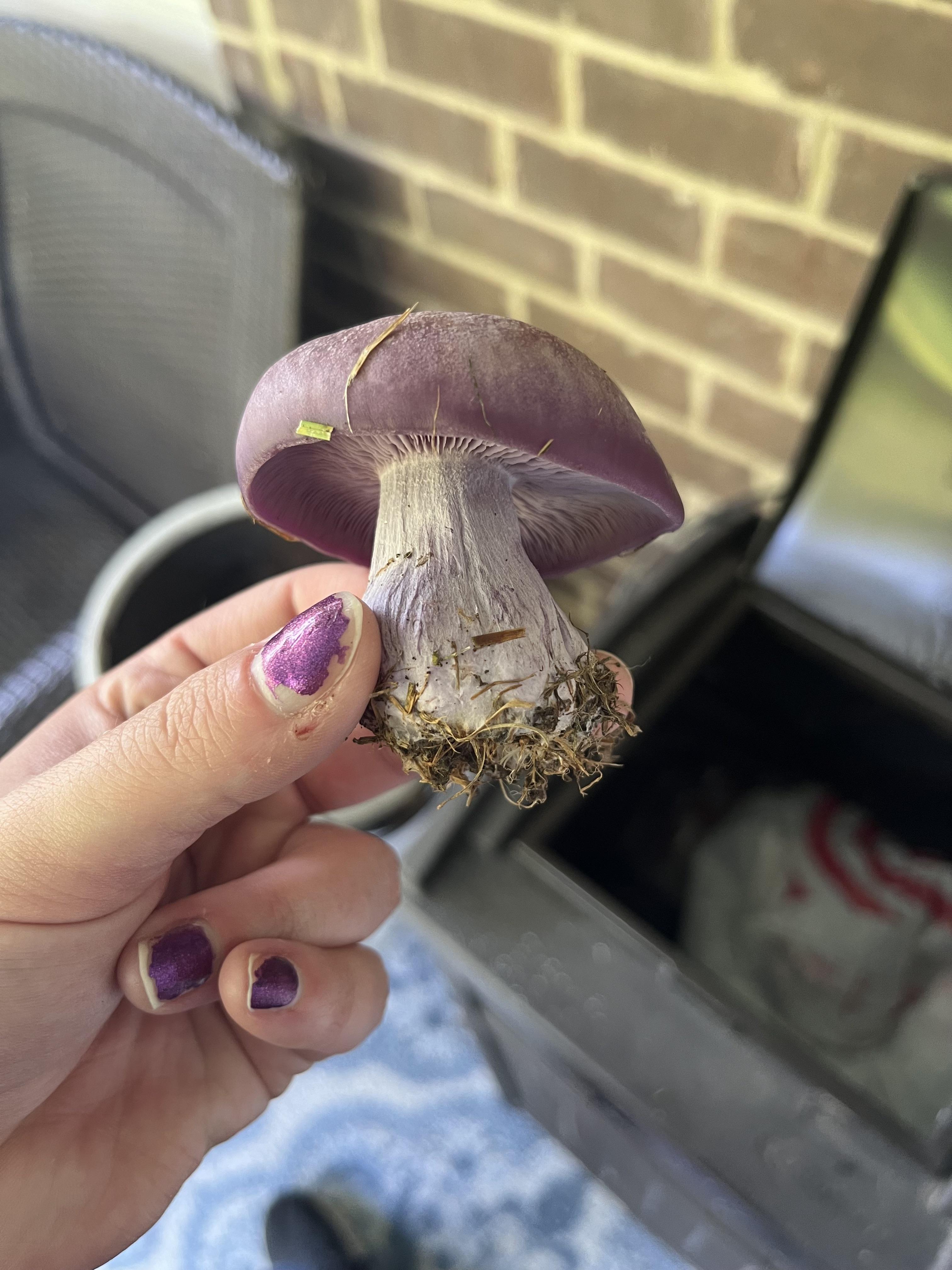
How to identify Purple Bolete
Boletus purpureus
Got a photo? Identify mushrooms instantly with the Mushby app
Open the appTo correctly identify Purple Bolete (Boletus purpureus), check each of these features in order. Misidentification is the most common cause of mushroom poisoning, so cross-reference multiple sources.
Step-by-step identification
- 1
Cap
Shape, color, surface texture, and diameter.
Typically 6-20 cm (2.4-7.9 in) in diameter, hemispherical to convex, becoming broadly convex to almost flat with age. The color is usually whitish, grayish-white, or pale buff, sometimes with a pinkish or yellowish tinge. The surface is dry, smooth, and often finely velvety when young, becoming glabrous with age. It does not bruise blue on the surface, but the flesh beneath will.
- 2
Gills
Attachment to stem, color, and spacing.
Pore surface is initially yellow, rapidly becoming deep red to crimson, especially towards the margin. Pores are small and round. They bruise dark blue to blackish-blue instantly upon touch.
- 3
Stem
Length, shape, surface, and any ring.
5-15 cm (2-6 in) long and 2-6 cm (0.8-2.4 in) thick, robust, often bulbous or swollen at the base, tapering slightly towards the apex. The color is yellow at the apex, transitioning to red or carmine-red over the lower two-thirds. It is typically covered with a prominent, coarse, red reticulation (net-like pattern) over a yellow background, especially on the upper part. The base may show yellowish mycelium. The flesh of the stem also stains blue when cut.
- 4
Flesh
Color, texture, and bruising reaction.
Pale yellow to lemon-yellow, especially in the cap and upper stem. It stains intensely blue immediately upon cutting or bruising, particularly in the cap and upper stem, fading somewhat to greenish-blue over time.
- 5
Fruiting body
Overall growth pattern.
A robust, fleshy mushroom with a cap, pores (not gills), and a central stem.
- 6
Habitat
Where it grows and on what substrate.
Mycorrhizal, forming symbiotic relationships with deciduous trees, particularly oak (Quercus), beech (Fagus), and sometimes hornbeam (Carpinus). It grows solitarily or scattered on the ground in broadleaf woodlands.
Key Facts
- Cap surfaces
- Dry, smooth to finely velvety, glabrous with age.
- Growth Form
- Terrestrial, mycorrhizal.
- Spore Print
- Olive-brown to brownish-olive.
- Body color
- Cap whitish/pale, pores red, stem yellow and red with red reticulation.
- Odor
- Mild.
- Flesh bruises
- Intensely blue immediately upon cutting or bruising.
- Height
- 5-15 cm (2-6 in)
- Cap Diameter
- 6-20 cm (2.4-7.9 in)
Fruit body characteristics
- Gill attachment: Pores, not gills; adnate to depressed.
- Stem shape: Bulbous to clavate (club-shaped) when young, becoming more cylindrical or slightly tapered with age.
- Stem surface: Yellow at apex, red below, covered with a prominent red reticulation.
- Ring: Absent.
- Stem cross-section: Solid.
Explore Purple Bolete
Identify mushrooms anywhere
Free on iOS, Android, and Web. Photo identification, full database, and your personal collection.