
Got a photo? Identify mushrooms instantly with the Mushby app
Open the appDescription
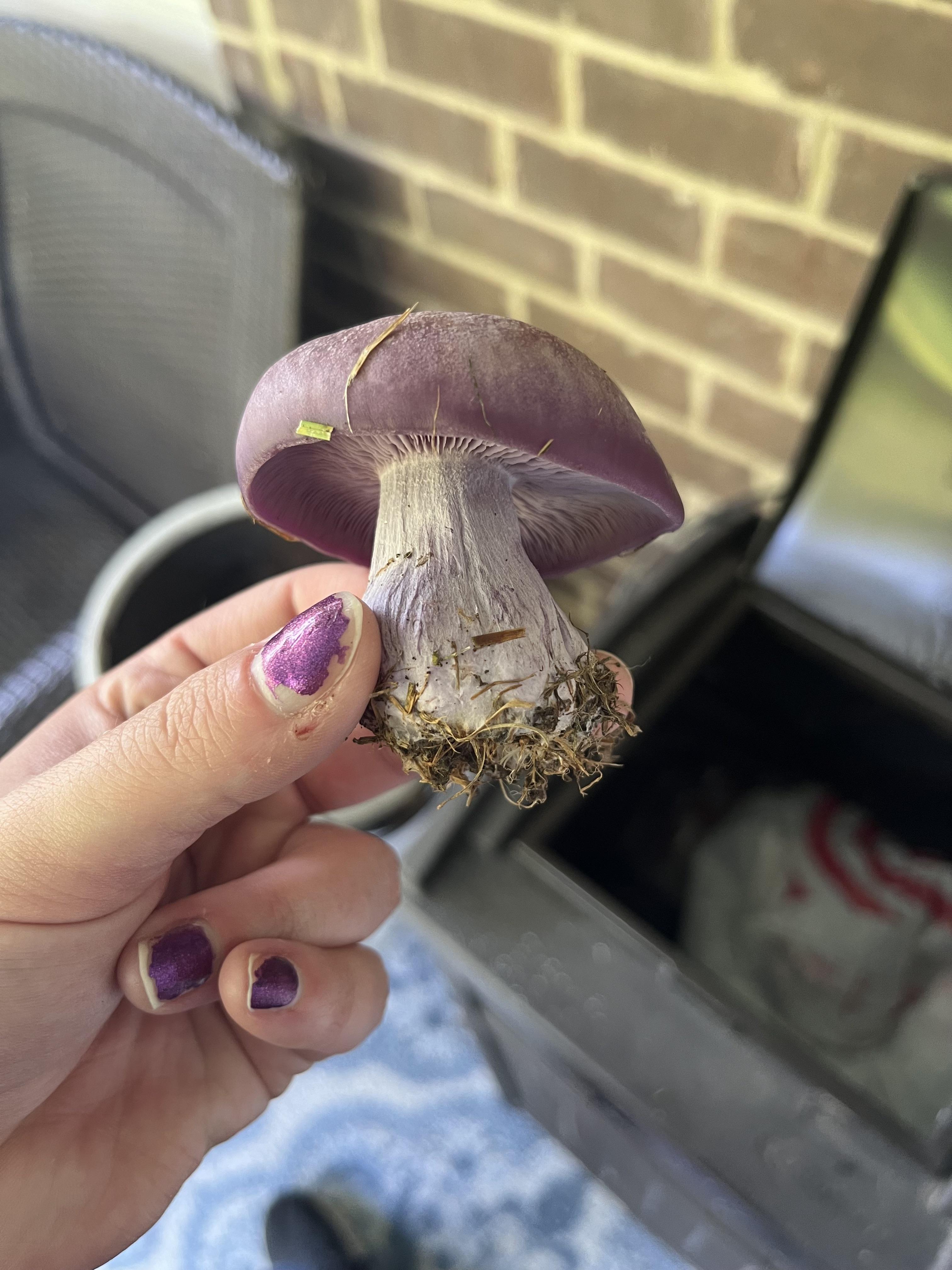
The Purple Bolete, now scientifically known as Rubroboletus rhodoxanthus, is a striking and robust bolete characterized by its pale cap, red pores, and a stem that is yellow at the apex and red towards the base, often covered with a red reticulation. A key identifying feature is its strong bluing reaction when cut or bruised. It is a toxic species, causing gastrointestinal upset if consumed.
How to Identify
- Cap
- Typically 6-20 cm (2.4-7.9 in) in diameter, hemispherical to convex, becoming broadly convex to almost flat with age. The color is usually whitish, grayish-white, or pale buff, sometimes with a pinkish or yellowish tinge. The surface is dry, smooth, and often finely velvety when young, becoming glabrous with age. It does not bruise blue on the surface, but the flesh beneath will.
- Gills
- Pore surface is initially yellow, rapidly becoming deep red to crimson, especially towards the margin. Pores are small and round. They bruise dark blue to blackish-blue instantly upon touch.
- Stem
- 5-15 cm (2-6 in) long and 2-6 cm (0.8-2.4 in) thick, robust, often bulbous or swollen at the base, tapering slightly towards the apex. The color is yellow at the apex, transitioning to red or carmine-red over the lower two-thirds. It is typically covered with a prominent, coarse, red reticulation (net-like pattern) over a yellow background, especially on the upper part. The base may show yellowish mycelium. The flesh of the stem also stains blue when cut.
- Flesh
- Pale yellow to lemon-yellow, especially in the cap and upper stem. It stains intensely blue immediately upon cutting or bruising, particularly in the cap and upper stem, fading somewhat to greenish-blue over time.
- Fruiting body
- A robust, fleshy mushroom with a cap, pores (not gills), and a central stem.
- Habitat
- Mycorrhizal, forming symbiotic relationships with deciduous trees, particularly oak (Quercus), beech (Fagus), and sometimes hornbeam (Carpinus). It grows solitarily or scattered on the ground in broadleaf woodlands.
Key Facts
- Cap surfaces: Dry, smooth to finely velvety, glabrous with age.
- Growth Form: Terrestrial, mycorrhizal.
- Spore Print: Olive-brown to brownish-olive.
- Body color: Cap whitish/pale, pores red, stem yellow and red with red reticulation.
- Odor: Mild.
- Flesh bruises: Intensely blue immediately upon cutting or bruising.
- Height: 5-15 cm (2-6 in)
- Cap Diameter: 6-20 cm (2.4-7.9 in)
- Nutrient gathering: Mycorrhizal
Toxic
Severe ToxicityRubroboletus rhodoxanthus is considered toxic, causing severe gastrointestinal upset if consumed, including nausea, vomiting, and diarrhea. Symptoms typically appear within 30 minutes to 3 hours after ingestion.
Quick Check
- Odor: Mild, sometimes described as slightly fruity or indistinct.
- Fruiting: Solitary to scattered.
- Substrate: Terrestrial, mycorrhizal with deciduous trees.
Where to Find
Europe
Widespread but uncommon across central and southern Europe, extending into parts of the Mediterranean region.
North America
Reports from North America are often misidentifications of other red-pored boletes. True Rubroboletus rhodoxanthus is primarily a European species.
Finding Tips
Deciduous Woodlands
Focus your search in mature deciduous forests, especially those dominated by oak and beech trees.
Summer to Early Autumn
The fruiting season typically runs from late summer through early autumn, usually from July to October, depending on local climate and rainfall.
Check for Bluing
Always perform a cut test on any suspected specimen. The rapid and intense blue staining of the flesh is a critical identifying feature for this group of boletes.
Examine Reticulation
Carefully observe the stem for the characteristic red reticulation, which is a key differentiator from some similar species.
Similar Species
Devil's Bolete
Rubroboletus
Also known as: Rubroboletus satanas
Scarletina Bolete
Neoboletus
Also known as: Neoboletus luridiformis (formerly Boletus luridiformis or Boletus erythropus)
Red-mouthed Bolete
Rubroboletus
Also known as: Rubroboletus legaliae
Scientific Classification
- Phylum
- Basidiomycota
- Class
- Agaricomycetes
- Order
- Boletales
- Family
- Boletaceae
- Genus
- Rubroboletus
Explore Purple Bolete
Identify mushrooms anywhere
Free on iOS, Android, and Web. Photo identification, full database, and your personal collection.