
How to identify Wood Ear
Auricularia auricula-judae
Got a photo? Identify mushrooms instantly with the Mushby app
Open the appTo correctly identify Wood Ear (Auricularia auricula-judae), check each of these features in order. Misidentification is the most common cause of mushroom poisoning, so cross-reference multiple sources.
Step-by-step identification
- 1
Cap
Shape, color, surface texture, and diameter.
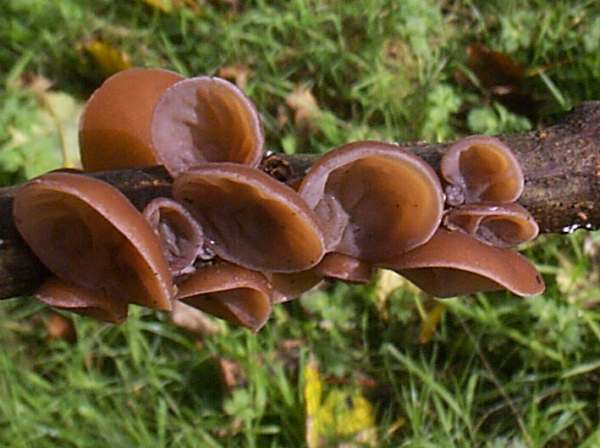
There isn't a distinct 'cap' in the traditional sense. The overall fruiting body functions as the cap. It ranges from 3-10 cm (1.2-4 inches) across, and 1-4 cm (0.4-1.6 inches) deep. The upper, outer surface (sterile surface) is typically somewhat hairy or finely velvety, especially when young, and can be pale brown to reddish-brown, often with purplish or grayish tints. The inner, fertile surface is smoother, somewhat shiny, and typically grayish-brown to dark brown, often with wrinkles or folds radiating from the point of attachment, mimicking an ear canal.
- 2
Gills
Attachment to stem, color, and spacing.
Auricularia auricula-judae is an aphyllophoroid fungus and does not possess gills. Spores are produced on the smooth, inner (fertile) surface of the fruiting body.
- 3
Stem
Length, shape, surface, and any ring.
A true stem is absent. It is sessile or possesses a very short, inconspicuous, lateral attachment to the wood.
- 4
Flesh
Color, texture, and bruising reaction.
The flesh is gelatinous and elastic when moist, becoming much thinner, brittle, and darker when dry. It has a translucent quality, especially when fresh and young. When broken after drying, it will snap rather than tear.
- 5
Fruiting body
Overall growth pattern.
The fruiting body is typically ear-shaped to cup-shaped, often irregularly lobed and wavy. It is gelatinous and somewhat rubbery when fresh, firming up and becoming brittle when dry, and regaining its gelatinous texture when rehydrated. It can be attached to the substrate by a small, inconspicuous stem-like base or directly by a constricted point.
- 6
Habitat
Where it grows and on what substrate.
Saprobic, growing on decaying deciduous wood, particularly abundant on elder (Sambucus spp.). Also found on beech, ash, sycamore, and other hardwoods. Typically found in clusters or individually attached to the bark or exposed wood.
Key Facts
- Cap surfaces
- Upper surface finely hairy/velvety, especially when young; inner surface smooth, often ridged/folded.
- Growth Form
- Sessile or with a very short lateral attachment, often gregarious (growing in clusters).
- Spore Print
- White to pale ochraceous.
- Body color
- Pale brown to reddish-brown, grayish-brown to dark brown, sometimes with purplish tints.
- Odor
- Mild and earthy, sometimes described as indistinct.
- Flesh bruises
- Does not bruise; maintains color and texture unless dried or damaged.
- Height
- Measures 3-10 cm (1.2-4 inches) across and 1-4 cm (0.4-1.6 inches) deep.
- Cap Diameter
- 3-10 cm (1.2-4 inches) in its longest dimension.
Fruit body characteristics
- Gill attachment: Absent (not a gilled mushroom)
- Stem shape: Absent or rudimentary (sessile)
- Stem surface: Absent
- Ring: Absent
- Stem cross-section: Absent
Explore Wood Ear
Identify mushrooms anywhere
Free on iOS, Android, and Web. Photo identification, full database, and your personal collection.