
Got a photo? Identify mushrooms instantly with the Mushby app
Open the appDescription
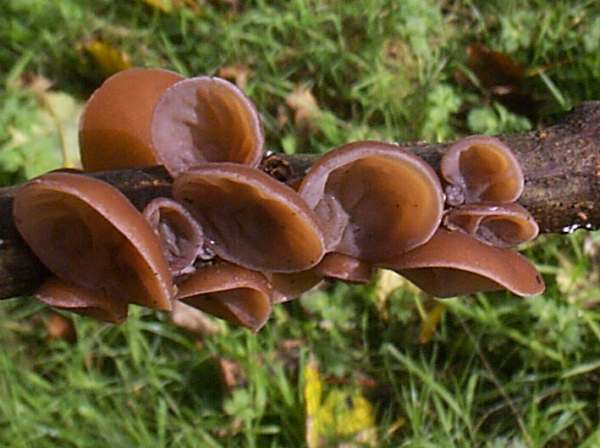
Auricularia auricula-judae, commonly known as Wood Ear or Jelly Ear, is a species of edible jelly fungus found worldwide. It is characterized by its ear-like and rubbery fruiting bodies, typically growing on dead wood, especially elder trees. Its historical common name, 'Judas' Ear,' stems from the belief that Judas Iscariot hanged himself from an elder tree.
How to Identify
- Cap
- There isn't a distinct 'cap' in the traditional sense. The overall fruiting body functions as the cap. It ranges from 3-10 cm (1.2-4 inches) across, and 1-4 cm (0.4-1.6 inches) deep. The upper, outer surface (sterile surface) is typically somewhat hairy or finely velvety, especially when young, and can be pale brown to reddish-brown, often with purplish or grayish tints. The inner, fertile surface is smoother, somewhat shiny, and typically grayish-brown to dark brown, often with wrinkles or folds radiating from the point of attachment, mimicking an ear canal.
- Gills
- Auricularia auricula-judae is an aphyllophoroid fungus and does not possess gills. Spores are produced on the smooth, inner (fertile) surface of the fruiting body.
- Stem
- A true stem is absent. It is sessile or possesses a very short, inconspicuous, lateral attachment to the wood.
- Flesh
- The flesh is gelatinous and elastic when moist, becoming much thinner, brittle, and darker when dry. It has a translucent quality, especially when fresh and young. When broken after drying, it will snap rather than tear.
- Fruiting body
- The fruiting body is typically ear-shaped to cup-shaped, often irregularly lobed and wavy. It is gelatinous and somewhat rubbery when fresh, firming up and becoming brittle when dry, and regaining its gelatinous texture when rehydrated. It can be attached to the substrate by a small, inconspicuous stem-like base or directly by a constricted point.
- Habitat
- Saprobic, growing on decaying deciduous wood, particularly abundant on elder (Sambucus spp.). Also found on beech, ash, sycamore, and other hardwoods. Typically found in clusters or individually attached to the bark or exposed wood.
Key Facts
- Cap surfaces: Upper surface finely hairy/velvety, especially when young; inner surface smooth, often ridged/folded.
- Growth Form: Sessile or with a very short lateral attachment, often gregarious (growing in clusters).
- Spore Print: White to pale ochraceous.
- Body color: Pale brown to reddish-brown, grayish-brown to dark brown, sometimes with purplish tints.
- Odor: Mild and earthy, sometimes described as indistinct.
- Flesh bruises: Does not bruise; maintains color and texture unless dried or damaged.
- Height: Measures 3-10 cm (1.2-4 inches) across and 1-4 cm (0.4-1.6 inches) deep.
- Cap Diameter: 3-10 cm (1.2-4 inches) in its longest dimension.
- Nutrient gathering: Saprobic (decomposer of dead organic matter).
Safe
SafeAuricularia auricula-judae is not toxic and is considered a choice edible mushroom. However, like all foraged foods, some individuals may experience allergic reactions or gastrointestinal upset. Always cook thoroughly before consumption.
Quick Check
- Odor: Mild, earthy, or indistinct
- Fruiting: Ear-shaped to cup-shaped, gelatinous, rubbery, often lobed
- Substrate: Decaying hardwood, especially elder
Where to Find
Deciduous Forests
Common in deciduous woodlands and forests where dead or dying hardwood trees are present.
Elder Trees
Especially prevalent on elder (Sambucus) trees, both living and dead branches, often close to the ground.
Urban/Suburban Areas
Can be found in parks, gardens, and urban settings where suitable hardwood hosts exist.
Worldwide Distribution
Cosmopolitan distribution; found in temperate and subtropical regions across North America, Europe, Asia, and Australia.
Finding Tips
Look for Dead or Dying Hardwoods
Target fallen logs, stumps, or dead branches on deciduous trees, particularly elder. They can also grow on living, but stressed or damaged, trees.
Check After Rain
Wood Ear mushrooms are most plump and visible after periods of rain or high humidity, which causes them to rehydrate and expand.
Year-Round Availability
While most common in autumn and winter (in temperate climates), they can be found throughout the year during mild, moist weather, as the fruiting bodies can persist and rehydrate.
Examine Bark and Undersides
Carefully inspect the bark and undersides of branches and logs where they might be less exposed.
Consider Elevation and Aspect
No specific elevation or aspect is preferred; rather, the presence of suitable host wood and moisture is key.
Don't Confuse with Other Jelly Fungi
While many other jelly fungi are not toxic, ensure you are picking Auricularia auricula-judae based on its distinct ear-like shape, texture, and growth on wood. Some Tremella species are brightly colored or more amorphous.
Similar Species
Amber Jelly Roll
Fungus
Also known as: Exidia recisa
Witch's Butter
Fungus
Also known as: Tremella mesenterica
False Wood Ear
Fungus
Also known as: Phaeoclavulina abietina (though less similar morphologically, sometimes confused due to growth on wood)
Cloud Ear Fungus
Fungus
Also known as: Auricularia polytricha (closely related, often sold as 'wood ear' in Asian markets, typically thinner and more velvety)
Brown Ear Fungus
Fungus
Also known as: Auricularia fuscosuccinea (similar but often more gelatinous and can have a more purplish tint, found in warmer climates)
Scientific Classification
- Phylum
- Basidiomycota
- Class
- Agaricomycetes
- Order
- Auriculariales
- Family
- Auriculariaceae
- Genus
- Auricularia
Storage Information
- Max Temperature: 0°C
- Freezing duration: 6 months
- Min Temperature: 1°C
- Refrigeration: 7 days
How to Clean
Gently wipe with a damp cloth or soft brush to remove any debris or insects. If heavily soiled, a quick rinse under cold running water is acceptable, but prolonged soaking should be avoided to prevent waterlogging, especially with fresh specimens. Pat dry immediately.
Explore Wood Ear
Identify mushrooms anywhere
Free on iOS, Android, and Web. Photo identification, full database, and your personal collection.