
How to identify Honey Mushroom
Armillaria borealis
Got a photo? Identify mushrooms instantly with the Mushby app
Open the appTo correctly identify Honey Mushroom (Armillaria borealis), check each of these features in order. Misidentification is the most common cause of mushroom poisoning, so cross-reference multiple sources.
Step-by-step identification
- 1
Cap
Shape, color, surface texture, and diameter.
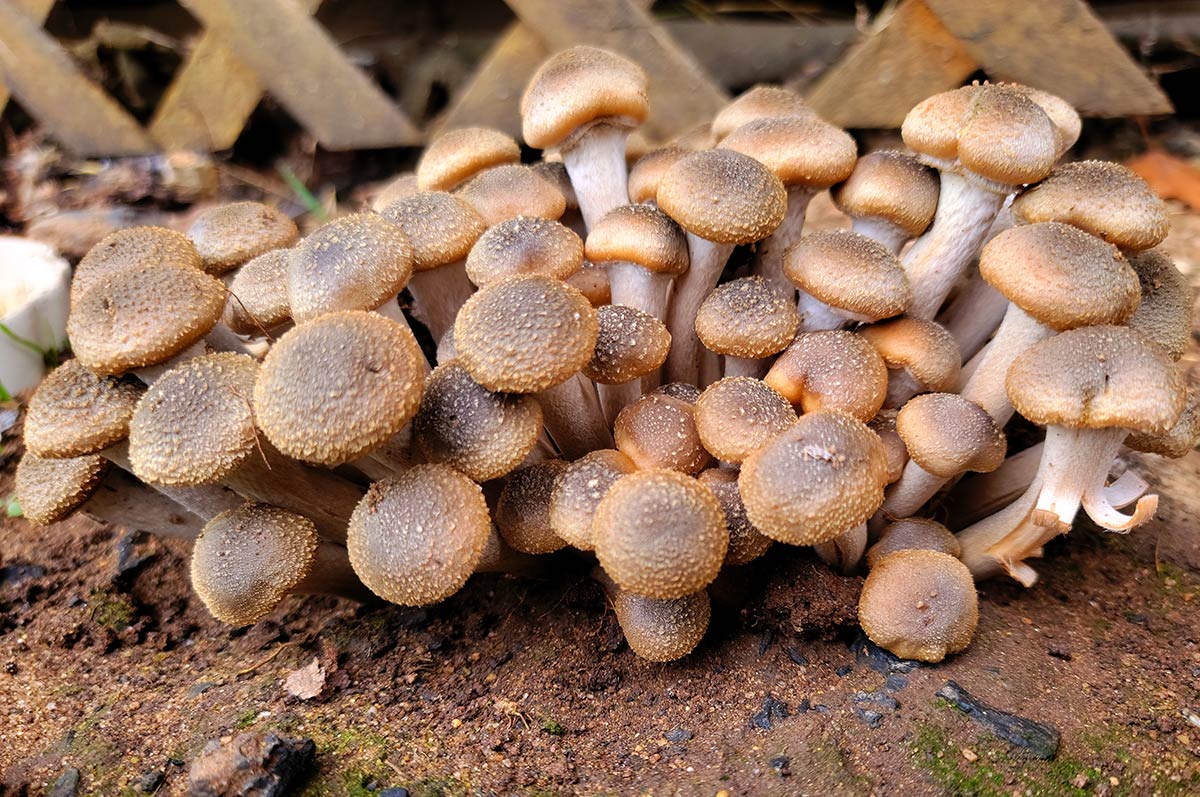
The cap is typically 3-15 cm (1.2-6 inches) in diameter, initially convex, expanding to broadly convex or nearly flat with age, often retaining a central umbo. The color varies from honey-yellow to yellowish-brown, reddish-brown, or olive-brown, often darker in the center. The surface is usually covered with small, dark, erect scales (squamules), especially when young, which may become sparse or disappear with age, particularly towards the margin. The margin is often incurved when young and may be striate (lined) in older specimens.
- 2
Gills
Attachment to stem, color, and spacing.
The gills are adnate to slightly decurrent, crowded, and initially white or cream-colored, becoming yellowish, then pinkish-buff to brownish with age, often developing rusty spots. They are relatively narrow.
- 3
Stem
Length, shape, surface, and any ring.
The stem (stipe) is 5-20 cm (2-8 inches) long and 1-3 cm (0.4-1.2 inches) thick, central or slightly eccentric, tapering slightly towards the base or sometimes swollen at the base. It is fibrous, tough, and often concolorous with the cap or paler. A prominent, persistent, membranous ring (annulus) is present, typically located in the upper part of the stem. The ring is white to yellowish, often with a darker, cottony margin, and may collect brown spores. Below the ring, the stem surface is often covered with yellowish to brownish fibrils or scales.
- 4
Flesh
Color, texture, and bruising reaction.
The flesh is white to cream-colored, firm, and relatively thick in the cap. It does not change color when cut or bruised. It has a mild, sometimes slightly bitter taste, and a pleasant, mushroomy odor.
- 5
Fruiting body
Overall growth pattern.
The fruiting body of Armillaria borealis is typically robust, growing in dense clusters. It consists of a cap, gills, stem, and a prominent ring (annulus). The overall color ranges from honey-yellow to reddish-brown, often darker towards the center of the cap.
- 6
Habitat
Where it grows and on what substrate.
Armillaria borealis is a saprobic and parasitic fungus, growing in dense clusters on dead or decaying hardwood and conifer stumps, logs, and buried wood. It can also be a serious pathogen of living trees, causing white rot. It is commonly found in mixed forests, deciduous forests, and coniferous forests.
Key Facts
- Cap surfaces
- Scaly (squamulose) when young, becoming smoother with age
- Growth Form
- Cespitose (growing in dense clusters)
- Spore Print
- White to cream
- Body color
- Honey-yellow to reddish-brown
- Odor
- Mild, pleasant
- Flesh bruises
- No significant bruising reaction
- Height
- 5-20 cm (2-8 inches)
- Cap Diameter
- 3-15 cm (1.2-6 inches)
Fruit body characteristics
- Gill attachment: Adnate to slightly decurrent
- Stem shape: Cylindrical, tapering towards base, or slightly swollen at base
- Stem surface: Fibrous, often with fibrils or scales below the ring
- Ring: Present, prominent, membranous, persistent, located in the upper part of the stem
- Stem cross-section: Solid, becoming pithy with age
Explore Honey Mushroom
Identify mushrooms anywhere
Free on iOS, Android, and Web. Photo identification, full database, and your personal collection.