
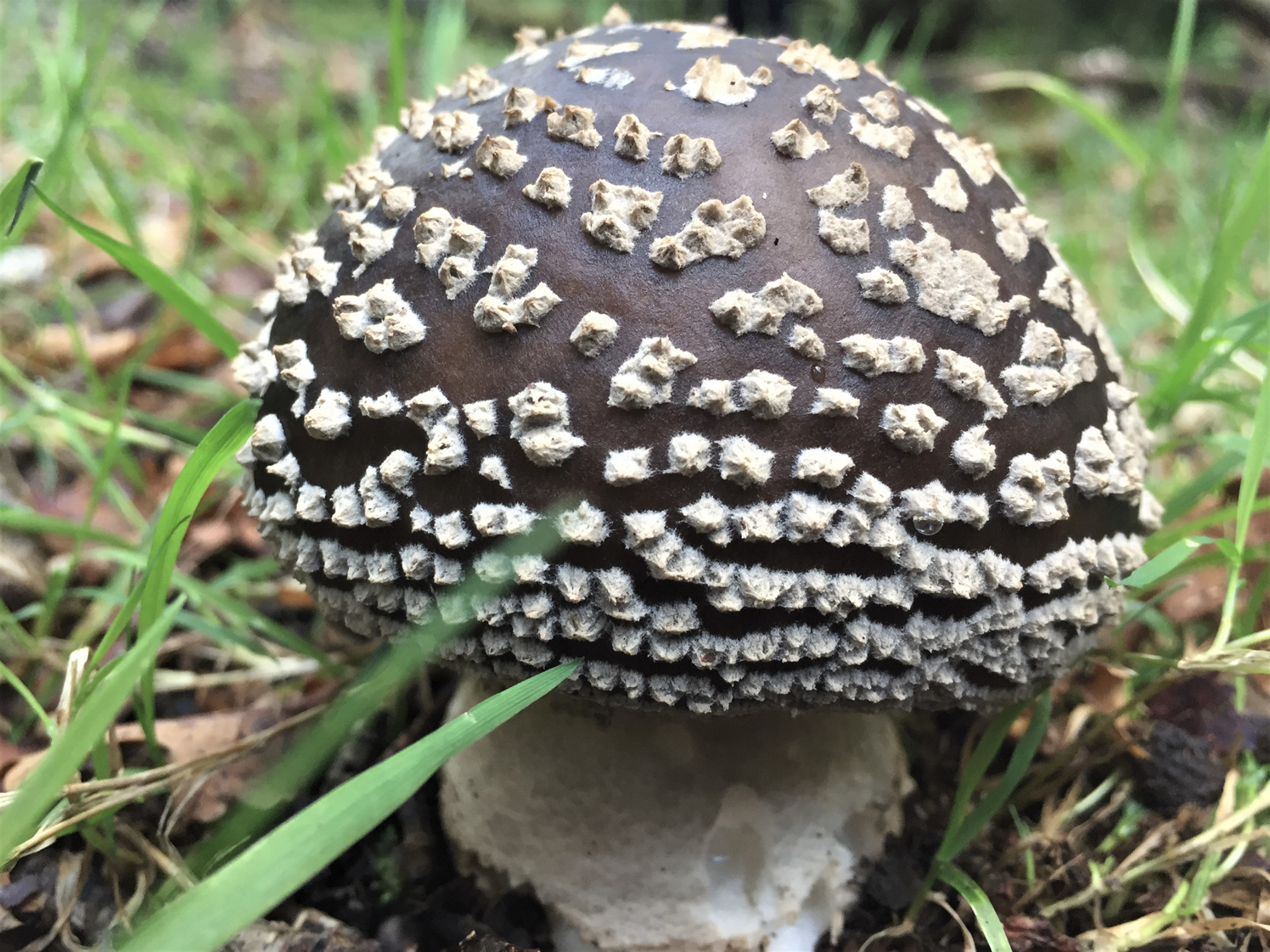
How to identify Grey Spotted Amanita
Amanita excelsa
Got a photo? Identify mushrooms instantly with the Mushby app
Open the appTo correctly identify Grey Spotted Amanita (Amanita excelsa), check each of these features in order. Misidentification is the most common cause of mushroom poisoning, so cross-reference multiple sources.
Step-by-step identification
- 1
Cap
Shape, color, surface texture, and diameter.
3-15 cm in diameter, initially hemispherical, becoming convex then plano-convex to almost flat with age. Color varies from grey-brown, dull greyish-olive, to brownish-grey. The surface is dry, usually covered with numerous greyish brown, felty, irregular patches or warts (volval remnants), which can be detached. The margin is not striate.
- 2
Gills
Attachment to stem, color, and spacing.
Free to adnexed, crowded, broad, white to cream-colored. Lammellulae (short gills) are frequent.
- 3
Stem
Length, shape, surface, and any ring.
6-15 cm tall and 1-3 cm thick, tapering slightly upwards from a bulbous base. Solid, white to greyish-white, often with felty or scaly zones below the ring. The ring (annulus) is membranous, white, striate on the upper surface, and often with greyish ragged edges or patches on the underside. Volva is typically represented by concentric rings of grey warts or scales on the bulbous base, not a distinct sac-like structure.
- 4
Flesh
Color, texture, and bruising reaction.
White, thick, and firm. May turn slightly reddish-brown when bruised or cut, but not as distinctly as Amanita rubescens (the Blusher).
- 5
Fruiting body
Overall growth pattern.
Ranges from medium to large size, with a robust structure typical of Amanita species. The overall appearance is stocky with a prominent ring and a bulbous base.
- 6
Habitat
Where it grows and on what substrate.
Grows solitarily or scattered in coniferous, mixed, and deciduous woodlands, forming mycorrhizal associations with various tree species, including oak, beech, birch, and pines.
Key Facts
- Cap surfaces
- Dull greyish to brownish-grey, covered with greyish-brown, felty, detachable warts.
- Growth Form
- Solitary or scattered.
- Spore Print
- White.
- Body color
- Overall greyish-brown cap with white gills and stem, often with reddish-brown staining on flesh.
- Odor
- Faintly radish-like or potato-like.
- Flesh bruises
- Often stains slightly reddish-brown, especially when cut or bruised, but less pronounced than A. rubescens.
- Height
- 6-15 cm
- Cap Diameter
- 3-15 cm
Fruit body characteristics
- Gill attachment: Free to adnexed.
- Stem shape: Cylindrical, tapering slightly upwards, with a bulbous base.
- Stem surface: White to greyish-white, often with felty or scaly zones below the ring.
- Ring: Membranous, white, striate on the upper surface, often ragged on the underside, and persistent.
- Stem cross-section: Solid.
Explore Grey Spotted Amanita
Identify mushrooms anywhere
Free on iOS, Android, and Web. Photo identification, full database, and your personal collection.