
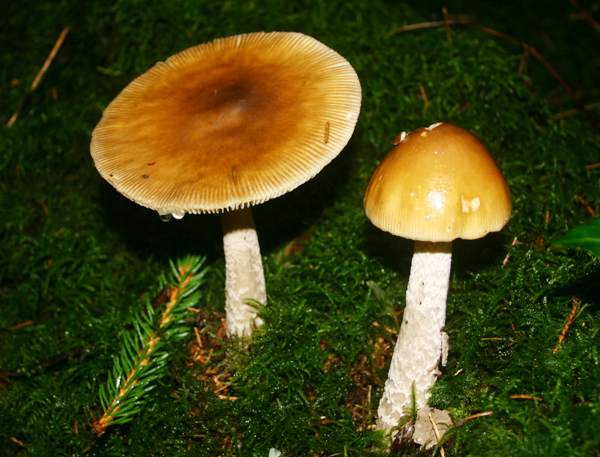
How to identify Orange Grisette
Amanita crocea
Got a photo? Identify mushrooms instantly with the Mushby app
Open the appTo correctly identify Orange Grisette (Amanita crocea), check each of these features in order. Misidentification is the most common cause of mushroom poisoning, so cross-reference multiple sources.
Step-by-step identification
- 1
Cap
Shape, color, surface texture, and diameter.
The cap of Amanita crocea ranges from 5 to 12 cm (2 to 4.7 inches) in diameter, initially ovoid or bell-shaped, expanding to convex and then plano-convex or almost flat with age. The color is typically a vibrant orange, saffron, or yellowish-orange, often darker towards the center. The cap margin is distinctly striate (grooved) for about 1-2 cm (0.4-0.8 inches) from the edge, reflecting the gills beneath. The surface is smooth, moist, and often slightly sticky when wet, becoming shiny when dry. Universal veil remnants are typically absent from the cap surface, distinguishing it from species like Amanita muscaria.
- 2
Gills
Attachment to stem, color, and spacing.
The gills are free from the stem, crowded, soft, and white to cream-colored, sometimes with a yellowish tint. They are often slightly broader towards the cap margin.
- 3
Stem
Length, shape, surface, and any ring.
The stem (stipe) is 8 to 20 cm (3.1 to 7.9 inches) long and 1 to 2 cm (0.4 to 0.8 inches) thick, tapering slightly upwards from a bulbous base. It is typically white to pale yellowish or orange-tinged, often with fine, woolly or scaly ornamentation (floccules) that are concolorous with the stem or slightly darker. A key identifying feature is the complete absence of an annulus (ring). The base of the stem is encased in a prominent, sac-like, white to yellowish-white volva, which is often deeply buried in the substrate.
- 4
Flesh
Color, texture, and bruising reaction.
The flesh is white, thin, and fragile, especially in the cap. It does not change color when cut or bruised.
- 5
Fruiting body
Overall growth pattern.
The fruiting body is typically agaricoid, meaning it has a cap, gills, and a central stem. It emerges from a universal veil, leaving a distinctive volva at the base of the stipe.
- 6
Habitat
Where it grows and on what substrate.
Amanita crocea is a mycorrhizal fungus, forming symbiotic relationships with various tree species, primarily hardwoods such as oak (Quercus), beech (Fagus), birch (Betula), and sometimes conifers like pine (Pinus) and spruce (Picea). It grows solitarily or in scattered groups on the ground in deciduous, coniferous, and mixed forests.
Key Facts
- Cap surfaces
- Smooth, moist, shiny when dry, distinctly striate margin
- Growth Form
- Solitary to scattered
- Spore Print
- White
- Body color
- Orange to saffron cap, white to pale yellowish stem, white volva
- Odor
- Mild, indistinct
- Flesh bruises
- No color change
- Height
- 8-20 cm (3.1-7.9 inches)
- Cap Diameter
- 5-12 cm (2-4.7 inches)
Fruit body characteristics
- Gill attachment: Free
- Stem shape: Cylindrical, tapering upwards from a bulbous base
- Stem surface: White to pale yellowish, often with fine, woolly or scaly floccules
- Ring: Absent
- Stem cross-section: Solid to hollow with age
Explore Orange Grisette
Identify mushrooms anywhere
Free on iOS, Android, and Web. Photo identification, full database, and your personal collection.