
Got a photo? Identify mushrooms instantly with the Mushby app
Open the appDescription
Amanita crocea, commonly known as the Orange Grisette, is a striking and relatively common mushroom belonging to the genus Amanita, section Vaginatae. Unlike many of its deadly relatives, A. crocea is considered edible, though caution is always advised due to the presence of numerous toxic Amanita species. It is characterized by its vibrant orange to saffron-colored cap, absence of a ring (annulus), and a distinctive sac-like volva at the base of the stem.
How to Identify
- Cap
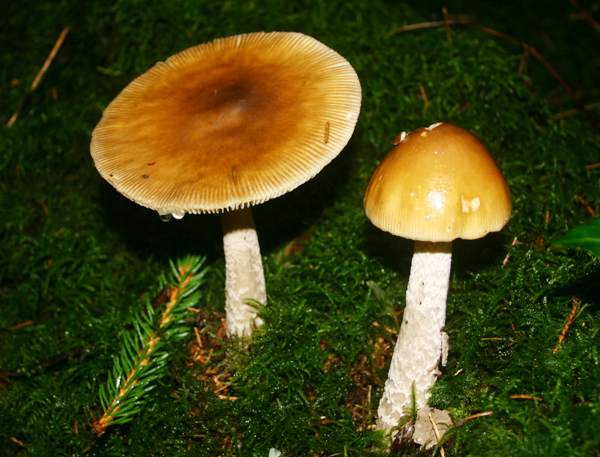
- The cap of Amanita crocea ranges from 5 to 12 cm (2 to 4.7 inches) in diameter, initially ovoid or bell-shaped, expanding to convex and then plano-convex or almost flat with age. The color is typically a vibrant orange, saffron, or yellowish-orange, often darker towards the center. The cap margin is distinctly striate (grooved) for about 1-2 cm (0.4-0.8 inches) from the edge, reflecting the gills beneath. The surface is smooth, moist, and often slightly sticky when wet, becoming shiny when dry. Universal veil remnants are typically absent from the cap surface, distinguishing it from species like Amanita muscaria.
- Gills
- The gills are free from the stem, crowded, soft, and white to cream-colored, sometimes with a yellowish tint. They are often slightly broader towards the cap margin.
- Stem
- The stem (stipe) is 8 to 20 cm (3.1 to 7.9 inches) long and 1 to 2 cm (0.4 to 0.8 inches) thick, tapering slightly upwards from a bulbous base. It is typically white to pale yellowish or orange-tinged, often with fine, woolly or scaly ornamentation (floccules) that are concolorous with the stem or slightly darker. A key identifying feature is the complete absence of an annulus (ring). The base of the stem is encased in a prominent, sac-like, white to yellowish-white volva, which is often deeply buried in the substrate.
- Flesh
- The flesh is white, thin, and fragile, especially in the cap. It does not change color when cut or bruised.
- Fruiting body
- The fruiting body is typically agaricoid, meaning it has a cap, gills, and a central stem. It emerges from a universal veil, leaving a distinctive volva at the base of the stipe.
- Habitat
- Amanita crocea is a mycorrhizal fungus, forming symbiotic relationships with various tree species, primarily hardwoods such as oak (Quercus), beech (Fagus), birch (Betula), and sometimes conifers like pine (Pinus) and spruce (Picea). It grows solitarily or in scattered groups on the ground in deciduous, coniferous, and mixed forests.
Key Facts
- Cap surfaces: Smooth, moist, shiny when dry, distinctly striate margin
- Growth Form: Solitary to scattered
- Spore Print: White
- Body color: Orange to saffron cap, white to pale yellowish stem, white volva
- Odor: Mild, indistinct
- Flesh bruises: No color change
- Height: 8-20 cm (3.1-7.9 inches)
- Cap Diameter: 5-12 cm (2-4.7 inches)
- Nutrient gathering: Mycorrhizal
Safe
SafeAmanita crocea is generally considered edible after cooking. However, it is crucial to exercise extreme caution due to its close resemblance to several deadly Amanita species, particularly those in section Phalloideae (e.g., Death Cap - Amanita phalloides) and section Amanita (e.g., Fly Agaric - Amanita muscaria). The primary danger lies in misidentification. All Amanita species should be identified by an expert before consumption. Raw consumption of A. crocea is not recommended as it may cause gastrointestinal upset. Thorough cooking is essential.
Quick Check
- Odor: Mild, indistinct
- Fruiting: Late summer to autumn
- Substrate: Ground in deciduous, coniferous, and mixed forests
Where to Find
Europe
Widespread across temperate regions of Europe, from the British Isles to Eastern Europe and Scandinavia.
North America
Found in various regions of North America, particularly in the eastern United States and Canada, often associated with oak and birch.
Asia
Reported in parts of Asia, though its distribution may be less well-documented or it may be represented by closely related species.
Finding Tips
Look for Mycorrhizal Hosts
Focus your search in forests dominated by oak, beech, birch, or other hardwood trees, as well as mixed forests. The presence of these trees increases the likelihood of finding A. crocea.
Check for the Volva
Always carefully excavate the base of the stem to confirm the presence of the sac-like volva. This is a crucial identifying feature for Amanita species and helps differentiate it from other genera.
Observe Cap Margin Striations
The distinct striations on the cap margin are a reliable characteristic of the section Vaginatae and A. crocea specifically. This helps distinguish it from other Amanita species that may lack this feature.
Note Absence of Ring
The lack of an annulus (ring) on the stem is a critical feature. Many deadly Amanita species possess a prominent ring, so its absence in A. crocea is a key differentiator.
Seasonal Timing
Search during its peak fruiting season, typically from late summer through autumn, though it can appear earlier or later depending on local climate and rainfall.
Similar Species
Grisette
Amanita vaginata
Also known as: Grisette Amanita
Tawny Grisette
Amanita fulva
Also known as: Brown Grisette
Fly Agaric
Amanita muscaria
Also known as: Fly Amanita
Death Cap
Amanita phalloides
Also known as: Deadly Amanita
Scientific Classification
- Phylum
- Basidiomycota
- Class
- Agaricomycetes
- Order
- Agaricales
- Family
- Amanitaceae
- Genus
- Amanita
Storage Information
- Max Temperature: 4°C
- Freezing duration: 6 months
- Min Temperature: 0°C
- Refrigeration: 5 days
How to Clean
Gently brush off any dirt or debris from the cap and stem using a soft brush or damp cloth. Avoid washing under running water, as mushrooms can absorb excess moisture and become soggy. If necessary, a quick rinse and immediate drying with a paper towel can be done. Trim off any damaged or insect-infested parts, especially the base of the stem where the volva is often dirty.
Explore Orange Grisette
Identify mushrooms anywhere
Free on iOS, Android, and Web. Photo identification, full database, and your personal collection.