
How to identify Caesar's Mushroom
Amanita caesarea
Got a photo? Identify mushrooms instantly with the Mushby app
Open the appTo correctly identify Caesar's Mushroom (Amanita caesarea), check each of these features in order. Misidentification is the most common cause of mushroom poisoning, so cross-reference multiple sources.
Step-by-step identification
- 1
Cap
Shape, color, surface texture, and diameter.
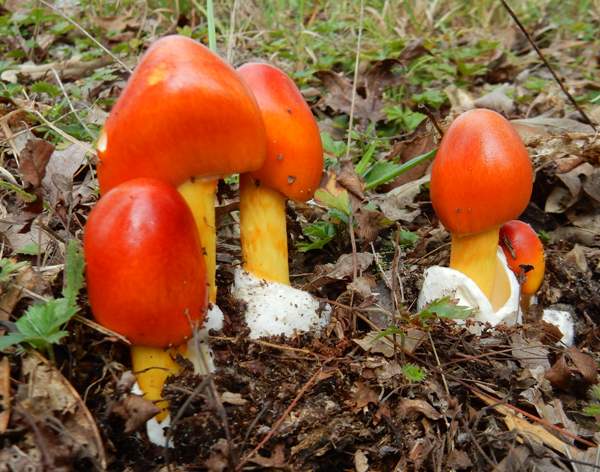
The cap is typically 8-20 cm (3-8 inches) in diameter, initially hemispherical, expanding to convex and then nearly flat with age. The color is a vibrant orange-red to scarlet, often fading to orange-yellow at the margin. The surface is smooth, moist, and often slightly sticky when wet, becoming dry with age. It typically lacks universal veil remnants (warts) on the cap, though occasionally a few white patches may be present, especially in younger specimens.
- 2
Gills
Attachment to stem, color, and spacing.
The gills are free from the stem, crowded, broad, and a distinctive deep golden-yellow to orange-yellow color. They remain this color even in older specimens.
- 3
Stem
Length, shape, surface, and any ring.
The stem is 8-15 cm (3-6 inches) long and 1-3 cm (0.4-1.2 inches) thick, solid, cylindrical, and tapers slightly upwards. It is the same deep golden-yellow color as the gills. It features a prominent, skirt-like, membranous ring (annulus) that is also yellow and often striate on the upper surface. The base of the stem is encased in a large, thick, sac-like, white volva, which is often deeply buried in the substrate.
- 4
Flesh
Color, texture, and bruising reaction.
The flesh is firm, thick, and white, with a yellowish tinge directly beneath the cap cuticle. It does not change color when cut or bruised.
- 5
Fruiting body
Overall growth pattern.
The fruiting body is a classic agaric shape, emerging from a prominent white volva.
- 6
Habitat
Where it grows and on what substrate.
Caesar's Mushroom is a mycorrhizal fungus, forming symbiotic relationships primarily with broadleaf trees, especially oaks (Quercus species), chestnuts (Castanea species), and cork oaks (Quercus suber). It prefers warm, temperate climates and often grows in open woodlands or at the edges of forests.
Key Facts
- Cap surfaces
- Smooth, moist, sometimes slightly sticky
- Growth Form
- Solitary to scattered
- Spore Print
- White
- Body color
- Orange-red cap, golden-yellow gills and stem, white volva
- Odor
- Mild, pleasant
- Flesh bruises
- No color change
- Height
- 8-15 cm (3-6 inches)
- Cap Diameter
- 8-20 cm (3-8 inches)
Fruit body characteristics
- Gill attachment: Free
- Stem shape: Cylindrical, tapering slightly upwards
- Stem surface: Smooth, sometimes finely striate above the ring
- Ring: Present, prominent, membranous, skirt-like, yellow, often striate on upper surface
- Stem cross-section: Solid
Explore Caesar's Mushroom
Identify mushrooms anywhere
Free on iOS, Android, and Web. Photo identification, full database, and your personal collection.