
Got a photo? Identify mushrooms instantly with the Mushby app
Open the appDescription
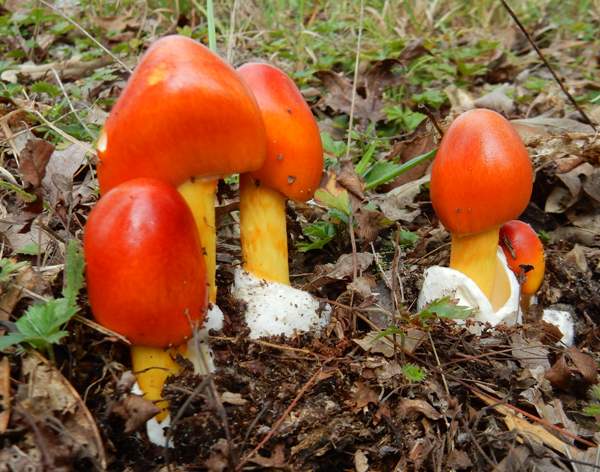
Amanita caesarea, commonly known as Caesar's Mushroom, is a highly prized edible basidiomycete fungus in the genus Amanita. It is characterized by its striking orange-red cap, deep yellow gills and stem, and a prominent white volva. Historically, it was a favorite of Roman emperors, hence its common name. It is native to southern Europe and North Africa, and has closely related species in North America and Asia.
How to Identify
- Cap
- The cap is typically 8-20 cm (3-8 inches) in diameter, initially hemispherical, expanding to convex and then nearly flat with age. The color is a vibrant orange-red to scarlet, often fading to orange-yellow at the margin. The surface is smooth, moist, and often slightly sticky when wet, becoming dry with age. It typically lacks universal veil remnants (warts) on the cap, though occasionally a few white patches may be present, especially in younger specimens.
- Gills
- The gills are free from the stem, crowded, broad, and a distinctive deep golden-yellow to orange-yellow color. They remain this color even in older specimens.
- Stem
- The stem is 8-15 cm (3-6 inches) long and 1-3 cm (0.4-1.2 inches) thick, solid, cylindrical, and tapers slightly upwards. It is the same deep golden-yellow color as the gills. It features a prominent, skirt-like, membranous ring (annulus) that is also yellow and often striate on the upper surface. The base of the stem is encased in a large, thick, sac-like, white volva, which is often deeply buried in the substrate.
- Flesh
- The flesh is firm, thick, and white, with a yellowish tinge directly beneath the cap cuticle. It does not change color when cut or bruised.
- Fruiting body
- The fruiting body is a classic agaric shape, emerging from a prominent white volva.
- Habitat
- Caesar's Mushroom is a mycorrhizal fungus, forming symbiotic relationships primarily with broadleaf trees, especially oaks (Quercus species), chestnuts (Castanea species), and cork oaks (Quercus suber). It prefers warm, temperate climates and often grows in open woodlands or at the edges of forests.
Key Facts
- Cap surfaces: Smooth, moist, sometimes slightly sticky
- Growth Form: Solitary to scattered
- Spore Print: White
- Body color: Orange-red cap, golden-yellow gills and stem, white volva
- Odor: Mild, pleasant
- Flesh bruises: No color change
- Height: 8-15 cm (3-6 inches)
- Cap Diameter: 8-20 cm (3-8 inches)
- Nutrient gathering: Mycorrhizal
Safe
SafeAmanita caesarea is considered one of the finest edible mushrooms globally. However, extreme caution is paramount due to the presence of deadly toxic Amanita species (e.g., Amanita phalloides, Amanita virosa) that can be mistaken for it by inexperienced foragers. The key distinguishing features are the vibrant yellow gills and stem, and the absence of a universal veil remnant on the cap (though sometimes present as small patches). The white volva is also crucial. Never consume any Amanita mushroom unless 100% certain of its identification by an expert. Cooking is required; it should not be eaten raw.
Quick Check
- Odor: Mild, pleasant, mushroomy
- Fruiting: Late summer to autumn
- Substrate: Soil, mycorrhizal with broadleaf trees (oaks, chestnuts)
Where to Find
Southern Europe
Common in countries like Italy, France, Spain, Portugal, and Greece, particularly in oak and chestnut forests.
North Africa
Found in similar habitats in Morocco, Algeria, and Tunisia.
Parts of Asia
Closely related species or varieties are found in parts of Asia, though the true Amanita caesarea is primarily European/North African.
Finding Tips
Look for specific trees
Focus your search in woodlands dominated by oaks, chestnuts, and cork oaks, as these are its preferred mycorrhizal partners.
Warm, humid conditions
Caesar's Mushroom thrives in warm, humid conditions, often appearing after summer rains.
Check for the volva
Always carefully excavate the base of the mushroom to confirm the presence of the distinctive white, sac-like volva, which is a key identifying feature and crucial for distinguishing it from toxic look-alikes.
Seasonal timing
It typically fruits from late summer through autumn, depending on local climate and rainfall.
Similar Species
Fly Agaric
Amanita
Also known as: Amanita muscaria
Royal Amanita
Amanita
Also known as: Amanita regalis
American Caesar's Mushroom
Amanita
Also known as: Amanita jacksonii
Yellow Patches
Amanita
Also known as: Amanita flavoconia
Scientific Classification
- Phylum
- Basidiomycota
- Class
- Agaricomycetes
- Order
- Agaricales
- Family
- Amanitaceae
- Genus
- Amanita
Storage Information
- Max Temperature: 4°C
- Freezing duration: 6 months
- Min Temperature: 0°C
- Refrigeration: 5-7 days
How to Clean
Gently brush off any dirt or debris with a soft brush or damp cloth. Avoid washing under running water, as mushrooms can absorb excess moisture. If necessary, a quick rinse and immediate drying are acceptable. Trim off any damaged or insect-ridden parts.
Explore Caesar's Mushroom
Identify mushrooms anywhere
Free on iOS, Android, and Web. Photo identification, full database, and your personal collection.