
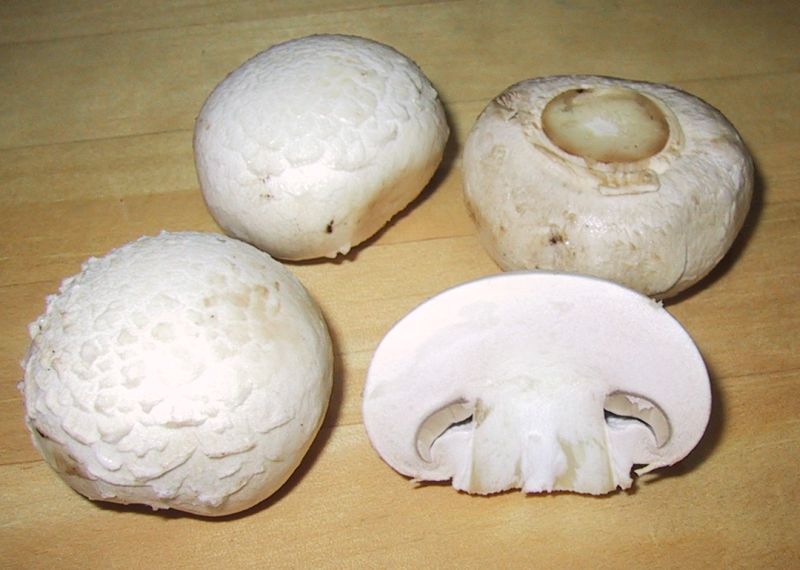
How to identify Cremini Mushroom
Agaricus bisporus
Got a photo? Identify mushrooms instantly with the Mushby app
Open the appTo correctly identify Cremini Mushroom (Agaricus bisporus), check each of these features in order. Misidentification is the most common cause of mushroom poisoning, so cross-reference multiple sources.
Step-by-step identification
- 1
Cap
Shape, color, surface texture, and diameter.
3-10 cm in diameter, initially convex, expanding to broadly convex or flat with age. Color ranges from light tan to reddish-brown, often smooth but can be finely fibrillose. The margin is inrolled when young, sometimes with remnants of the partial veil.
- 2
Gills
Attachment to stem, color, and spacing.
Free, crowded. Initially pinkish-tan when young, becoming dark brown to blackish-brown with age as spores mature. This color change is a key identifier for Agaricus species.
- 3
Stem
Length, shape, surface, and any ring.
3-8 cm long and 1-2.5 cm thick, central, stout, and cylindrical, sometimes slightly tapering towards the apex or base. White to off-white, smooth or finely fibrillose. Features a prominent, persistent, white, membranous ring (annulus) which can be single-layered or somewhat skirt-like, often darkens due to falling spores.
- 4
Flesh
Color, texture, and bruising reaction.
White, firm, and thick, often staining reddish-brown when cut or bruised, particularly towards the base of the stem. The flesh does not stain yellow when bruised, which distinguishes it from some toxic Agaricus species.
- 5
Fruiting body
Overall growth pattern.
Typically agaricoid (cap and stem), medium-sized.
- 6
Habitat
Where it grows and on what substrate.
Saprotrophic, growing on nutrient-rich organic matter. Primarily cultivated commercially, but wild forms can be found in disturbed soils, pastures, gardens, and rich woodlands, often in groups or scattered. Prefers composted soils and dung.
Key Facts
- Cap surfaces
- Smooth to finely fibrillose, dry.
- Growth Form
- Solitary to gregarious (in groups).
- Spore Print
- Dark brown to purplish-brown.
- Body color
- Cap light tan to reddish-brown; stem and flesh white.
- Odor
- Mild, pleasant, often described as mushroomy or slightly almond-like in some varieties.
- Flesh bruises
- May bruise reddish-brown, especially in the stem base. Does NOT stain yellow.
- Height
- 3-8 cm
- Cap Diameter
- 3-10 cm
Fruit body characteristics
- Gill attachment: Free (gills do not attach to the stem).
- Stem shape: Cylindrical, sometimes slightly tapering.
- Stem surface: Smooth to finely fibrillose.
- Ring: Present; a prominent, persistent, white, membranous annulus (ring) that can be single-layered or skirt-like.
- Stem cross-section: Solid or somewhat stuffed (not hollow).
Explore Cremini Mushroom
Identify mushrooms anywhere
Free on iOS, Android, and Web. Photo identification, full database, and your personal collection.