
Got a photo? Identify mushrooms instantly with the Mushby app
Open the appDescription
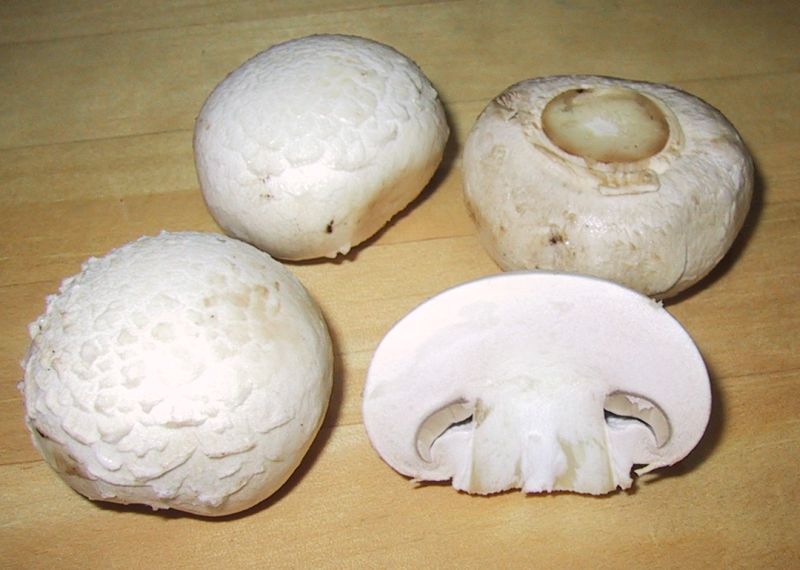
The Cremini mushroom is a cultivar of the cultivated mushroom species Agaricus bisporus, representing a stage of development between the white button mushroom and the fully mature Portobello. It is characterized by its light brown cap and a more robust, earthy flavor compared to its younger, white counterpart. It is one of the most widely cultivated and consumed mushrooms globally.
How to Identify
- Cap
- 3-10 cm in diameter, initially convex, expanding to broadly convex or flat with age. Color ranges from light tan to reddish-brown, often smooth but can be finely fibrillose. The margin is inrolled when young, sometimes with remnants of the partial veil.
- Gills
- Free, crowded. Initially pinkish-tan when young, becoming dark brown to blackish-brown with age as spores mature. This color change is a key identifier for Agaricus species.
- Stem
- 3-8 cm long and 1-2.5 cm thick, central, stout, and cylindrical, sometimes slightly tapering towards the apex or base. White to off-white, smooth or finely fibrillose. Features a prominent, persistent, white, membranous ring (annulus) which can be single-layered or somewhat skirt-like, often darkens due to falling spores.
- Flesh
- White, firm, and thick, often staining reddish-brown when cut or bruised, particularly towards the base of the stem. The flesh does not stain yellow when bruised, which distinguishes it from some toxic Agaricus species.
- Fruiting body
- Typically agaricoid (cap and stem), medium-sized.
- Habitat
- Saprotrophic, growing on nutrient-rich organic matter. Primarily cultivated commercially, but wild forms can be found in disturbed soils, pastures, gardens, and rich woodlands, often in groups or scattered. Prefers composted soils and dung.
Key Facts
- Cap surfaces: Smooth to finely fibrillose, dry.
- Growth Form: Solitary to gregarious (in groups).
- Spore Print: Dark brown to purplish-brown.
- Body color: Cap light tan to reddish-brown; stem and flesh white.
- Odor: Mild, pleasant, often described as mushroomy or slightly almond-like in some varieties.
- Flesh bruises: May bruise reddish-brown, especially in the stem base. Does NOT stain yellow.
- Height: 3-8 cm
- Cap Diameter: 3-10 cm
- Nutrient gathering: Saprotrophic
Safe
SafeAgaricus bisporus (Cremini, White Button, Portobello) is generally considered safe and edible, especially the commercially cultivated varieties. However, there are toxic look-alikes in the Agaricus genus that can cause gastrointestinal distress. Wild Agaricus species should never be consumed unless positively identified by an experienced mycologist.
Quick Check
- Odor: Mild, pleasant mushroomy odor; sometimes slightly earthy or nutty.
- Fruiting: Year-round (cultivated); late spring to autumn (wild).
- Substrate: Composted soil, enriched organic matter, pastures, gardens, rich disturbed ground.
Where to Find
Supermarkets and grocery stores
The most common place to find Cremini mushrooms, as they are commercially cultivated on a large scale.
Farmers' markets
Often available fresh from local cultivators.
Pastures and meadows (wild forms)
Wild Agaricus bisporus can occasionally be found in grassy areas, often after rain, particularly in rich, disturbed ground. However, identification requires great care to avoid toxic look-alikes.
Gardens and compost heaps (wild forms)
Similar to pastures, wild forms may appear in garden beds or areas with decomposing organic material.
Finding Tips
Commercial Availability
Cremini mushrooms are readily available year-round in most grocery stores due to widespread cultivation.
Wild Collection Caution
While wild forms exist, extreme caution is advised for foragers. Several toxic Agaricus species and other genera (e.g., Amanita) can resemble edible Agaricus. Always consult an expert and use multiple identification features.
Spore Print Examination
A dark brown spore print is characteristic of Agaricus species and is crucial for distinguishing them from white-spored (e.g., Amanita) or pink-spored (e.g., Entoloma) look-alikes.
Bruising Reaction
The flesh of Agaricus bisporus may bruise reddish-brown. Crucially, it should NOT stain yellow when scratched or bruised, particularly at the base of the stem, which is a key indicator of toxic yellow-staining Agaricus species.
Similar Species
White Button Mushroom
Fungus
Also known as: Common mushroom, cultivated mushroom, table mushroom, champignon de Paris
Portobello Mushroom
Fungus
Also known as: Portabella, Portobella
Yellow-staining Mushroom
Fungus
Also known as: Agaricus xanthodermus
Horse Mushroom
Fungus
Also known as: Agaricus arvensis
Scientific Classification
- Phylum
- Basidiomycota
- Class
- Agaricomycetes
- Order
- Agaricales
- Family
- Agaricaceae
- Genus
- Agaricus
Storage Information
- Max Temperature: 4°C
- Freezing duration: 6 months
- Min Temperature: 0°C
- Refrigeration: 5-7 days
How to Clean
Gently wipe with a damp cloth or soft brush to remove any dirt. Avoid rinsing heavily under water, as mushrooms absorb moisture quickly and can become soggy. If absolutely necessary, a quick rinse under cold water followed by immediate drying with a paper towel is acceptable. Trim off any dried or discolored parts of the stem.
Explore Cremini Mushroom
Identify mushrooms anywhere
Free on iOS, Android, and Web. Photo identification, full database, and your personal collection.