
Got a photo? Identify mushrooms instantly with the Mushby app
Open the appDescription
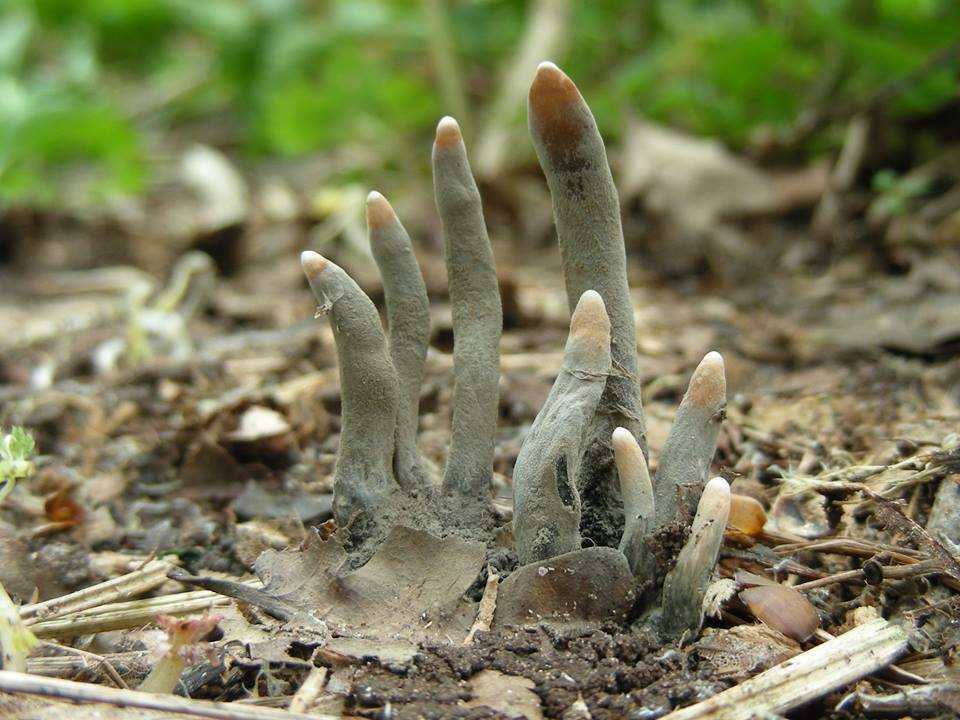
Xylaria polymorpha, commonly known as Dead Man's Fingers, is a saprobic fungus. It is characterized by its distinctive finger-like or club-like appearance, typically dark in color, resembling decaying fingers emerging from the ground or wood. This fungus is commonly found on decaying wood, often in clusters.
How to Identify
- Cap
- There is no distinct cap in Xylaria polymorpha. The fruiting body is a single, elongated structure.
- Gills
- This fungus does not have gills.
- Stem
- There is no distinct stem. The fruiting body arises directly from the substrate.
- Flesh
- The flesh is tough and whitish inside, becoming black with age.
- Fruiting body
- The fruiting body of Xylaria polymorpha is typically club-shaped or finger-like, ranging from 3 to 10 cm in height and 1 to 3 cm in width. Young specimens may have a grayish or bluish tint, but they mature to a dark brown or black color. The surface is often rough and textured.
- Habitat
- Xylaria polymorpha is commonly found on decaying wood, such as fallen logs, stumps, and branches. It is a saprobic fungus, meaning it obtains nutrients from dead organic matter. It can be found in various woodland habitats.
Key Facts
- Cap surfaces: N/A
- Growth Form: Clustered or solitary
- Spore Print: Black
- Body color: Dark brown to black
- Odor: Not distinctive
- Flesh bruises: Does not bruise
- Height: 3-10 cm
- Cap Diameter: N/A
- Nutrient gathering: Saprobic
Safe
SafeXylaria polymorpha is generally considered non-toxic, but it is not typically consumed due to its tough texture and lack of flavor.
Quick Check
- Odor: Not distinctive
- Fruiting: Club-shaped or finger-like
- Substrate: Decaying wood
Where to Find
Woodland Habitats
Look for Dead Man's Fingers in deciduous or mixed woodlands, particularly where there is plenty of decaying wood.
Decaying Wood
Search on and around fallen logs, tree stumps, and branches, especially those that are partially buried or in contact with the soil.
Finding Tips
Timing
Dead Man's Fingers can be found year-round, but they are most conspicuous in the late autumn and winter when other vegetation has died back.
Look for Clusters
These fungi often grow in clusters, so if you find one, look around for others nearby.
Similar Species
Candlesnuff Fungus
Ascomycete fungus
Also known as: Xylaria hypoxylon
Scientific Classification
- Phylum
- Ascomycota
- Class
- Ascomycetes
- Order
- Xylariales
- Family
- Xylariaceae
- Genus
- Xylaria
Storage Information
- Max Temperature: N/A
- Freezing duration: N/A
- Min Temperature: N/A
- Refrigeration: N/A
How to Clean
Dead Man's Fingers are not typically consumed, so cleaning is not applicable.
Explore Dead Man's Fingers
Identify mushrooms anywhere
Free on iOS, Android, and Web. Photo identification, full database, and your personal collection.