
Got a photo? Identify mushrooms instantly with the Mushby app
Open the appDescription
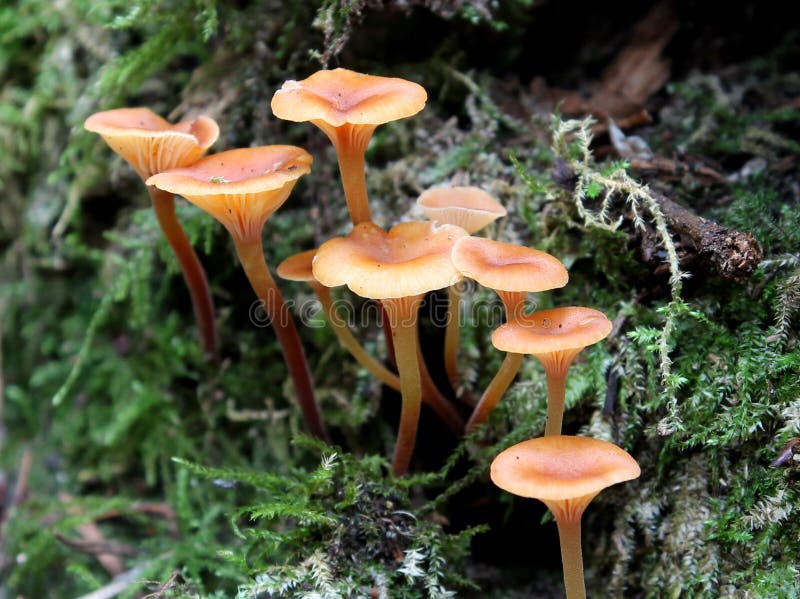
Xeromphalina campanella, commonly known as the Golden Trumpet or Campanella, is a small, distinctive saprobic mushroom belonging to the family Mycenaceae. It is characterized by its bell-shaped to convex, often depressed, yellowish-orange to reddish-brown cap, widely spaced, decurrent gills, and a slender, tough, dark stem that is typically hairy at the base. It grows in dense clusters on decaying conifer wood, particularly logs and stumps, and is a common sight in coniferous and mixed forests across its range.
How to Identify
- Cap
- 1-3 cm in diameter, initially bell-shaped (campanulate) to convex, becoming broadly convex to flat, often with a central depression or umbilicus. The margin is typically striate (grooved) when moist. Color ranges from yellowish-orange to reddish-brown, often fading to buff or yellowish-tan with age or in dry conditions. The surface is smooth and somewhat translucent when wet.
- Gills
- Decurrent (running down the stem), widely spaced, and often connected by cross-veins (anastomosing). Color is typically pale yellow to yellowish-orange, sometimes becoming slightly darker with age.
- Stem
- 2-6 cm long and 1-3 mm thick, central, slender, tough, and cartilaginous. The color is typically yellowish at the apex, gradually darkening to reddish-brown or nearly black towards the base. The base is often covered with fine, reddish-brown hairs (tomentose). It is hollow.
- Flesh
- Thin, yellowish, and rather tough.
- Fruiting body
- Small, gregarious to densely clustered, often appearing in large numbers on decaying wood.
- Habitat
- Saprobic, growing in dense clusters on decaying conifer wood, particularly logs, stumps, and woody debris. Less commonly found on hardwood. It is a significant decomposer of woody material.
Key Facts
- Cap surfaces: Smooth, striate when moist.
- Growth Form: Clustered, saprobic.
- Spore Print: White to pale cream.
- Body color: Yellowish-orange to reddish-brown cap, yellowish gills, dark stem.
- Odor: Mild.
- Flesh bruises: Does not bruise.
- Height: 2-6 cm
- Cap Diameter: 1-3 cm
- Nutrient gathering: Saprobic (decomposer of dead wood).
Safe
SafeXeromphalina campanella is considered non-toxic, but its edibility is generally rated as poor due to its small size, thin flesh, and tough texture. It is not known to contain any harmful compounds, but it also offers little culinary value.
Quick Check
- Odor: Mild, not distinctive.
- Fruiting: Gregarious to densely clustered.
- Substrate: Decaying conifer wood.
Where to Find
Coniferous Forests
Abundant in coniferous forests, especially where there are fallen logs and stumps of pine, spruce, and fir.
Mixed Forests
Can also be found in mixed forests, provided there is a significant presence of decaying conifer wood.
Woody Debris
Look for it on well-rotted logs, stumps, and other woody debris on the forest floor.
Finding Tips
Look for clusters
Xeromphalina campanella almost always grows in dense clusters, sometimes numbering in the hundreds, making them quite conspicuous.
Check decaying conifer wood
Focus your search on fallen conifer logs and stumps that are in various stages of decay. They prefer wood that is not too fresh and not completely disintegrated.
Seasonal timing
While they can appear throughout the growing season, they are often most prolific in late summer and autumn, especially after periods of rain.
Examine the stem base
The hairy, dark base of the stem is a key identifying feature. Gently lift a cluster to observe this characteristic.
Similar Species
Orange Mycena
fungus
Also known as: Mycena leaiana
Velvet-footed Pax
fungus
Also known as: Tapinella atrotomentosa
Omphalina
fungus
Also known as: Omphalina spp.
Scientific Classification
- Phylum
- Basidiomycota
- Class
- Agaricomycetes
- Order
- Agaricales
- Family
- Mycenaceae
- Genus
- Xeromphalina
Storage Information
- Max Temperature: 4°C
- Freezing duration: 6 months
- Min Temperature: 1°C
- Refrigeration: 3 days
How to Clean
Due to their small size and tough texture, Golden Trumpets are generally not collected for culinary purposes. If one were to clean them, a soft brush or damp cloth would suffice to remove debris. Avoid washing, as they can become waterlogged.
Explore Golden Trumpet
Identify mushrooms anywhere
Free on iOS, Android, and Web. Photo identification, full database, and your personal collection.