
Got a photo? Identify mushrooms instantly with the Mushby app
Open the appDescription
Volvopluteus gloiocephalus, commonly known as the Big Volvariella, Rosegill, or Silky Rosegill, is a relatively large and attractive mushroom. It is considered edible but not particularly flavorful.
How to Identify
- Cap
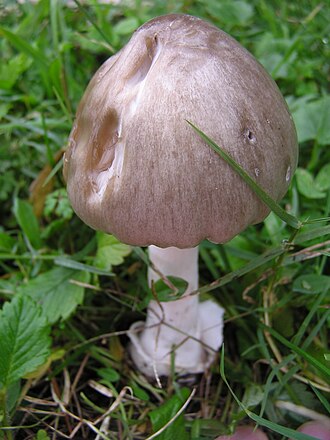
- The cap is 5–15 cm (2–6 in) in diameter, fleshy, and ranges from oval when young to convex or flat in maturity. The cap surface is smooth and moist, often with radial wrinkles, and varies in color from white to gray or brownish. It lacks any veil remnants.
- Gills
- The gills are free from the stem, crowded, and initially white, turning pinkish as the spores mature. They are easily separable from the cap.
- Stem
- The stem is 8–22 cm (3–9 in) long and 1–2.5 cm (0.4–1 in) thick, cylindrical or slightly tapering upwards, and white to pale gray. The base of the stem is enclosed in a volva, which is a sac-like structure. The stem lacks a ring.
- Flesh
- The flesh is white and does not change color when cut.
- Fruiting body
- The fruiting body is fleshy and typically medium to large in size.
- Habitat
- It grows in grassy areas, gardens, and disturbed soil, often in urban environments. It can appear solitarily or in groups, typically from summer to autumn.
Key Facts
- Cap surfaces: Smooth, moist, often with radial wrinkles
- Growth Form: Solitary or in groups
- Spore Print: Pinkish
- Body color: White, gray, or brownish
- Odor: Mild or indistinct
- Flesh bruises: Does not change color
- Height: 8–22 cm (3–9 in)
- Cap Diameter: 5–15 cm (2–6 in)
- Nutrient gathering: Saprophytic
Safe
SafeVolvopluteus gloiocephalus is generally considered edible, but it is not highly regarded for its flavor. It is important to properly identify the mushroom to avoid confusion with toxic species.
Quick Check
- Odor: Mild or indistinct
- Fruiting: Summer to autumn
- Substrate: Grass, gardens, disturbed soil
Where to Find
Grasslands
Found in grassy areas such as meadows and pastures.
Gardens
Often appears in gardens and cultivated areas.
Disturbed Soil
Grows in areas with disturbed soil, such as construction sites or recently tilled land.
Urban Environments
Commonly found in urban settings, including parks and roadside verges.
Finding Tips
Look in Grassy Areas
Search in meadows, lawns, and other grassy habitats, especially after rain.
Check Disturbed Soil
Inspect areas where the soil has been recently disturbed, such as construction sites or gardens.
Observe After Rain
These mushrooms often appear after periods of rain, so check potential habitats a few days after a rainfall.
Note the Season
They typically fruit from summer to autumn, so focus your search during these months.
Similar Species
Amanita species
a genus of poisonous mushrooms
Also known as: various names depending on the specific species
Scientific Classification
- Phylum
- Basidiomycota
- Class
- Agaricomycetes
- Order
- Agaricales
- Family
- Pluteaceae
- Genus
- Volvopluteus
Storage Information
- Max Temperature: 20°C
- Freezing duration: 3 months
- Min Temperature: 2°C
- Refrigeration: 3-5 days
How to Clean
To clean Volvopluteus gloiocephalus, gently brush off any dirt or debris from the cap and stem. Use a soft, damp cloth to wipe the surface if necessary. Avoid soaking the mushroom in water, as it can become waterlogged. Trim the base of the stem to remove any remaining soil or debris.
Explore Silky Rosegill
Identify mushrooms anywhere
Free on iOS, Android, and Web. Photo identification, full database, and your personal collection.