
Got a photo? Identify mushrooms instantly with the Mushby app
Open the appDescription
Tuber magnatum is a highly prized subterranean ascomycete fungus. It is renowned for its intense, musky, and garlicky aroma. It forms a symbiotic mycorrhizal relationship with host trees, primarily oaks, poplars, beeches, and willows.
How to Identify
- Cap
- N/A (Subterranean)
- Gills
- None (Hypogeous fungus)
- Stem
- None
- Flesh
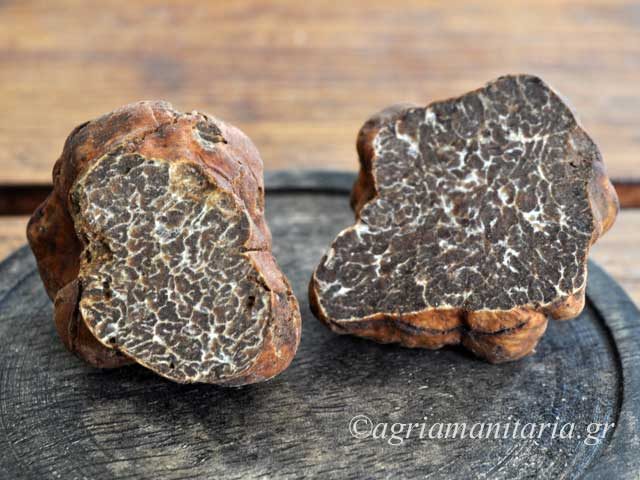
- Firm, cream to light brown or ochre, with a distinct 'marbled' pattern of fine white veins.
- Fruiting body
- Irregular, tuber-like ascocarp, typically 2–12 cm in diameter.
- Habitat
- Hypogeous, growing 5–30 cm underground in symbiotic association with roots of specific broadleaf trees.
Key Facts
- Cap surfaces: Smooth, finely velvety, pale yellow to light brown.
- Growth Form: Solitary or clustered, hypogeous.
- Spore Print: Brown (microscopic observation required).
- Body color: Cream, ochre, or pale brownish-yellow.
- Odor: Strongly aromatic, complex, distinct.
- Flesh bruises: Darkens slightly when bruised or cut.
- Height: Variable (subterranean tuber)
- Cap Diameter: 2–12 cm
- Nutrient gathering: Mycorrhizal (mutualistic with tree roots).
Safe
SafeEdible, but must be distinguished from toxic false truffles like Choiromyces meandriformis, which can cause gastrointestinal distress.
Quick Check
- Odor: Intense, pungent, reminiscent of garlic, shallots, and aged cheese.
- Fruiting: Late Summer through Autumn (typically September to December).
- Substrate: Symbiotic with roots of broadleaf trees (Populus, Salix, Quercus, Tilia) in moist, lime-rich soil.
Where to Find
Italy (Piedmont Region)
The primary historic and commercial epicenter of Tuber magnatum production.
Central and Northern Europe
Scattered populations found in areas with specific alluvial soils and moist microclimates, particularly along riverbanks.
Finding Tips
Trained Animals
Due to its subterranean nature, Tuber magnatum cannot be found by sight. It must be located using trained dogs (traditionally Lagotto Romagnolo) or sometimes pigs, though dogs are preferred as they do not consume the find.
Ecological Indicators
Look for 'brûlés' or scorched-earth areas around the base of host trees where the fungus has inhibited the growth of other plants.
Similar Species
Tuber borchii
Whitish Truffle
Also known as: Bianchetto
Choiromyces meandriformis
Pig Truffle
Also known as: False Truffle
Scientific Classification
- Phylum
- Ascomycota
- Class
- Pezizomycetes
- Order
- Pezizales
- Family
- Tuberaceae
- Genus
- Tuber
Storage Information
- Max Temperature: 4°C
- Freezing duration: Not recommended (freezing destroys the delicate aromatic compounds)
- Min Temperature: 2°C
- Refrigeration: 5 to 7 days in an airtight container wrapped in paper towel
How to Clean
Gently remove soil using a soft-bristled brush. Avoid washing with water until the moment of consumption, as moisture drastically reduces shelf life and aroma quality.
Explore Piedmont White Truffle or Alba Truffle
Identify mushrooms anywhere
Free on iOS, Android, and Web. Photo identification, full database, and your personal collection.