
Got a photo? Identify mushrooms instantly with the Mushby app
Open the appDescription
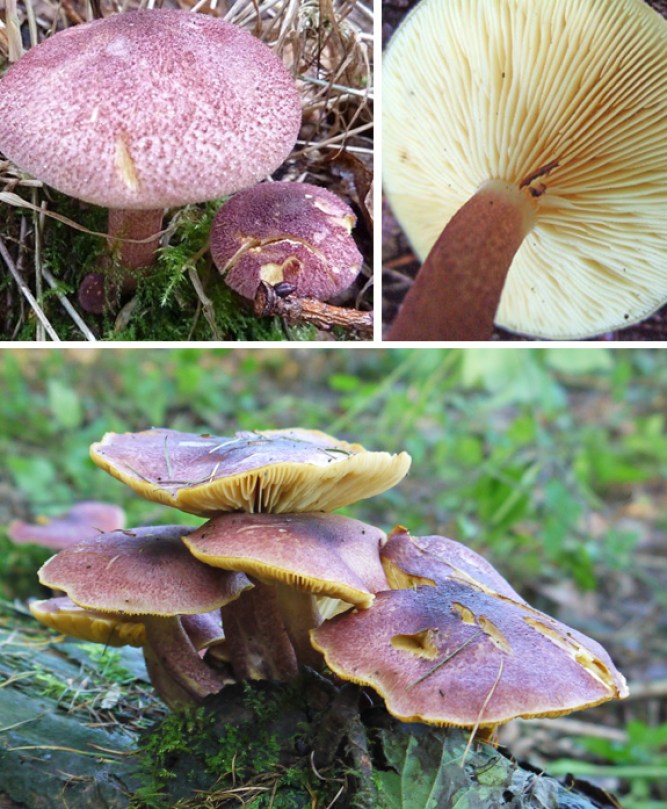
The Plums and Custard mushroom (Tricholomopsis rutilans) is a striking and easily recognizable fungus known for its vibrant colors and distinctive appearance. It is a saprobic species, meaning it obtains nutrients from decaying organic matter, particularly coniferous wood. This mushroom is not considered edible due to its bitter taste and potential for causing gastrointestinal upset in some individuals.
How to Identify
- Cap
- The cap is convex to flattened, measuring 4-10 cm in diameter. It is characteristically yellow with purplish-red to reddish-brown scales or fibrils. The margin is often incurved when young.
- Gills
- The gills are adnate to slightly decurrent, closely spaced, and yellow. They may have a slightly serrated edge.
- Stem
- The stem is 4-8 cm long and 1-2 cm thick, yellowish, and covered with reddish-brown fibrils or scales. It is typically solid and may be slightly club-shaped.
- Flesh
- The flesh is yellowish, relatively thin, and has a slightly bitter taste.
- Fruiting body
- The fruiting body is medium-sized, with a colorful cap and a central stem. The overall appearance is quite distinctive due to the contrasting colors.
- Habitat
- Grows on decaying conifer wood, such as logs and stumps, in coniferous forests.
Key Facts
- Cap surfaces: Dry, with scales or fibrils
- Growth Form: Solitary or in small groups
- Spore Print: White
- Body color: Yellow with purplish-red scales
- Odor: Mild, not distinctive
- Flesh bruises: Does not typically bruise
- Height: 4-8 cm
- Cap Diameter: 4-10 cm
- Nutrient gathering: Saprobic
Safe
Mild ToxicityThe Plums and Custard mushroom is not considered highly toxic, but it can cause gastrointestinal upset in some individuals. It is generally regarded as inedible due to its bitter taste.
Quick Check
- Odor: Mild
- Fruiting: Late summer to autumn
- Substrate: Decaying conifer wood
Where to Find
Coniferous Forests
Found in coniferous forests, particularly on or near decaying conifer logs and stumps.
Finding Tips
Seasonal Timing
Look for it in late summer and autumn.
Habitat Preference
Check around dead or decaying conifer wood.
Visual Identification
The bright yellow and purplish-red colors make it relatively easy to spot.
Similar Species
Armillaria mellea (Honey Fungus)
Mushroom
Also known as: None
Scientific Classification
- Phylum
- Basidiomycota
- Class
- Agaricomycetes
- Order
- Agaricales
- Family
- Tricholomataceae
- Genus
- Tricholomopsis
Storage Information
- Max Temperature: N/A (not typically stored due to inedibility)
- Freezing duration: N/A
- Min Temperature: N/A
- Refrigeration: N/A
How to Clean
Cleaning Plums and Custard mushrooms is generally not recommended, as they are not typically consumed. If cleaning is desired for study purposes, gently brush off any debris with a soft brush. Avoid washing, as this can damage the delicate surface and alter its characteristics.
Explore Plums and Custard
Identify mushrooms anywhere
Free on iOS, Android, and Web. Photo identification, full database, and your personal collection.