
Got a photo? Identify mushrooms instantly with the Mushby app
Open the appDescription
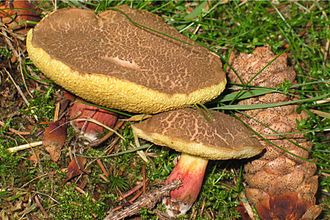
Suillus variegatus, commonly known as the sandy bolete, is a bolete fungus in the family Suillaceae. These mushrooms are typically found in coniferous forests and are edible, though not highly regarded.
How to Identify
- Cap
- The cap is typically 5-15 cm in diameter, convex, and becomes flattened with age. The color ranges from yellowish-brown to ochre, often with darker spots or streaks. The surface is dry but can be slightly sticky when wet.
- Gills
- Suillus species do not have gills. Instead, they have pores. The pores of Suillus variegatus are small, angular, and yellowish to olive-brown. They bruise darker when handled.
- Stem
- The stem is 4-10 cm long and 1-2 cm thick, cylindrical or slightly club-shaped. It is yellowish-brown in color and may have brownish granules or spots.
- Flesh
- The flesh is yellowish, sometimes bruising bluish-green when cut or damaged.
- Fruiting body
- The fruiting body of Suillus variegatus has a convex cap that flattens with age. The surface is typically dry and slightly sticky when moist. The pores are small and angular, yellowish to olive-brown, bruising darker when handled.
- Habitat
- Suillus variegatus is found in coniferous forests, often associated with pine trees. It fruits from summer to autumn.
Key Facts
- Cap surfaces: Dry, slightly sticky when moist
- Growth Form: Mycorrhizal
- Spore Print: Olive-brown
- Body color: Yellowish-brown to ochre
- Odor: Mild, mushroomy
- Flesh bruises: Sometimes bluish-green
- Height: 4-10 cm
- Cap Diameter: 5-15 cm
- Nutrient gathering: Mycorrhizal
Safe
SafeSuillus variegatus is generally considered edible, though it may cause gastrointestinal upset in some individuals. It is not known to contain any significant toxins.
Quick Check
- Odor: Mild, mushroomy
- Fruiting: Summer to Autumn
- Substrate: Soil, associated with pine trees
Where to Find
Europe
Common in coniferous forests throughout Europe.
North America
Found in North American coniferous forests.
Finding Tips
Look near pine trees
Sandy boletes are mycorrhizal with pine trees, so search in areas where pine trees are common.
Check sandy soils
As the name suggests, this bolete prefers sandy soils.
Similar Species
Slippery Jack
a bolete mushroom
Also known as: Suillus luteus
Scientific Classification
- Phylum
- Basidiomycota
- Class
- Agaricomycetes
- Order
- Boletales
- Family
- Suillaceae
- Genus
- Suillus
Storage Information
- Max Temperature: 20
- Freezing duration: 3 months
- Min Temperature: 2
- Refrigeration: 3 days
How to Clean
Clean Suillus variegatus by brushing off any dirt or debris from the cap and stem. Avoid washing them unless necessary, as they can become slimy. If washing, dry them thoroughly before cooking.
Explore Sandy Bolete
Identify mushrooms anywhere
Free on iOS, Android, and Web. Photo identification, full database, and your personal collection.