
Got a photo? Identify mushrooms instantly with the Mushby app
Open the appDescription
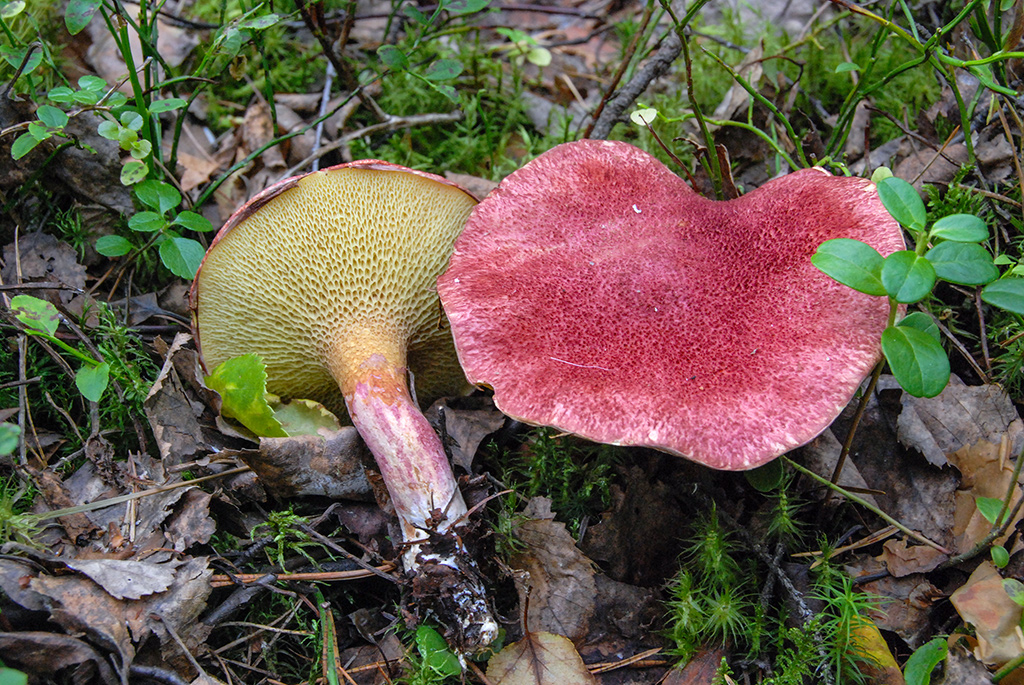
Suillus ochraceoroseus is a species of bolete mushroom in the family Suillaceae. It is characterized by its association with Larch trees (Larix species), its often rosy-ochre to pinkish-brown cap, and its glandular dots on the stem. Like many Suillus species, it has a slimy cap, especially when moist, and a ring on the stem, which can sometimes be ephemeral.
How to Identify
- Cap
- The cap is typically 4-12 cm in diameter, convex to broadly convex or nearly flat in age. The color ranges from rosy-ochre, pinkish-brown, to reddish-brown, often with yellowish or orange tones, especially towards the margin. The surface is viscid (slimy) when moist, becoming shiny when dry, and often adorned with darker, radially arranged fibrils or scales, particularly when young. The margin is often incurved when young, sometimes with remnants of the veil.
- Gills
- This mushroom has a pore surface, not gills. The pore surface is adnate to slightly decurrent, yellow to yellowish-orange, becoming olive-yellow to brownish-yellow with age. The pores are small and angular, 1-2 per millimeter. The tubes are concolorous with the pores, 0.5-1.5 cm deep.
- Stem
- The stem is 4-10 cm long and 1-2.5 cm thick, central, cylindrical or slightly tapering towards the base. It is yellowish to pale yellow above the ring, becoming brownish or reddish-brown below. The stem surface is typically covered with glandular dots, which are initially yellowish but often turn brownish or reddish-brown with age. A prominent, membranous ring is present, often yellowish to brownish, sometimes with a purplish tint, and can be persistent or disappear with age.
- Flesh
- The flesh is thick, soft, and yellowish to pale yellow, sometimes with a pinkish tinge, especially near the cap surface. It does not typically change color significantly when cut or bruised, or may show a very faint pinkish or brownish discoloration.
- Fruiting body
- The fruiting body is a typical bolete shape, with a cap, central stem, and a pore surface instead of gills.
- Habitat
- Suillus ochraceoroseus is mycorrhizal, forming a symbiotic relationship exclusively with Larch (Larix species). It grows solitarily or scattered on the ground in coniferous forests where Larch trees are present.
Key Facts
- Cap surfaces: Viscid (slimy) when moist, shiny when dry, often with darker radial fibrils or scales.
- Growth Form: Solitary to scattered
- Spore Print: Olive-brown to cinnamon-brown
- Body color: Cap: Rosy-ochre, pinkish-brown, reddish-brown; Pores: Yellow to olive-yellow; Stem: Yellowish above ring, brownish below.
- Odor: Mild, pleasant, or indistinct
- Flesh bruises: Does not bruise significantly, or very faintly pinkish/brownish.
- Height: 4-10 cm
- Cap Diameter: 4-12 cm
- Nutrient gathering: Mycorrhizal
Safe
SafeSuillus ochraceoroseus is generally considered edible, but like many Suillus species, it can cause gastrointestinal upset in some individuals, especially if consumed in large quantities, not properly cooked, or if the slimy cap cuticle and pore layer are not removed. It is not known to be toxic, but individual sensitivities vary. Always cook thoroughly.
Quick Check
- Odor: Mild, pleasant, or indistinct
- Fruiting: Late summer to autumn
- Substrate: Terrestrial, mycorrhizal with Larch (Larix spp.)
Where to Find
North America
Commonly found in regions with native or planted Larch forests, particularly in the Pacific Northwest and parts of the Rocky Mountains.
Europe
Found in areas where Larch (Larix decidua, Larix sibirica, etc.) is present, often in mountainous regions.
Asia
Reported in parts of Asia where Larch species are native or cultivated.
Finding Tips
Larch Association
Always look for this mushroom growing under Larch trees. If there are no Larch trees nearby, it is not Suillus ochraceoroseus.
Seasonal Timing
Typically fruits from late summer through autumn, depending on local climate and rainfall.
Cap Sliminess
Check for the characteristic slimy cap, especially after rain or in humid conditions. This is a key feature of Suillus species.
Glandular Dots
Examine the stem for glandular dots, which are often brownish or reddish-brown and can be a good identifier for Suillus species.
Similar Species
Slippery Jack
Suillus
Also known as: Suillus luteus
Larch Bolete
Suillus
Also known as: Suillus grevillei
Painted Suillus
Suillus
Also known as: Suillus pictus
Scientific Classification
- Phylum
- Basidiomycota
- Class
- Agaricomycetes
- Order
- Boletales
- Family
- Suillaceae
- Genus
- Suillus
Storage Information
- Max Temperature: 4°C
- Freezing duration: 6 months
- Min Temperature: 0°C
- Refrigeration: 5 days
How to Clean
Due to the slimy cap, it is often recommended to peel the cap cuticle before cooking. The pore layer can also be removed, especially in older specimens, as it can become soft and mushy during cooking. Wipe the stem clean with a damp cloth or brush.
Explore Rosy Larch Bolete
Identify mushrooms anywhere
Free on iOS, Android, and Web. Photo identification, full database, and your personal collection.