
How to identify Green-Cracking Bolete
Suillus grevillei
Got a photo? Identify mushrooms instantly with the Mushby app
Open the appTo correctly identify Green-Cracking Bolete (Suillus grevillei), check each of these features in order. Misidentification is the most common cause of mushroom poisoning, so cross-reference multiple sources.
Step-by-step identification
- 1
Cap
Shape, color, surface texture, and diameter.
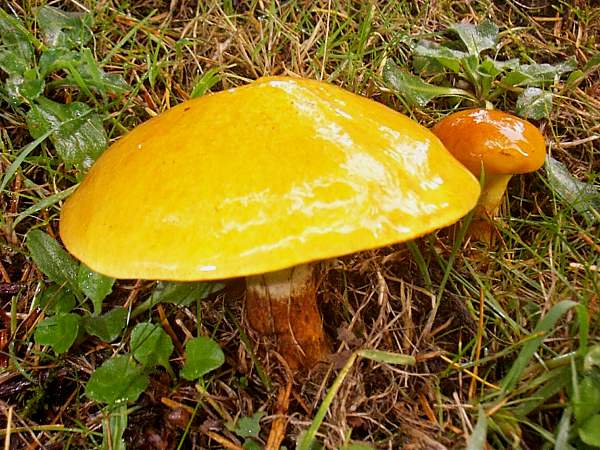
The cap of the Green-Cracking Bolete is green and often cracks and peels as it matures. The cap is convex when young and becomes flatter with age.
- 2
Gills
Attachment to stem, color, and spacing.
The gills of the Green-Cracking Bolete are yellow and are attached to the stem.
- 3
Stem
Length, shape, surface, and any ring.
The stem of the Green-Cracking Bolete is yellow and is often covered in a sticky substance.
- 4
Flesh
Color, texture, and bruising reaction.
The flesh of the Green-Cracking Bolete is white and does not change color when cut.
- 5
Fruiting body
Overall growth pattern.
The Green-Cracking Bolete is a large mushroom with a distinctive green cap.
- 6
Habitat
Where it grows and on what substrate.
The Green-Cracking Bolete is found in coniferous forests, particularly under larch trees.
Key Facts
- Cap surfaces
- Smooth, sticky
- Growth Form
- Solitary or in groups
- Spore Print
- Brown
- Body color
- Green
- Odor
- Mild
- Flesh bruises
- Does not change color
- Height
- 5-15 cm
- Cap Diameter
- 5-15 cm
Fruit body characteristics
- Gill attachment: Adnate
- Stem shape: Club-shaped
- Stem surface: Smooth
- Ring: None
- Stem cross-section: Solid
Explore Green-Cracking Bolete
Identify mushrooms anywhere
Free on iOS, Android, and Web. Photo identification, full database, and your personal collection.