
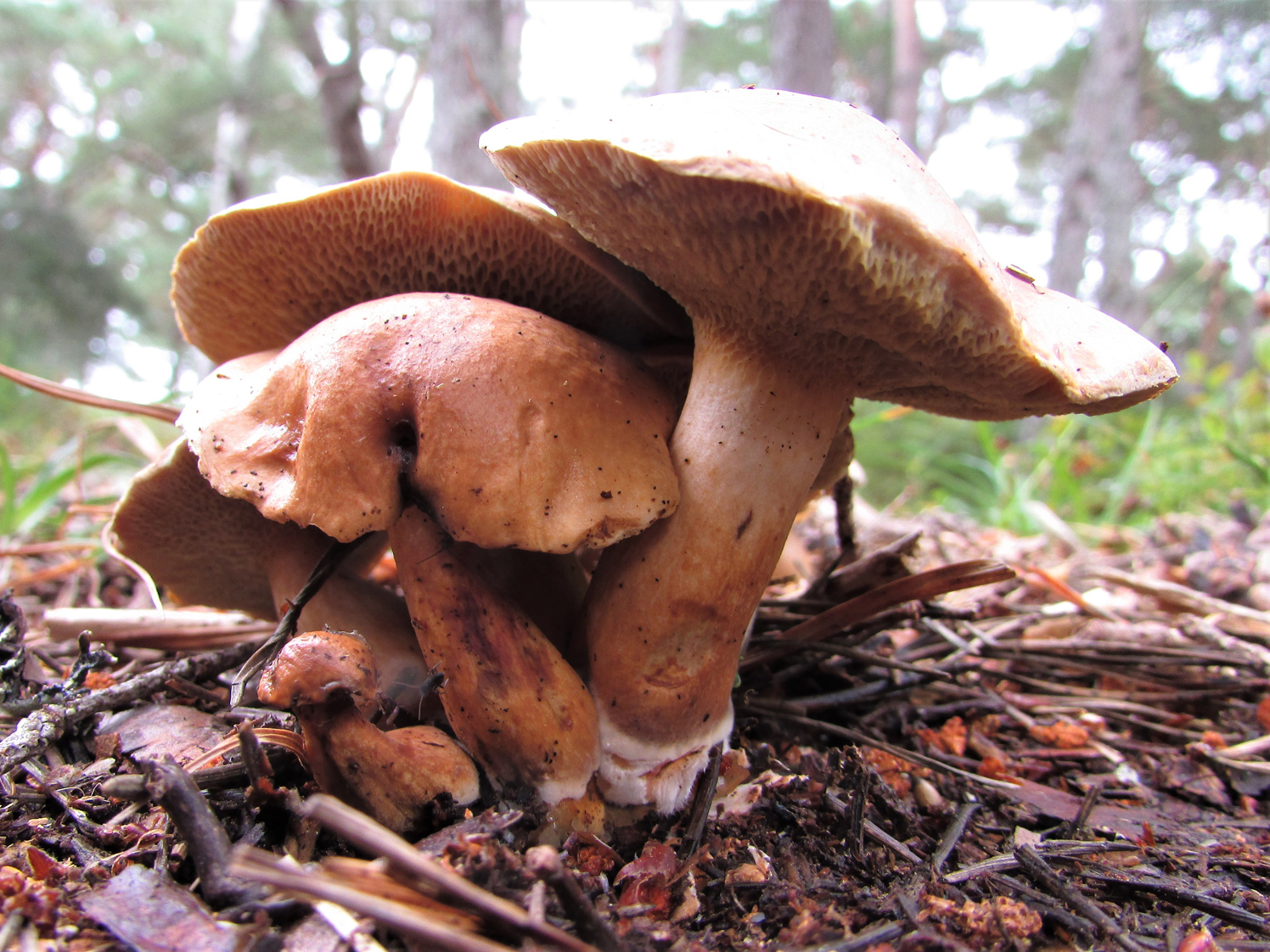
How to identify Bovine Bolete
Suillus bovinus
Got a photo? Identify mushrooms instantly with the Mushby app
Open the appTo correctly identify Bovine Bolete (Suillus bovinus), check each of these features in order. Misidentification is the most common cause of mushroom poisoning, so cross-reference multiple sources.
Step-by-step identification
- 1
Cap
Shape, color, surface texture, and diameter.
The cap is typically 4-12 cm (1.5-4.7 inches) in diameter, convex to broadly convex or nearly flat in maturity. The color ranges from yellowish-brown to orange-brown, sometimes with olive or reddish tints. The surface is distinctly slimy or viscid when moist, becoming shiny when dry. The margin is often incurved when young, becoming wavy or irregular with age. The cuticle is easily peelable.
- 2
Gills
Attachment to stem, color, and spacing.
Instead of gills, Suillus bovinus has a pore surface. The pores are angular, large, and radially elongated, appearing somewhat labyrinthine or maze-like, especially near the stem. They are initially yellowish, becoming olive-yellow to brownish-yellow with age, and often stain greenish-blue or brownish when bruised. The tubes are decurrent (running down the stem) and concolorous with the pores.
- 3
Stem
Length, shape, surface, and any ring.
The stem is 3-10 cm (1.2-3.9 inches) long and 1-2 cm (0.4-0.8 inches) thick, cylindrical or slightly tapering towards the base. It is solid, yellowish to brownish, often paler than the cap, and lacks a ring (annulus). The surface can be smooth or finely granular, sometimes with reddish-brown streaks or dots, especially towards the base.
- 4
Flesh
Color, texture, and bruising reaction.
The flesh is pale yellow to yellowish-white, soft, and often stains faintly pinkish or bluish when cut or bruised, especially in the stem base. It has a mild, sometimes slightly fruity odor and a mild taste.
- 5
Fruiting body
Overall growth pattern.
The fruiting body is a typical bolete shape, consisting of a cap and a central stem. It is generally medium-sized.
- 6
Habitat
Where it grows and on what substrate.
Suillus bovinus is mycorrhizal, forming a symbiotic relationship exclusively with pine trees (Pinus species). It is commonly found growing solitarily or in scattered groups on the ground in pine forests, plantations, and heathlands where pines are present. It prefers sandy or acidic soils.
Key Facts
- Cap surfaces
- Viscid/slimy when moist, shiny when dry, easily peelable cuticle
- Growth Form
- Solitary to scattered or gregarious
- Spore Print
- Olive-brown to yellowish-brown
- Body color
- Yellowish-brown to orange-brown cap, yellowish pores, yellowish stem
- Odor
- Mild
- Flesh bruises
- Faintly pinkish or bluish, especially in stem base
- Height
- 3-10 cm (1.2-3.9 inches)
- Cap Diameter
- 4-12 cm (1.5-4.7 inches)
Fruit body characteristics
- Gill attachment: Decurrent (pores)
- Stem shape: Cylindrical or slightly tapering towards base
- Stem surface: Smooth or finely granular, sometimes with reddish-brown streaks
- Ring: Absent
- Stem cross-section: Solid
Explore Bovine Bolete
Identify mushrooms anywhere
Free on iOS, Android, and Web. Photo identification, full database, and your personal collection.