
Got a photo? Identify mushrooms instantly with the Mushby app
Open the appDescription
The Wine Cap Mushroom (Stropharia rugosoannulata) is a saprophytic mushroom known for its large size and wine-red cap color. It is commonly cultivated in gardens and landscapes for both culinary and composting purposes.
How to Identify
- Cap
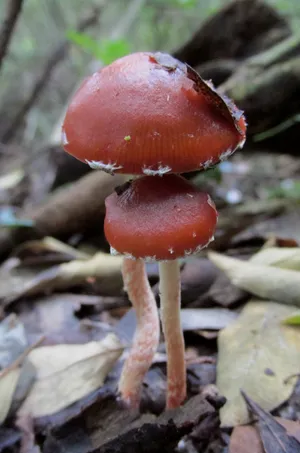
- The cap is typically 5-20 cm in diameter, starting convex and flattening with age. The color ranges from wine-red to reddish-brown, often fading to tan at the edges. The surface is smooth and slightly sticky when moist.
- Gills
- The gills are crowded and start as pale gray, turning dark purple-brown as the spores mature.
- Stem
- The stem is sturdy, 5-15 cm long and 1-3 cm thick, white to pale yellow, and has a distinctive ring. The base of the stem may have mycelial threads.
- Flesh
- The flesh is firm and white, sometimes with a reddish tint near the cap surface. It does not typically change color when bruised.
- Fruiting body
- Large size, wine-red cap, and a prominent ring on the stem are key features.
- Habitat
- Found in gardens, wood chip beds, and compost piles, often growing in clusters.
Key Facts
- Cap surfaces: smooth, slightly sticky when moist
- Growth Form: saprophytic
- Spore Print: dark purple-brown
- Body color: reddish-brown
- Odor: mild, mushroomy
- Flesh bruises: no bruising
- Height: 5-15 cm
- Cap Diameter: 5-20 cm
- Nutrient gathering: saprotrophic
Safe
SafeWine Cap Mushrooms are generally considered safe to eat when properly identified. However, it is crucial to avoid consuming any mushroom unless you are 100% certain of its identification.
Quick Check
- Odor: mild, mushroomy
- Fruiting: late spring to early fall
- Substrate: wood chips, straw, compost
Where to Find
Gardens and Wood Chip Beds
Wine Cap Mushrooms are often found in wood chip beds, gardens, and compost piles.
Compost Piles
They thrive in areas with decaying organic matter, such as compost heaps and mulched areas.
Disturbed Soil
These mushrooms can also be found in disturbed soil and along the edges of wooded areas.
Finding Tips
Seasonal Timing
Look for Wine Cap Mushrooms in the late spring to early fall, especially after rainfall.
Mulch and Wood Chips
Check areas where wood chips or straw have been used as mulch, as these provide a suitable substrate.
Clustered Growth
Wine Caps often grow in clusters, so if you find one, search the surrounding area for more.
Similar Species
Hypholoma species
mushroom
Also known as: none
Scientific Classification
- Phylum
- Basidiomycota
- Class
- Agaricomycetes
- Order
- Agaricales
- Family
- Strophariaceae
- Genus
- Stropharia
Storage Information
- Max Temperature: 2
- Freezing duration: 3 months
- Min Temperature: -18
- Refrigeration: 1 week
How to Clean
To clean Wine Cap Mushrooms, gently brush off any dirt or debris. If necessary, lightly rinse them under cool water and pat dry. Avoid soaking them, as they can become waterlogged.
Explore Wine Cap Mushroom
Identify mushrooms anywhere
Free on iOS, Android, and Web. Photo identification, full database, and your personal collection.